Tuesday, July 20, 2010

Should we really be fasting?

A guest post by Rabba bar bar Chana

In an article in Haaretz, Anshel Pfeffer claims that it’s wrong to still fast on Tisha B’Av:

“Tisha B'Av was never supposed to be an eternal day of mourning…


“For the first time in the history of the Jews, a majority of them are choosing not to live in an independent Jewish state in Zion - of their own free will…


“Mourning on the Ninth of Av in this day and age flies in the face of both secular Zionism and religious Zionism. It contradicts the right of Jews around the world to decide where they prefer to live. The exile is over, and the temple has not been rebuilt because we don't want to do it.”
He definitely has a point, (despite his silly implication in the article that we should remove the mosques from the Temple Mount.) It’s ironic to see people who live in fancy houses in Flatbush, travel to Israel on El Al several times a year, and have full religious freedoms in America begging Hashem to “end the terrible golus!”

But there’s another way of looking at it, and it’s the way I choose to look at many of our traditions. What we commemorate on Tisha B’Av isn’t just the loss of the Temple. It isn’t just a yearning for the Beit HaMikdash to be rebuilt and for sacrifices and a monarchy to be reinstituted. As DovBear pointed out a few days ago, how likely, practical, or even desirable does that really seem?

Instead, we fast because we’ve fasted for 2,000 years. We mourn for the very real people who died for being Jews throughout our long history. We fast because our parents, their parents, and their parents fasted. Looking at the tragedies of Judaism, we also gaze at our rich and varied history.

There’s a myopia sometimes, in the way that many frum people look at Judaism. It’s a focus on a history that ended 2,000 years ago, and a focus on a future that has not yet come. There’s a lack of internalizing the richness of our history and of how Judaism (and Jews) changed and evolved and grew for millennia. It’s as if all of that time was just a holding pattern and is only religiously significant in terms of what came before and the hope of what will come.

The exile created the Judaism we have today. It’s a far different religion, and we’re a far different people, than what we were in the year 70 AD. Part and parcel of that religion is fasting on Tisha B’Av. It’s not just about the destruction, it’s about who we are now, who we were 100, 500, and 1,000 years ago. The kinot we read aren’t just about the destruction. They’re also about the time they were written in, the beautiful poetry of Eliezer HaKalir in the early medieval period or the ones written in the wake of the tragedy of our times, the Shoah.

It’s also about hope. Anshel Pfeffer claims that since Eretz Yisrael is under Jewish control and we could rebuild the Temple should we choose, there’s no need to fast. But as I wrote above, yearning for the redemption isn’t just about the Temple and the monarchy. Instead, it’s about yearning and hoping for a world at peace, where war and hate are no more. It’s a vision that can transcend sectarian differences and is unencumbered by petty differences of theology. Instead it’s about hope.

And that’s why we fast.


Search for more information about why we fast at 4torah.com.

My post about the survey

This summary is not available. Please click here to view the post.

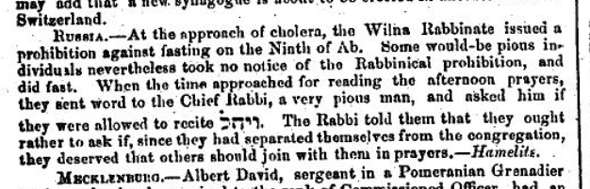
Pious Frauds


Source: http://onthemainline.blogspot.com/2010/07/canceled-fast-in-vilna-for-ninth-of-av.html
Article is the London Jewish Chronicle of October 16, 1871

Nice to see Jews are always Jews.

Hat tip Mark. Will update with source as soon as I know it.


Search for more information about [topic] at 4torah.com.

Monday, July 19, 2010

A follow-up to yesterday's Moshiach post

Great. Just great. Two days before Tisha B'av, and the Haredim are rioting, this time because their local post office provides waiting patrons with news updates on large plasma television screens. TVs, even when they are showing nothing but news updates, are an abomination, see, and 25 goons [2 of them at left; note the sefer] thought rioting was the very best way to make that clear. According to YNET, they hit post office employees, called them names like "Nazi", painted graffiti on the walls and so on. I'm sure lots of extra holiness was brought into the world via the violent destruction of those TV screens. Aren't you?

Now, here's why this post is titled a follow-up to yesterday's Moshiach post (and I hope those who honestly bleieve I never backtrack, change my mind or qualify are paying attention). The very basic Jewish idea of Moshiach, the core belief found in most, if not all the interpretations, predictions and writings on the subject is that when Moshiach arrives (whatever that means) things are going to be good. We don't know what laws or practices will be brought back, or discontinued. We don't know if life will change dramatically with a new supernatural order introduced, or if things will carry on pretty much as they did before. We don't even know if the Temple service will be restored. (Authorities argue about all these points; and anyway their predictions have no influence over how reality , over time, unfolds.) In fact, we don't know anything about what Moshiach is or is not, or even if its an authentic Jewish idea going back to Sinai, or the invention of disappointed, impatient and tired-of-being-persecuted Jews during the Persian or Greek periods.[*] All we do know is that whenever a Jewish thinker made a prediction, or shared a deduction about Moshiach he always, always, always predicted or deduced that things post-Moshiach would be Good.

So let's go with that.

In my post yesterday, I made my own prediction. I said that right after Moshiach's arrival heads will roll as the Moshiach and his followers cracked down on Jews who were expecting a different kind of Moshiach. I imagined that no matter what kind of Moshiach arrived, he'd advocate a style of Judaism other Jews would find intolerable and infighting would be the inevitable result.  I still think there is something to that, but I recognize its not the only possible outcome. Maybe Moshiach doesn't come on a donkey. Maybe Moshiach is a word to describe the goodness that results as mankind gets its act together. I don't know if we're there yet, but our Southern States are certainly closer to Moshiach then they were when Jim Crow was the rule of their land. We may have miles to go, but Russia is closer than it was 30 years ago, isn't it? As mankind improves, and puts away its ancient prejudices and pettiness, aren't we getting closer to the Good, and might that be what's meant by Moshiach? People getting along, and treating one another with justice? Moshiach may not appear in the Prophets, but this idea that Zion is only redeemed with justice, and that we're all going to suffer until the widow and the orphan are treated properly is everywhere in those books. Everywhere.


[*]I am aware the Talmud and virtually every Jewish thinker of note from the Mishna on forward thought Moshiach was an old, old Jewish idea. However, what can't be denied is that no mention of him  appears until Daniel (though hints are discovered in other books) and that nothing overt is said about him, or what he will do anywhere in the  Hebrew bible. If you're of a skeptical bent, this is strange and troubling, and perhaps strongly suggestive of something at least quasi heretical. Enough of that for now.


Search for more information about [topic] at 4torah.com.

Old Posts about Tisha B'av and the Nine Days

What follows is a no-music, voices only, men only, presentation of Salamone de Rossi's Al Naharot Bavel. Who was Salamone de Rossi? Shame on you. de Rossi was a brilliant Italian composer, who in the 17th century(!) set many of our prayers to music in the baroque style.

Think of him a Lipa Smeltzer's spiritual great great great grandpappy.


Search for more information about 9 Av at 4torah.com.

God's Thoughts on Tisha B'Av

A GUEST POST BY HENOCH:

In consideration of all efforts to create and participate in meaningful programs for Tisha B’Av, it should be noted that in Sefer Zechariah Chapter 7, God's view on this subject is recorded.

Some background information: As the second Temple was being rebuilt, the Jews had been keeping the 4 fast days related to the destruction for the last 70 years. It occurred to residents of Bavel that perhaps these fasts were obsolete. After all, the Temple was being rebuilt, so why would they continue to mourn over its destruction? They assembled a delegation to go to Jerusalem where the halachic question would be brought to the leadership that still included Neviim. The answer given by God through Zechariah Hanavi is quite surprising and would be considered completely inappropriate had anyone else given that answer.

At first the question of whether to fast or not, is ignored. Then Zechariah said in the name of God that when Jews eat at times that they deem appropriate, or fast when they decide to fast, they do so because it is what they think will serve their own interests. It isn’t necessarily for the right reasons. Zechariah essentially states that our idea of fasting misses the mark and even questions its’ sincerity. He then goes further and says in the name of God what would be a more proper approach to the subject. He says that the correct approach to this problem is to
“Execute true judgment, and show mercy and compassion every man to his brother and oppress not the widow, nor the fatherless, the stranger, nor the poor; and let none of you devise evil against his brother in your heart.”
Being that the Jews ignored these basic ideas, they were exiled and scattered across the world.

Hashem is looking at us and saying, it is quite simple, and it has always been quite simple. I don’t want false piety or even grand programs that are limited to fasting and davening. If you want to do them, that is your decision. But don’t lose sight of what I want. Hashem says “I want honesty, compassion and love”.

Zechariah 7 is a treasure that should be reviewed and internalized in preparation for Tisha B’Av.


Search for more information about Tisha B'Av at 4torah.com.

Sunday, July 18, 2010

Do you really want Moshiach?

REVISED 7/18 @ 6 pm


Do you really want Moshiach? Think about this question carefully.

There are many views about what Moshiach means and what he will do, but among the Orthodox, the most common expectation is that when Moshiach gets here the whole world, or at least the whole of Jewery, will live under the law of the Torah. This is less cool than it sounds. Living according to Torah law means bringing back kings, and permitting slavery, and child marriage and polygamy and brutal forms of execution. If the moshiach is a Charedi, it will also mean severe limitations on personal freedom and fewer rights and opportunities for women. A charedi moshiach would also mean the elimination of all the non-Torah industries and the widespread unemployment that would follow. All of the lawyers, entertainers, journalists, politicians and the people who depend on them will need new vocations.

But will Moshiach be Charedi? Unclear. He might be some other flavor of Orthodox Jew, or perhaps he won't be Orthodox, at all. In any event, his arrival and anticipated preference for one expression of Judaism to the exclusion of all others will also mean the elimination of Jewish diversity. If you're like most Jews you sort of unreflectivly expect that the messianic era means your sect will dominate, but how can you be sure? Perhaps the King Mossiach will be a reform Jew. Perhaps he'll argue that all the familiar and cherished rabbinic pieties we've accumulated over the last 2000 years are invalid, or no longer needed. Will the Orthodox stand for that? And even if he's Orthodox, he might not be your kind of Orthodox. What if he's a Litvak? Will the Hasidic rebbes resign their authority, and recognize his? Unlikely. And what if he's Satmar? Would Lubovitch stick around for a Satmar king? No chance.

In short, the whole beautiful idea of one unified Judaism under a universally accepted Jewish king sounds impossible unless quite a few heads are broken first. The King Mossiah will need an army of secret police to root out and destroy all the competing flavors of Judaism, even within Orthodoxy. It will be like something out of an Orwellian nightmare, at least at until the opposition is defeated. Perform the wrong ritual, think the wrong thought, worship God in a way not authorized by the King, and you can expect severe punishment. That's the Torah way, isn't it? And no out-of-favor-sect will be safe. If the King is a Maimonidian all of you who believe in magic, demons, and specific divine providence will require re-education. Utter any of the well known, beloved prayers which reference the saving powers of angles, and the Maimonidian king will have not just the grounds, but the obligation to execute you for heresy. And similar examples can easily be found no matter what style of king has the throne. Every Jewish sect does something terribly wrong by the lights of the other sects. Unless these real, entrenched, differences of opinion are made to magically disappear the king will be required to root out the opposition and to bring the rest of Judaism into line by force.

Are you really desirous of a Messianic era ushered in with vicious infighting and a murderous civil war? Given what you know about human nature, and the history of Judaism do you think it could happen any other way?


Search for more information about [topic] at 4torah.com.

Saturday, July 17, 2010

Kupat Ha'Ir Blatantly Lies

A Guest Post By E. Fink

This year's Kupat Ha'Ir campaign is hilarious. It is a weak attempt at addressing the skeptics and scoffers (as they call them) and "prove" how their methods and promises are foolproof and of ancient vintage.

The 8 page propaganda piece is full of flimsy logic and scare tactics. I recommend seeing the thing for yourself, just for kicks.

My favorite part of the whole thing is the picture below. Don't they see that the caption below the photo is an obviously blatant lie?


How many other lies are in their ads...?


Search for more information about false advertising at 4torah.com.

Friday, July 16, 2010

Two more questions

Minyanim and the NYT

A guest post by LWP

During my 7+ years living a Frum lifestyle, there's one thing that everyone holds as Emes: the New York Times hates Jews and hates Israel. Well, I've been working there for over three months now on the "Metered Model" as a software developer, and I don't think that they deserve the rep. Not only are there more yomikas working there than you'd think, I came within a whisker of getting the following article in the paper (not just the website). The editor thought it was "too insidery"; maybe it is, hard to tell.

I can say that she was enthusiastic about it. You all be the judge as to whether a newspaper that would very seriously literally spilling lots of ink on the following article is truly anti-semitic.

See it after the jump

The new, next, Jewish crisis

The Diaspora Need Not Apply
By ALANA NEWHOUSE
Published by The New York Times on July 15, 2010

WHO is a Jew? It’s an age-old inquiry, one that has for decades (if not centuries) provoked debate, discussion and too many punch lines to count — all inspired by what many assumed was the question’s essential unanswerability. But if developments this week are any indication, the Israeli parliament, the Knesset, might soon offer an official, surprising answer: almost no one.

Take the DovBear Survey

It is after the jump. Thanks in advance.

Thursday, July 15, 2010

I take it back: THIS is the funniest devar torah ever

Here again is Pastor Anderson, preaching the word of the Lord as revealed in 1 Kings 14:10 Here's the verse:

לָכֵ֗ן הִנְנִ֨י מֵבִ֤יא רָעָה֙ אֶל־ בֵּ֣ית יָרָבְעָ֔ם וְהִכְרַתִּ֤י לְיָֽרָבְעָם֙ מַשְׁתִּ֣ין בְּקִ֔יר עָצ֥וּר וְעָז֖וּב בְּיִשְׂרָאֵ֑ל וּבִֽעַרְתִּי֙ אַחֲרֵ֣י בֵית־ יָרָבְעָ֔ם כַּאֲשֶׁ֛ר יְבַעֵ֥ר הַגָּלָ֖ל עַד־ תֻּמֹּֽו׃

The phrase that has Pastor Steve all excited (and boy does he start screaming) is מַשְׁתִּ֣ין בְּקִ֔יר, a rough, vivid epithet for "male" Literally, it means "pisser against a wall." To my ear, it sounds like mafia talk, sort of an ANE Soprano-speak, but there's no way to know. Anyway, Dumb Pastor Moron thinks this phrase has an important biblical message for men everywhere. Have a look,,,


Search for more information about things you shouldn't do to a wall at 4torah.com.

The funniest dvar torah I have ever read

Ok, this isn't really a dvar torah. Actually, its a political, homophobic, diatribe written by Steven Anderson, the hate-filled baptist preacher previously best known for asking God to smite the duly elected president of these United States. I call it dvar torah because Pastor Steve quotes our scriptures on behalf of his ludicrous point. As follows:

Many people today have the idea that Jesus Christ while he was on this earth had long hair and wore clothing that looked like a dress. The reason for this is that many people derive what they believe from artwork or the opinions of so-called “theologians” and “scholars” instead of getting their information directly from the Bible itself. First of all, the Bible makes it clear that it is a sin for a man to have long hair..:

DB: The cites are from the New Testament, and though I haven't gone to the original Greek it seems like a drasha: The verses don't say anything explicit about long hair. Anderson is interpreting. As for long-hair in the Bible, we know that Absalon, at least, wore his in the hippie style.

These same type of paintings have also given people the idea that “Jesus did not wear pants.” Some have even made utterly ridiculous and bizarre statements such as, “pants had not been invented yet,” or “they didn’t have pants back then.” According to these “scholars,” the men of the past who built the pyramids and Stonehenge just hadn’t thought of pants yet!

DB: We'll discuss pants presently. First, I want to point out Anderson's factual and reasoning errors: (1) The pyramids aren't anything amazing from an engineering POV. Toddlers build pyramids with wooden blocks. The ancient Egyptians did the exact same thing with clay blocks. Big whoops.(2) And even if the pyramids were as difficult to make as, say a skyscraper, it doesn't follow that the particular genius that goes into a skyscraper can also be applied  to creating a style of clothing. (3) And really what's so great about pants? Men wear them instead of skirts for entirely arbitrary/subjective reasons. Coming up with them had nothing to do with intelligence. Its just style. 

What I believe is based upon the Bible, not “historical evidence,”

DB: And there in 11 small words is one of the best indictments of fundamentalism I have ever seen

...but the historical record also proves that men in the ancient Middle East wore pants. For example... The Bible uses the word “breeches” to refer to pants. Our modern day spelling of this word is britches, such as in the expression, “he is a little too big for his britches.” Here are several mentions from the Bible of men wearing britches (pants): [All having to do with the costume of the kohen]

DB: The word the bible uses is michnasayim.  Christians very often forget they rely on a translation. Moreover, he's wrong about breeches and britches. Breeches is a perfectly good modern English word; britches is a variant spelling based originally on a corrupt pronunciation. Both words mean "pants" today, and they also mean "underpants" which is exactly what they meant when the translation Pastor Moron relies upon was written. More to the point, as the Bible originally meant it, the michnasayim were UNDERGARMENTS. They were completely covered by the kitonet which was a skirt-like tunic! 

Anyone who has not had their mind warped by a so-called theologian or historian knows that a dress is a woman’s garment. The only men I have seen wearing dresses in 2010 are homosexuals, Catholic priests (sorry to be redundant), Islamic clerics, and Buddhist monks. These men are an abomination according to the Bible.

What about Sean Connery? I've seen him and other Scottish men in kilts. And many men wear sarongs, dhotis, caftans, and other types of skirt-like garments. Are they all gay abominations?

Important News From Monsey

A Guest Post By E. Fink

One bit of news from Monsey NY (where I am visiting for part of the summer):

A Rebbe Was Fired For Molesting a 5 Year Old Boy

This has been briefly mentioned on a couple other blogs and in the comments elsewhere. I want to publicize the swift action taken by one school (email me if you want to know which school) to fire a 70 year old rebbe who was busted for sexual abuse. He was fired after the hanhala verified the story and approached him. He eventually admitted the abuse and was given the boot immediately. Authorities were notified as well.

He is the second rebbe in as many years to be fired for a sex abuse offense at this yeshiva.

Some of the reasons I think this is important to publicize are:
  • People (victims) should know that their accusations are not going unheard. There are some schools where the hanhala is doing the right thing. This would increase the likelihood a victim will speak up.
  • Other schools should know that their competitors are weeding out the sickos and if they don't follow suit, they will be less desirable institutions.
  • Authorities and whistle-blowers will begin to try to work with our yeshivos instead of fighting them.

I am sure there are more. These are just off the top of my head.

(HT: Everyone in Monsey)


Search for more information about Monsey criminals at 4torah.com.

Wednesday, July 14, 2010

How dare they criticize a sitting president when we're at war?!

The very latest in Tea-Party treason:

A billboard ordered and paid for by the North Iowa Tea Party
shows President Barack Obama, Adolf Hitler, left and Vladimir Lenin.


Reform Judaism's 200th birthday

A guest post by Rabba bar bar Chana

Reform Judaism is something new under the sun. It isn’t “real” Judaism and will disappear as everyone in the movement assimilates, right?

Well, it’s worth noting that this Shabbat, the 17th of July, will mark the 200th anniversary of the first Reform Synagogue. It was established by Rabbi Israel Jacobson in Seesen, Germany. 200 years is hardly a flash in the pan, and shows that despite the hopes of many frum Jews, Reform Judaism is here to stay.

This may sound like I’m celebrating Reform Judaism, and in a sense I am. More on that below. But I certainly have a lot of issues with it as well, especially as it was practiced in the beginning. My biggest issue was the expunging of the any hint of yearning for Eretz Yisrael. Reform Judaism was meant to show loyalty to the country the Jews lived in. And the temple was decked out to look and feel like as much as possible like a church.

Over the years, American Reform Judaism softened their anti-Zionist stance, and today are usually strongly supportive of the state of Israel.

Interestingly, there was no gender egalitarianism in that first temple in Seesen. Men and women sat separately. Hmm – separate seating and anti-Zionism… was that first Reform temple charedi? (Yes, I’m aware that “Zionism” per se didn’t exist in 1810. I’m using term for convenience.)

One innovation that shocked and appalled more traditional Jews was the use of German to deliver the sermon, instead of the more traditional Yiddish so that the masses could understand. Today we think nothing of hearing a drasha in English in the most Charedi shuls.

And Reform certainly changed traditional Judaism in far larger ways as well. Opposition to Reform brought rapprochement between the Chassidim and Misnagdim and created a new movement called Orthodox Judaism. This wasn’t merely a gathering together under a new name, but a crystallizing of disparate practices and movements into one. Thus, in a sense, Reform Judaism preceeded (and created) Orthodox Judaism.

I still have problems with contemporary Reform Judaism. I think that a Judaism devoid of ritual is far poorer for it and loses much of its Jewish character. (Though ritual has been increasing in the movement in recent years.) But I still feel that there’s much to celebrate about the movement as well, as I mentioned above.

One common refrain among Orthodox Jews is that Reform Judaism has been a huge gateway to assimilation. That may be true, to a degree. But let’s pretend that Reform (or the other heterodox movements) didn’t exist. Do you really think that those 1.5 million American Jews that count themselves as Reform would have anything to do with Judaism at all today? It’s unlikely that they’d all be Orthodox. If anything, Reform has probably helped more Jews retain a Jewish identity than they’ve helped lose. That’s 1.5 million Jews who might have been lost to Judaism entirely. 1.5 million Jews who care about Israel. Yes, some of their Jewish identity may be superficial, but frankly, that could be said of some Jews in every movement.

So Happy 200th Birthday, Reform Judaism!


Search for more information about the history of Reform Judaism at 4torah.com.