Showing posts with label Just some notes on the daf I'm currently doing. Show all posts

Tuesday, November 23, 2010

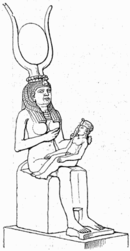
Who are the nursing mother and the Sar Apis?

Avoda Zara 43a1:

The gemerah discusses two commonly worshiped images, the nursing mother and Sar Apis.

The gemarah identified the former with Eve, who "suckled the whole world" and thus became a deity. The latter is said to represent Joseph who was a sar prince who calmed the world by handing out grain.

I hate to be a party pooper, but even a non-specialist like me thinks Seraphis and Isis, who is often depicted nursing a child, are better fits for this description. Though the gemarah's guesses are charming, I'm not sure what to make of them. Seraphis was an Egyptian deity originally, who developed into a Greek and then a Roman god. If it possible he was first based on Joseph? Even the grain measure Sar Apis is said to carry fits the description of Seraphis, but then Joseph did make his name in Egypt by handing out grain. Mysterious. 

UPDATE: Art Scroll pays lip service to the possibility that Sar Apis is Seraphis; nothing about Isis though. Rashi is silent, too. Haven't checked others.

Related daf posts from Avoda Zara.

Search for more information about [topic] at 4torah.com.

Tuesday, September 07, 2010

Who was Cain's father?

Yet another post, inspired by a Twitter conversation....

Here's R. Yochanan on BT Avoda Zara 22B:
When the serpent came unto Eve he infused filthy lust into them
Asked @Marksofla:
R' Yochanan says that the nachash had sexual relations with Chava. Is this from a medrash somewhere?
First, any non-halachic information found in the Talmud is, by definition, a medrash, so the short answer is, yes, it is a found in a midrash somewhere, and that somewhere is the Talmud itself, which discusses the illicit relationship between Eve and the snake in three places.

And where does the story of Eva and the sexy snake come from? Seemingly from an earlier idea that Cain was the product of an illicit union between Eve and a wicked angel disguised as the snake, an idea that itself appears to be very old and appears to have gotten its start with an interpretation of Genesis 4:1.

The verse reads: וְהָ֣אָדָ֔ם יָדַ֖ע אֶת־ חַוָּ֣ה אִשְׁתֹּ֑ו וַתַּ֙הַר֙ וַתֵּ֣לֶד אֶת־ קַ֔יִן וַתֹּ֕אמֶר קָנִ֥יתִי אִ֖ישׁ אֶת־ יְהוָֽה׃.

Some things are curious about this verse.

(1) Why does Eve refer to her newborn as an ish? Ish is a full grown man, not an infant.
(2) What did Eve mean when she said "I have acquired a man with YKVK (the Lord?)" 

For that matter, the whole story of Cain and Abel is puzzling. Why, for instance, did he kill his brother, and why was his sacrifice rejected?

An answer is given by Targum-Pseudo-Johnathan (dating uncertain) on the spot: And Adam knew that his wife Eve had conceived via Samael the angel of the Lord and she became pregnant and gave birth to Cain. He resembled the upper ones (angels), not the lower ones so she said I have acquired a man (kaniti ish) indeed (or via) an angel of the Lord.

The answer, or interpretation/drash given by TPJ seems based on the idea that ish often means angel (Cain resembled the upper ones) and on the understanding that the Torah uses ellipses (thus "via an angel of") and on a convention that the word YKVK can sometimes refer to a wicked angel (as it is understood for example in Exodus 4:24). 

TPJ solves another problem by explaining that "knew" is not being used in 4:1 in the usual biblical sense, as a euphemism for sexual relations, but literally: Adan knew that his wife had conceived via Samel

The idea that Cain was the son of a wicked angel solves the problem in Exodus 4:1, gives a reason for the rejection of the sacrifice, and also explains why Cain killed his brother (He was evil from birth, and the son of the devil, see?) This idea seems to have been in circulation at the end of the first Temple period as it pops up in a variety of places:
  • First epistle of John: (first century): Do not be like Cain, who belonged to the evil one and murdered his brother
  • TPJ 3:6: And the woman saw Samel and was afraid
Later, or at the same time, the idea seems to have developed that the snake that tempted her was actually the wicked angel in disguise: 
  • Pirquei deR. Eliezer (dating unclear): The serpent came unto her and she became pregnant with Cain as it says... What did he know? That she was already pregnant from someone else.
  • Apocalypse of Moses (first century) The devil answered me through the mouth of the serpent
  • 3 Baruch (first century)(probably) Satanel, when he dressed himself as the serpent
  • Macabbes 4 (between first century BCE and first century CE) "I was a pure virgin and did not go outside my father's house; but I guarded the rib from which woman was made. No seducer corrupted me on a desert plain, nor did the destroyer, the deceitful serpent, defile the purity of my virginity.
All of the sources above are older than BT Avoda Zara, by the way.


Search for more information about demon snakes  at 4torah.com.


Tuesday, August 31, 2010

A strange Roman ritual, and two interpretations of it

On BT Avoda Zara 11b, Rav Yehudah b. Ezekiel (d 299) provides a description of a Roman ritual which he attributes to his teacher Shmuel (d 250)
Said Rab Judah in the name of Samuel: They have yet another festival in Rome [which occurs] once every seventy years. Then a healthy man is brought and made to ride on a lame man; he is dressed in the attire of Adam, on his head is placed the scalp of R. Ishmael, and on his neck are hung pieces of fine gold to the weight of four zuzim, the market places [through which these pass] are paved with onyx stones, and the proclamation is made before him: 'The reckoning of the ruler is wrong. The brother of our lord, the impostor! Let him who will see it see it; he who will not see it now will never see it. Of what avail is the treason to the traitor or deceit to the deceiver!'; and they concluded thus: Woe unto the one when the other will arise [Soncino translation]
According to Rashi, the ritual is a Jacob and Esav pageant. Soncino summarizes Rashi's view:
Jacob, representing the Jews, here impersonated by the lame man (Gen. XXXII, 32 and he halted upon his thigh); and to Esau, representing Rome, impersonated by the healthy man; The reckoning which is pronounced as wrong alludes Jacob's prediction as to what would happen to his descendants at the end of days (Gen. XLIX, 1) the treason being an allusion to Jacob's deceitful gaining of the paternal blessing which was intended for Esau, and the concluding threat is a warning to Israel for whom the rising of Rome would be fraught with trouble
In short, Rashi seems to beleive that Rome created a ceremony in which various Rabbinic teachings are expressly rebuked. The problem is we don't have any reason to assume that Rome accepted Rabbinic teachings. The idea that Esav = Rome, for example, is nowhere found in scripture. Its an interpretation, propagated by the Rabbis after Rome ascended; prior to the rise of Rome, Esav was identified with Edom.  It's also hard to understand why Rome would go to the bother of establishing a ritual designed specifically to rebuke this teaching. What would such a ritual accomplish? Why go to the trouble of putting on such a show, unless you shared the perspective of the Rabbis, which Rome certainly did not?

A better answer (no offense to Rashi) is provided by Soncino:
Quite a different interpretation is offered by Rapaport ('Erek Millin s.v. [H]). According to him, Samuel here presents an account which reached him of one of the Ludi Saeculares, the spectacular carnivals and pompous pageants, of which altogether ten are known to Roman history. This one must have been arranged by the Roman Emperor Philippus, about 247 C.E., who introduced into the pageant the spectacle of a halting dancer ridden upon by a strong man. This was intended to satyrise and discredit P's rival, Decius, who pretended to be a friend and 'brother' of the Emperor, yet had accepted the crown which P. fondly hoped would be handed to his own son. The lame dancer with a larva, or kind of mask, tied at his neck (described by the Rabbi as R. Ishmael's scalp), thus impersonated Decius the treacherous 'ruler' whose plans and plottings are declared as wrong. The rider was impersonating Philippus. When he (or his son) rises woe betide his rival. The exclamation 'Let him who will see it etc.' alludes to the festivity which occurs but once in a lifetime. The fact that Samuel lived till 3 or 13 years after the date of this Game lends added feasibility to this interpretation.
This is a much better explanation of Samuel's words, but its not without problems. First, Samuel assumes that the larva was actually R. Ishmael's scalp (apparently the Rabbis thought Rome kept it as a souvenir after murdering him); second  he imagines one of the men was dressed in the "attire of Adam."  According to Rapaport's reading, Samuel was wrong on both counts. Can we say such a thing? Yes, I think, we can. Samuel's interpretation of the Roman event does not have the status of Torah She Ba'al Peh. We can't say that he received his description or interpretation of the ritual as part of an unbroken chain stretching back to Sinai, as the revelation occurred over a thousand years before the event in Rome. We can also rely on the teaching of Shmuel Hanagid (d 1050) who said that the non-halachic parts of the Torah are not binding on us, and that we're free to disregard or accept them as we see fit. (a view shared by many) Therefore it strikes me as perfectly okay to say that Samuel was wrong when he misidentified the larva as R. Ishmael's scalp; likewise, its valid to suggest that Rashi was mistaken when he interpreted the ceremony as having to do with Jacob and Esav.

What do you think?

Aside: Last night I had a whole long discussion with @unclechaim and others about this on Twitter in which I erroneously attributed Rashi's explanation to Samuel. As you can see from the cite, Samuel never claimed that the ritual had anything to do with Jacob or Esav.


Search for more information about Rome at 4torah.com.

Monday, July 05, 2010

What is spirituality?

On the last few comment threads, some of you have brought up spirituality. Adam, for example, says the OPR rabbi is causing "spiritual damage" to his congregation. Before that, on a post about the development of midrashim, Kramer claims that statements made by the Sages have more "spiritual value" than identical, or nearly identical statements found in the much older Apocrypha. Back on the OPR thread R. Harry says a Rabbi is supposed to deliver "spiritual guidance".

I confess to having absolutely no idea what any of that means.When challenged the speakers provided no explanations.

My theories
(1) Spiritual damage, spiritual value, and spiritual guidance are all nonsense phrases, that don't mean anything. What the speaker really means is something more concrete, and the mumbo-jumbo about "spirituality" is just a lazy way to sound pious. For instance, perhaps what Kramer is really trying to say is that he trusts the Sages more than he trusts the anonymous authors of the apocrypha; therefore he feels more comfortable reading in BT Sanhedrin that the phrase "vayihi acherai hadevarim ha'eyleh" at the beginning of the Akeida episode is a clue that Satan talked God into testing Abraham than he does reading pretty much the exact same thing in the much older book of Jubilees.  (click page 171) What he means by spiritual value then, is something like "this makes me happier" or "this just feels right." Likewise (according to this theory) what Adam really means is that the OPR makes him mad, and Harry's intent is that a Rabbi is supposed to tell us how to live our lives in ways that deliver the best results.

(2) We have something like spiritual bank accounts, to which we make deposits whenever we fulfill a commandment. According to this theory, perhaps Adam is worried that a shul-led by an OPR is not going to make as many mitzvah deposits as a shul with an OJR. How this works is unclear, however. If deposits to the account are made via actions, what difference does it make to the mitzvah-performing shul members is the man at the front of the room is a fraud? The congregation is still performing mitzvos; thus their deposits should still be good.  If Adam wants to make the case that what he is saying is true, he needs to provide more information about the mechanics. Same for Kramer. If this is what he meant to say, like Adam, he needs to explain why reading an idea in one book puts money into the account, while reading the same idea somewhere else does not. Harry, though, is fine: Per this theory, when he says a Rabbi delivers spiritual guidance what he means is that the Rabbi tells us how to make deposits and avoid unnecessary withdrawals (I don't see any reason why a knowledgeable and trained OPR couldn't fulfill this task. Knowing how to best fill up the mitzvah account doesn't seem to me to depend on belief in God.)

Anything else?


Search for more information about [topic] at 4torah.com.

Thursday, July 01, 2010

A proof that tannaim created midrashim?

On BT Shabbas 96b, Rabbi Akiva identifies Zelophehad as the mkoshesh eitzim or stick-gatherer on the basis of a gezeira shava that is a word the appears twice in different contexts. In this case, the word  is "bamidbar" or wilderness. Because it's used to tell us where the stick-gatherer sinned, and also where Zelophehad  - and seems superfluous in either instances - Rabbi Akiva concludes that the two people are one and the same.

Now where did this drasha/interpretation come from?

Wednesday, April 28, 2010

Why won't I join a Daf Yomi shiur?

Often, I'm asked why I prefer to study my daily daf alone instead of joining one of the many neighborhood classes/shiurim. The reason I give is that I'm usually a few pages behind, but that's not all of it. I also avoid the public daf yomi lectures because I don't trust myself to sit calmly in the face of barbarities and absurdities such as the one I encountered last night on BT Sanhedrin 69.

Friday, April 02, 2010

The censored Good Friday Gemarah

No coincidences? Hah. Today is Good Friday, the day Jesus was killed, and it was just five days ago that the Daf Yomi arrived at BT Sanhedrin 43, the page that once discussed the execution of Jesus, but does no longer because Jews respect and accept the judgment of Christian censors. More on that in a bit. First here are some of the highlights of the excised passages:

1 - Jesus was hanged on Passover eve (I only have it in English, so I can't tell you what the Hebrew or Aramaic is, but I assume it was not the word that means "executed by hanging" but the word that means "hung" as in the body was hung on a pole. According to the generally accepted history, Jesus was killed not on Passover eve, but on the second day of chol hamoed

2 - The passage immediately before the censored bits discusses the lengths a Jewish court would take to ensure that an innocent man was never executed (something our modern day pro-life/pro death penalty morons care nothing about) This included sending out a herald seeking witnesses who might have grounds for acquittal. According to the deleted passage, a herald announced that Jesus stood accused of both witchcraft and idolatry, and tried for forty days to find someone who could prove his innocence. The fact that a herald went out suggests that Jesus was executed by a Jewish court, and the forty day search suggests he was in their custody for quite some time. Both of these "facts" contradict the established history.

3 - Ullah challenges the Talmud's history, saying that a herald would not have gone out for Jesus, as he was someone who led people to idolatry, and the gemarah has already established that those who lead people to idolatry are not awarded protections such as having the herald go out. The gemarah responds that Jesus was different, and an exception was made for him because he was "connected to the government" (= royal or otherwise influential) This is yet another point where the Talmud's history and the established version of events do not agree.

4 - Next, the gemarah tells the very strange story of Matthai, Nakai, Nezer, Buni and Todah, five deciples of Jesus who were executed by a Jewish court. I call it strange both because we have no record of the five men, and also because the court proceedings, as recounted by the Talmud, are most irregular. Each of the condemned men offers a text, based on his name, to prove that he should not be killed, and the court responds with a text, also based on the accused's name, to show that he should be killed. For example: "When Matthai was brought [before the court] he said to them [the judges], Shall Matthai be executed? Is it not written, Matthai [when] shall I come and appear before God? Thereupon they retorted; Yes, Matthai shall be executed, since it is written, When Matthai [when] shall [he] die and his name perish" Since when do we settle capital cases using puns? Clearly, this story isn't meant to be history, and I doubt the Gemarah recognized it as history, but I don't know what purpose the story is believed/intended to have served.

Now why don't we print these stories in our gemarahs anymore? What are we worried about? Why are we afraid to print the Talmud in full? We no longer have censors to worry about, and to the best of my knowledge, there's no tradition of allowing a suppressed Gemarah to remain suppressed. The only answer I can find to this question is a bad one: It seems to me that the publishers of the Talmud (including ArtScroll) are afraid to think for themselves and make reasonable changes. We haven't printed the Jesus passages in several hundred years so there's no reason to start now, I guess.... Other, than honesty, truth, and accuracy

Search for more information about other bad changes to Judaism that aren't corrected because the leading Jews are too scared to do what needs to be done at 4torah.com.