This is an outrage, a travesty and, once again, also a golden opportunity for me to cash in. I invite you to please join me in the great mitzvah of defending the indefensible, as described here. Please swap in the name of last years travesty, with this year's walking embarrassment.
Monday, January 31, 2011
Another Orthodox Jewish Ponzi Scheme
This is an outrage, a travesty and, once again, also a golden opportunity for me to cash in. I invite you to please join me in the great mitzvah of defending the indefensible, as described here. Please swap in the name of last years travesty, with this year's walking embarrassment.

Why Terry Ord will live like a grad student... forever
On Slate, a secular, godless, academic, liberal named Toby Ord has a post announcing his plans to live frugally, and to give away all of his extra money. As he puts it, the decision seems obvious:
...I chose to do this after realising just how much more good my money could do for others than for me. I'm a research fellow in ethics, and my thoughts on the ethical issues around global poverty have had a dramatic impact on my personal behavior. Philosopher Peter Singer—a fellow Australian—said that the money we spend on luxuries could be used to save people's lives in developing countries if we so wished. How then can we justify choosing the luxuries? This is a strong argument, and quite confronting.
This is also quite a clever way to outmaneuver the local richies. Can't afford an extension on your house, or a landscape created by the local hot gardener? Try this instead: Give away all your extra money, and forgo all luxuries. You'll gain peace of mind, countless mitzvah points, and the moral high road!
See, what I am trying to get at it in my snarky way, is this: Everything we do, we do for a payoff. The local richie feels good when he spends money on himself, so that's what he does. He wants people to know he's wealthy and powerful ;adding on a new wing to his house, or parking a Lexus in the driveway gets the message across. (Perhaps he also sets aside large sums for charity, but he does this, too, because of how it makes him feel.) The fellow planning for a life of extreme poverty is no different, only his emotional payoff comes from a conspicuous shows of virtue, rather than from conspicuous shows of wealth and consumption. This is not to say Toby Ord is wrong to behave so charitably, only that because of how his brain works, the sacrifice isn't as great as it seems. For someone who gets his payoff from living large, the choice Ord has made would be impossible. Ord wants to be seen as a good person so giving away all of his money, after taking care to alert us all to his decision on Slate, is merely a multi-million dollar home extension by another name. Sure, the world would be a better place if all of us shared Ord's priorities, but much of the credit for Ord's generosity should go to the parents and teachers and whoever else linked extreme generosity with his self-image, and raised him to feel good about being charitable
See, what I am trying to get at it in my snarky way, is this: Everything we do, we do for a payoff. The local richie feels good when he spends money on himself, so that's what he does. He wants people to know he's wealthy and powerful ;adding on a new wing to his house, or parking a Lexus in the driveway gets the message across. (Perhaps he also sets aside large sums for charity, but he does this, too, because of how it makes him feel.) The fellow planning for a life of extreme poverty is no different, only his emotional payoff comes from a conspicuous shows of virtue, rather than from conspicuous shows of wealth and consumption. This is not to say Toby Ord is wrong to behave so charitably, only that because of how his brain works, the sacrifice isn't as great as it seems. For someone who gets his payoff from living large, the choice Ord has made would be impossible. Ord wants to be seen as a good person so giving away all of his money, after taking care to alert us all to his decision on Slate, is merely a multi-million dollar home extension by another name. Sure, the world would be a better place if all of us shared Ord's priorities, but much of the credit for Ord's generosity should go to the parents and teachers and whoever else linked extreme generosity with his self-image, and raised him to feel good about being charitable
Judaism and its Peter Popoff problem
Last night, while flipping through the channels, I was astounded to see Peter Popoff, the famous faith fraudster on BET selling magic water and supernatural cures. It wasn't a show, but an infomercial, but the contours of the program were identical to the performances that made Popoff infamous in the 70s.
In clipped sentences, punctuated by inappropriate uses of the word "Amen", Popoff hawked his magic water and told viewers of his supernatural faith-healing abilities. Through the magic use of Jesus's name [amen] tumors had been made to disappear [amen] sight had been reeeee-stored to the blind, and the lame had cah-limbbed out of their wheelchairs [amen!] Dramatic footage from Poppoff's revival meetings reinforced the claims. We saw Popoff throw canes and crutches on the alter, as their owners danced. As the cameras rolled, and the organ played, one person after another approached the microphone to praise Popoff and to testify about the miracles he had brought about.
Those of us sitting at home,were invited to share in the glory by calling the special prayer line. All free, of course, though callers to the prayer line were likely to receive a letter like this describing secret rituals, magical prophecies, and promises of yeshuos and nechamos in exchange for a mere 17 dollars (1 being for God, and 7 being His secret magic number)
Its all flim-flam, of course. Popoff is a notorious bunko artist who was exposed as a cheat in the early 80s by James "The Amazing" Randi." Why BET is permitting him to run his informercials and prey on a new generation of suckers is anyone's guess.
What I find deeply troubling, however, is how similar the Popoff routine is to the workings of various Orthodox Jewish charities. We've all seen the notorious Kupat Hair letters promising blessings in exchange for money, and as cruelly deceptive as they are, that's really just the tip of the iceberg.
In advance of every Jewish holiday, I receive RoboCalls in which a thickly accented man promises me riches, cures, shidduchim, and blessings if I send him a check. His clipped sentences are punctuated by inappropriate uses of the words "Baruch Hashem" and the Gedolim, rather than Jesus, are the conduits for the miracle; otherwise the RoboCaller's routine is a dead-ringer for Popoff's.
And even that's not all: I've also heard stories about various Rebbes who have allegedly taken 5 and 6 figure sums in exchange for blessings and promises. In one story, a second tier Hasidic Rebbe whose name you know is alleged to have taken $10,000 from a distraught father in exchange for "removing the ayin hara" from his OTD daughter. In another story, a different second tier Hasidic Rebbe whose name you know is said to have taken $25,000 from a couple that desperately wanted a child. If you sit at the right sholishudis table, or frequent the right mikvaot, you will hear stories like this all the time. [The daughter is now very successful, happy, content and shacked up with a non-Jew; the couple had a child.]
These are all scams that prey on the desperate and separate the stupid from their money. Its an outrage and a failure of Orthodox Jewish leadership that they are allowed to continue. Those rabbis, and community organizations like Aguddah, or journalists like PinnyHorowitz Lipshutz of the Yated, who sit silently while Kupait Hair and noted Hasidic Rebbes take advantage of the gullible masses are nothing but cowards and collaborators. All of their inveighing against blogs, and short skirts are smoke and vapor until they show themselves capable of standing up to the thieves with fancy names, and prominent letterheads. All of their whining about the respect due to Jewish leaders are as nothing until the Jewish leaders who use religion to steal from us are exposed as frauds and cast out.
Its really as simple as that.
Search for more information about Peter Popoff at 4torah.com.
In clipped sentences, punctuated by inappropriate uses of the word "Amen", Popoff hawked his magic water and told viewers of his supernatural faith-healing abilities. Through the magic use of Jesus's name [amen] tumors had been made to disappear [amen] sight had been reeeee-stored to the blind, and the lame had cah-limbbed out of their wheelchairs [amen!] Dramatic footage from Poppoff's revival meetings reinforced the claims. We saw Popoff throw canes and crutches on the alter, as their owners danced. As the cameras rolled, and the organ played, one person after another approached the microphone to praise Popoff and to testify about the miracles he had brought about.
Those of us sitting at home,were invited to share in the glory by calling the special prayer line. All free, of course, though callers to the prayer line were likely to receive a letter like this describing secret rituals, magical prophecies, and promises of yeshuos and nechamos in exchange for a mere 17 dollars (1 being for God, and 7 being His secret magic number)
Its all flim-flam, of course. Popoff is a notorious bunko artist who was exposed as a cheat in the early 80s by James "The Amazing" Randi." Why BET is permitting him to run his informercials and prey on a new generation of suckers is anyone's guess.
What I find deeply troubling, however, is how similar the Popoff routine is to the workings of various Orthodox Jewish charities. We've all seen the notorious Kupat Hair letters promising blessings in exchange for money, and as cruelly deceptive as they are, that's really just the tip of the iceberg.
In advance of every Jewish holiday, I receive RoboCalls in which a thickly accented man promises me riches, cures, shidduchim, and blessings if I send him a check. His clipped sentences are punctuated by inappropriate uses of the words "Baruch Hashem" and the Gedolim, rather than Jesus, are the conduits for the miracle; otherwise the RoboCaller's routine is a dead-ringer for Popoff's.
And even that's not all: I've also heard stories about various Rebbes who have allegedly taken 5 and 6 figure sums in exchange for blessings and promises. In one story, a second tier Hasidic Rebbe whose name you know is alleged to have taken $10,000 from a distraught father in exchange for "removing the ayin hara" from his OTD daughter. In another story, a different second tier Hasidic Rebbe whose name you know is said to have taken $25,000 from a couple that desperately wanted a child. If you sit at the right sholishudis table, or frequent the right mikvaot, you will hear stories like this all the time. [The daughter is now very successful, happy, content and shacked up with a non-Jew; the couple had a child.]
These are all scams that prey on the desperate and separate the stupid from their money. Its an outrage and a failure of Orthodox Jewish leadership that they are allowed to continue. Those rabbis, and community organizations like Aguddah, or journalists like Pinny
Its really as simple as that.
Search for more information about Peter Popoff at 4torah.com.
Sunday, January 30, 2011
Great Moments in Geography


WikiParshaNotes: Mishpatim
Sorry, true believers, but I haven't been able to finish the 5771 edition of Mishpatim ParshaNotes. Though I expect to post something soon, I thought it might be fun to create a community wiki-edition. Here's what I have in mind:
-DB
Search for more information about the sedra of the (last) week at 4torah.com.
- Post any thoughts you've had about the parsha to this post's thread. It doesn't have to be your original thought, but be sure to credit it.
- Keep it short. The ParshaNotes style is terse and brief. No more than two or three sentances, please. Links to longer discussions on your own blog, or elsewhere, are ok. In fact, I encourage it.
- If you don't have a blog, do your favorite blogger a favor and provide a one sentance summary of his or her awesome Mishpatim post, with a link.
- Today or perhaps tomorrow, I'll post my edition of ParshaNotes with your submissions included.
-DB
Search for more information about the sedra of the (last) week at 4torah.com.
Friday, January 28, 2011
Trembling Before Teddy Bears
A video depicting the Orthodox Jewish Teddy Bears discussing homosexuality was blogged recently by Andrew Sullivan at the Atlantic who adds: "To say I empathize would be an understatement. My own lengthy discussion of reparative therapy and the legacy of Freud with respect to homosexual orientation (I remain a fan of Freud's) is the second chapter of Love Undetectable."
See it after the jump.
See it after the jump.
Rabbi Dov Lior: Gentile sperm will produce barbarian kids
A Guest Post by Philo
This guy (the chief rabbi of Kiryat Arba) is an ignorant bigot. I’m resisting the temptation to use stronger terms.
During a recent women’s health conference, while deploring the practice of using non-Jewish sperm for infertile couples, he said:
"Sefer HaChinuch states that the character traits of the father pass on to the son. If the father in not Jewish, what character traits could he have? Traits of cruelty, of barbarism! These are not traits that characterize the people of Israel."
Right. All non-Jews are cruel barbarians. And all Jews are “merciful, shy and charitable”.
But I’m sure Rabbi Lior has at least formed this opinion based on years of personal observation:
"I even read in books that sometimes the crime, the difficult traits, the bitterness – a child that comes from these traits, it's no surprise that he won't have the qualities that characterize the people of Israel."
What else? Let’s see. Children of single mothers by choice become criminals. And it’s the fault of western influence that women are getting married late. They should be concentrating on their real role, that of child rearing.
According to Wikipedia:
“Lior is considered by many to be a leading scholar of the Religious Zionist camp”
Looks like Religious Zionism is in good (sexist and racist) hands.
Search for more information about Rabbi Dov Lior at 4torah.com.
Religion: What is it good for?
By Avromie (translatedseforim.wordpress.com)
The Kotzker Rebbe's yahrtzeit was yesterday The Heilige Kotzker, as he's known, was a man who devoted his entire life to the pursuit of truth, and to a relationship with God. Yet he, like many other Tzaddikim was extremely depressed. How does this reflect on Judaism?
The Kotzker Rebbe's yahrtzeit was yesterday The Heilige Kotzker, as he's known, was a man who devoted his entire life to the pursuit of truth, and to a relationship with God. Yet he, like many other Tzaddikim was extremely depressed. How does this reflect on Judaism?
Thursday, January 27, 2011
Great moments in photojournalism
 |
| An Israeli motorist runs down a masked Palestinian youth who was among a group of boys throwing stones at Israeli cars in the mostly Arab east Jerusalem neighborhood of Silwan. The boy was injured but his condition was described as stable. |
Photographer: Ilia Yefimovich/AFP
Source the Guardian Eyewitness series
Important context provided here with this video
Source the Guardian Eyewitness series
Important context provided here with this video
Problems with Parshas Mishpatim
I dislike parshas Mishpatim. The legal discussions are at best mind numbingly boring, and the brief narrative at the end is confusing and theologically precarious. In fact, the parsha is impossible to study without encountering significant kfriah issues. A sampling after the jump:
Wednesday, January 26, 2011
Hilarious Typo
A Guest Post By E. Fink

Search for more information about Jew York at 4torah.com.
HT: @elifrombrooklyn

Search for more information about Jew York at 4torah.com.
Are You Offended By This?
A Guest Post By E. Fink
Last week a 60 year old woman was arrested for trying to smuggle 44 iPhone 4s into Israel.

I'm not an alarmist when it comes to anti-Semitism. Nor do I look to be offended by any slight bias or ignorance from the media when it comes to frum Jews.
However, this photo on Gizmodo is borderline offensive:

See, the photo is a stock photo, it has nothing to do with the article. But it implies that the woman who was arrested was a charedi woman, dressed in Charedi garb. However, the article is about a woman dressed in traditional Georgian garb smuggling 44 iPhone 4s into Israel.
While I can see how traditional Georgian garb could be confused with traditional Polish garb such as the Charedi garb of 2011, the photo does more than illustrate traditional garb at Ben-Gurion, it subliminally suggests that the woman was Charedi.
For all we know, she could have been Charedi. But no news reports even hint that she was.
God's Hornet
In Exodus 23:28 the Lord promises to assist with the driving out of three Cannanite nations through the use of a tsir-aw צִּרְעָ֖ה, the definition of which is the stuff of a fascinating discussion.(summarized by Prof. Haim Genizi).
Here's how the ancient and medieval interpreters took it:
The modern interpreters have other ideas:
J. Garstang: The word bee is a metonym for Egypt, because it was used as a symbol for the country itself. The bee hieroglyph was first used to denote the king of Lower Egypt (the king of Upper Egypt was denoted with a reed), and is found on inscriptions from the First Dynasty down to the Roman period. Gerstrang reasons that the verse is promising that Egypt will help pave the way for conquest, and indeed letters and the like have been found suggesting that Egypt had dominion over the Canaanite people in ways that likely weakened their kings. For skeptics, this is a subtle example of vaticinium ex eventu.
Robert Alter: Observing the previous verse [Ex. 23:27] in which God promises to send his "terror" [ אֵֽימָתִי֙] Alter proposes that tsir'aw be emended ra'ats, which means Smash. (its a rearrangement of two letters) As he says, this change produces a parallel (much of the section seems to be written in verse) with "terror" suggesting that God will send his terror, and smash the opposition.
Search for more information about vaticinium ex eventu. at 4torah.com.
Here's how the ancient and medieval interpreters took it:
- Saadya Gaon: Sickness of some kind
- Rashi: Insect, presumably a hornet
- Ibn Ezra: A plague, connected to tzara'at [=leprosy]
- Ramban: A bee
The modern interpreters have other ideas:
J. Garstang: The word bee is a metonym for Egypt, because it was used as a symbol for the country itself. The bee hieroglyph was first used to denote the king of Lower Egypt (the king of Upper Egypt was denoted with a reed), and is found on inscriptions from the First Dynasty down to the Roman period. Gerstrang reasons that the verse is promising that Egypt will help pave the way for conquest, and indeed letters and the like have been found suggesting that Egypt had dominion over the Canaanite people in ways that likely weakened their kings. For skeptics, this is a subtle example of vaticinium ex eventu.
Robert Alter: Observing the previous verse [Ex. 23:27] in which God promises to send his "terror" [ אֵֽימָתִי֙] Alter proposes that tsir'aw be emended ra'ats, which means Smash. (its a rearrangement of two letters) As he says, this change produces a parallel (much of the section seems to be written in verse) with "terror" suggesting that God will send his terror, and smash the opposition.
Search for more information about vaticinium ex eventu. at 4torah.com.
NHL AntiSemitism
Report:
23-year-old Jason Bailey -- a 3rd round NHL pick in 2005 -- claims from the moment the Ducks assigned him to play for an affiliate team called the Bakersfield Condors ... his coaches unleashed a "barrage of anti-Semitic, offensive and degrading verbal attacks."
In the suit, filed today in Orange County Superior Court, Bailey claims the head coach of the Condors told him "[Jews] only care about money and who's who" and that he "never wanted his son to be raised Jewish or to wear a Yarmulke."
Bailey claims the assistant head coach would get in on the Jew-bashing too -- saying things like, "Oh, I just got a friend request from a dirty Jew."
Bailey says the coaches also forced him to travel apart from the team and he was "rarely given any ice time" in games because he's Jewish.
According to the documents, filed by Bailey's powerhouse lawyer Keith Fink, Bailey complained to the Ducks about the hostile work environment -- and the team reacted by instructing the coaches to pen apology letters to Bailey in which they both admitted to using hurtful language.
Bailey was eventually traded to the Ottawa Senators in 2009 -- and insists the Ducks were "happy to be rid of him."
Bailey is suing for unspecified damages.
Calls to the Ducks have not been returned.
Oldie/Goodie

Peek-a-Jew at the SOTU address
@nfessel spotted him first, and tweeted:

We recognize the tie (its very OJ) but not the face. As of this morning, we still have not identified the fellow. One of the Elders, I guess.
More Peek-a-Jew
Search for more information about #sotu at 4torah.com.
Who is the Frum guy with the yarmulka that entered the chamber last? #SOTU

We recognize the tie (its very OJ) but not the face. As of this morning, we still have not identified the fellow. One of the Elders, I guess.
More Peek-a-Jew
Search for more information about #sotu at 4torah.com.
Tuesday, January 25, 2011
Did Hosni Mubarak Flee the Country?
Amid unconfirmed rumors that Hosni Mubarak and his family have quit Egypt, we give you this remarkable video of protesters defacing his image. As Jeffery Goldberg said, "This is not something that usually happens in Egypt."
To say the least.
Search for more information about [topic] at 4torah.com.
To say the least.
Search for more information about [topic] at 4torah.com.
Avi Shafran vs Al Jezeera: Who has more respect for free expression?
Al Jazeera on January 23, 2011
Search for more information about things that strange but true at 4torah.com.
We know that some of what is presented [in the Palestinian Papers] will prove controversial, but it is our intention to inform, not harm, to spark debate and reflection – not dampen it. Our readers and viewers will note that we have provided a comments section in which to express opinions. In keeping with our editorial policies, we reserve the right to excise comments that we deem inappropriate, but all civil voices will be heard, all opinions respectedAvi Shafran on July 9, 2010
On a number of occasions my attention has been drawn to the fact that some of my essays posted on Cross-Currents have elicited in their comments sections negative remarks about, portrayals of, or insinuations concerning various groups of Jew... And so I have decided to disallow comments altogether to my postings.Avi and Al Jazeera are both concerned about uncivil comments; the difference is one recognizes the value of vigorous conversation, and the other does not. This is why Al Jezeera prefers to moderate comment threads and preserve opportunities for debate, whereas Avi prefers to ban them.
Search for more information about things that strange but true at 4torah.com.
First impressions of the Palestinian Papers

A First Take On The Palestine Papers
by MATT DUSS
While the release by Al Jazeera on Sunday of over 1600 documents relating to a decades’ worth of U.S.-managed Palestinian-Israeli negotiations is certain to impact both the negotiations themselves and perceptions of those negotiations, because there’s so many of them, and because their veracity remains in question, it’s probably best for the moment to hold off on grand pronouncements about What They Mean.
But here are a few impressions.
Monday, January 24, 2011
We should never know from this
The Times has an article today about one of the saddest ceremonies in our tradition: The circumcision of a deceased infant. Reading it, I could only think of that strange ungrammatical sentence my grand-mother would utter whenever she heard some terrible news: We should never know from this.
See the article after the jump:
See the article after the jump:
The disgusting things they put in grape juice
Benjamin of Tudela spots this:

Not sure what the problem is? Hmmm... Look at the second to last line, or visit Mostly Kosher. (and you're right; it would far worse is there WAS fear of shmitah and the other thing.)
Search for more information about ingredient labels at 4torah.com.

Not sure what the problem is? Hmmm... Look at the second to last line, or visit Mostly Kosher. (and you're right; it would far worse is there WAS fear of shmitah and the other thing.)
Search for more information about ingredient labels at 4torah.com.
Two Satmar dropouts in Yiddish remake of Romeo and Juliette
A Familiar Story of Boy Meets Girl, but in Yiddish
By JED LIPINSKI
New York Times
In Shakespeare’s tragedy, Romeo is so steeped in love poetry that Juliet accuses him of kissing “by the book.” By contrast, Lazer Weiss, who plays the lead role in the new film “Romeo and Juliet in Yiddish,” [ see the trailer] didn’t understand the concept of romantic love until he was in his 20s.
By JED LIPINSKI
New York Times
 |
Fred R. Conrad/The New York Times Lazer Weiss and Melissa Weisz, the leads of “Romeo and Juliet in Yiddish,” along Lee Street in South Williamsburg. |
In Shakespeare’s tragedy, Romeo is so steeped in love poetry that Juliet accuses him of kissing “by the book.” By contrast, Lazer Weiss, who plays the lead role in the new film “Romeo and Juliet in Yiddish,” [ see the trailer] didn’t understand the concept of romantic love until he was in his 20s.
Did the Covenant Code come out of a vacuum?
Any first year bible student knows that there are significant similarities between the Laws of Hammurabi and the Covenant Code [i.e. most of parshat Mishpatim]. These similarities include the topics discussed, the penalties imposed, and the way the laws are phrased. Significant differences between the two sets of laws have also been identified. These differences also relate to the topics discussed, the penalties imposed, and the way the laws are phrased.
However, what seems undisputed are the dates - Hammurabi's Law is older the Moses's - and the existence of certain correspondences, including the goring ox, and the mutilation of a slave's ear. [All 14 correspondences are provided after the jump]
In some instances even the wording of Hamurabbi's Code bears what Kugel calls a "striking resemblance" to the Bible. What explains this?
Suppose a new 21st century religious sect were to announce a divine revelation that corresponded in key ways with the Magna Carta. Though this would not be an argument against the revelation itself, it would be good grounds for saying that the new religious sect hadn't started with a completely clean slate.
Doesn't it follow that the Covenant Code likewise did not emerge from a vacuum? (yes) And does it matter? (no) As I say in comment #7:
(1) God might have given Moses a CC that shared aspects with the LH.There are any number of reasons why God might have done this.
(2) Even if CC was written by a human, its still OUR CC and it still has religious and historical significance, that can't casually be dismissed.
Fourteen correspondences between the Covenant Code and the Laws of Hammurabi after the jump
However, what seems undisputed are the dates - Hammurabi's Law is older the Moses's - and the existence of certain correspondences, including the goring ox, and the mutilation of a slave's ear. [All 14 correspondences are provided after the jump]
In some instances even the wording of Hamurabbi's Code bears what Kugel calls a "striking resemblance" to the Bible. What explains this?
Suppose a new 21st century religious sect were to announce a divine revelation that corresponded in key ways with the Magna Carta. Though this would not be an argument against the revelation itself, it would be good grounds for saying that the new religious sect hadn't started with a completely clean slate.
Doesn't it follow that the Covenant Code likewise did not emerge from a vacuum? (yes) And does it matter? (no) As I say in comment #7:
(1) God might have given Moses a CC that shared aspects with the LH.There are any number of reasons why God might have done this.
(2) Even if CC was written by a human, its still OUR CC and it still has religious and historical significance, that can't casually be dismissed.
Fourteen correspondences between the Covenant Code and the Laws of Hammurabi after the jump
Abortion in the Torah
From David Plotz's Blogging the Bible series:
The verse is question is actually one that is quite difficult to translate, and one that provides some interesting examples of ancient biblical interpretation. You can see my discussion here at Ancient Torah and non Torah True Views on Abortion
Search for more information about abortion at 4torah.com.
If a man pushes a pregnant woman and she miscarries, but is not otherwise hurt, then the offender pays only a fine to the victim's husband. This has interesting implications for how we think about abortion—in particular about the claim that killing a 17-week-old fetus is the same as killing a 17-year-old. According to Exodus, it's not. As [a reader] writes: "The text seems to clearly state that the destruction of a fetus is not a capital offense. It is a property crime for which monetary compensation is paid."If only it were so simple.
The verse is question is actually one that is quite difficult to translate, and one that provides some interesting examples of ancient biblical interpretation. You can see my discussion here at Ancient Torah and non Torah True Views on Abortion
Search for more information about abortion at 4torah.com.
Sunday, January 23, 2011
Israel is too democratic?
From Ynet: Poll: Religious sector thinks Knesset not Jewish enough
Survey reveals that most religious Israelis believe Knesset too democratic, but not Jewish enough, while seculars think opposite. All sectors consider human rights a Jewish value
What does it mean for a house of parliament to be too democratic? Is this a coded way of saying they wish a rabbi or committee of rabbis held sway?
Search for more information about [topic] at 4torah.com.
Survey reveals that most religious Israelis believe Knesset too democratic, but not Jewish enough, while seculars think opposite. All sectors consider human rights a Jewish value
What does it mean for a house of parliament to be too democratic? Is this a coded way of saying they wish a rabbi or committee of rabbis held sway?
Search for more information about [topic] at 4torah.com.
Each family is different
"Do you mind if I keep my hat on," I said to the neighbor as I entered her house. I was there to meet with her husband about a business matter, and was wearing a cap to protect against cold and wind. It had been on my head for hours, and I was now reluctant to remove it and expose a head of flat, sticky hair.
"Not at all," she replied, "Though if we were sitting down to a meal together, I'd take offense."
A short conversation ensured about family mores. In her house, the children all must ask to be excused before they're permitted to leave the table. In my house, no one eats until the cook sits down.
"Each family is different," she said by way of summing up, and of course she's right. Or, to go a step further, each family is different and that okay. We're not better people because we wait to eat until my wife is seated; the neighbors aren't our superiors simply because their children have been taught to utter a specific formula in a specific situation. A family isn't deemed a success by virtue of its embracing certain manners, or because it playacts certain rituals; rather, success is a measure of how happy and healthy the members of the family are. Certain rituals and manners might lead to health and happiness; likewise, the act of performing certain rituals might create happiness for those who perform it, but, for the most part, guaranteed outcomes are rare.
Many of the tensions in a new marriage are produced as husband and wife adjust to each other's idea of normal. The disagreements between Jewish neighborhoods and Jewish sects often result from something similar. If you've been raised to perceive a particular pronunciation of Hebrew, or a particular nusach or seating arrangement as "normal", someone elses perfectly good shul can seem foreign, and inauthentic. If the goal is serving the creator, or doing good int he world, or increasing health and happiness should artifacts, manners and styles matter? Yet they are often a subject of Jewish complaint. Perhaps, this is because the very act of complaining, and demeaning the styles and manner of others is itself often a source of happiness for the one who is doing the complaining.
Friday, January 21, 2011
Robert Bentley and the Jews of Alabama
In a new feature we call Wednesday's News Today, we present Republican Robert Bently of Alabama:
Later he apologized, but I sort of think he meant what he said, when he sent it. I also think he was speaking about Muslims and atheists just as surely as he was speaking about Jews. Doesn't matter, though: I don't live in Alabama where his gentle bigotry might affect me, and honestly I'm pleased the dope doesn't consider me part of his family.
Search for more information about Jew-hating Christains such as this one at 4torah.com.
"There may be some people here today who do not have living within them the Holy Spirit," Bentley said. ''But if you have been adopted in God's family like I have, and like you have if you're a Christian and if you're saved, and the Holy Spirit lives within you just like the Holy Spirit lives within me, then you know what that makes? It makes you and me brothers. And it makes you and me brother and sister."Nice, right? Way to perpetuate the prejudices, Governor Bently.
Bentley added, ''Now I will have to say that, if we don't have the same daddy, we're not brothers and sisters. So anybody here today who has not accepted Jesus Christ as their savior, I'm telling you, you're not my brother and you're not my sister, and I want to be your brother."
Later he apologized, but I sort of think he meant what he said, when he sent it. I also think he was speaking about Muslims and atheists just as surely as he was speaking about Jews. Doesn't matter, though: I don't live in Alabama where his gentle bigotry might affect me, and honestly I'm pleased the dope doesn't consider me part of his family.
Search for more information about Jew-hating Christains such as this one at 4torah.com.
ParshaNotes Yisro 5771
Welcome to another edition of ParshaNotes, this one sponsored in honor of all DovBear guest posters, past and present, by a generous, anonymous donor.
Antithesis
Jethro's arrival is set in thematic opposition to the arrival of Amelek in the preceding chapter. There are a network of parallels, and cross references. (Cassuto) [More] [And what is "Amelek" anyway?]
Moshe's display of leadership style is in many ways the antithesis of what we've seen from Pharaoh on the same score
Accurate idiom
18:18 נָבֹל תִּבֹּל גַּם־אַתָּה גַּם־הָעָם הַזֶּה You and your people will wear yourselves out
As Rashi says (following Onkelos) the verb here means "to wither." To an ancient, agricultural society, this means approximately what "burnout" might mean to a modern, technological society like ours. (Alter)
Common Error
Christians often forget that Jesus was not one of them, but one of us. They speak of Jesus teaching or arguing with "the Jews" forever oblivious to the fact that both Jesus and "the Jews" would have thought of each other as members of same religious and ethnic group. Jews are guilty of the opposite mistake, specifically toward Moshe's wife Tzipporah. Perhaps she converted (in whatever way that was done before the Torah was given) but she hadn't shared in the history or the burdens of her husband's nation. Their suffering was not her suffering. Her arrival with Jethro, after the Exodus has been executed, drives home the point that she was not one of us.
Biblical economy
18:4 Moshe calls his second son Elazar, because [Moses said,] "The God of my father came to my aid and rescued me from Pharaoh's sword." When? As the Midrash notes this must refer to an episode not depicted in the narrative. The story of Moshe's Magic Marble Neck is the (likely invented) solution.
Unnecessary comment
The verse [19:3] says "So shall you say to the house of Jacob and tell the sons of Israel" and Rashi, following mechilta, provides an explanation for the double language. This misses the point. It appears far more likely to me that God is speaking in verse to signify the grandeur and majesty of the moment. (The line's meaning and rhythm are both perfectly parallel.)
Upping the ante
God's original deal with Abraham was that we would practice justice and righteousness. Now [19:6] He says "And you shall be to Me a kingdom of princes."
Close Reading
Moshe demonstrates modesty when he speaks to his father-in-law. Though Yisro arrived after hearing of all "God had done for Moses and for Israel his people..."; Moshe, seven verses later "told his father in law all that the LORD had done unto Pharaoh and to the Egyptians for Israel's sake..."
External Parallels
- לֹא תַעֲשֶׂה־לְךָ פֶסֶל וְכָל־תְּמוּנָה אֲשֶׁר בַּשָּׁמַיִם מִמַּעַל וַאֲשֶׁר בָּאָרֶץ מִתָּחַת וַאֲשֶׁר בַּמַּיִם מִתַּחַת לָאָרֶץ׃
You shall not make for yourself an idol, or any likeness of what is in heaven above or on the earth beneath or in the water under the earth.
Here, God is speaking of the three realms of creation, and seems to be replying to Canaanite theology, which had a separate god for each zone (Baal: Land; Yaam:Sea; Mot: Underworld)
- Ancient Hittite treaties contained six parts: a preamble (identifying the treaty’s initiator and attributes), a historical review (explaining the relationship between the parties and reminding the subordinate party of their dependance on the suzerain), the stipulations (what is expected of each party), a call for deposition (placing the treaty in a place of honor in the vassal’s city), a list of witnesses (usually gods), and finally a statement of curses and blessings (what will happen if the terms of the treaty are or are not followed. The stroy of the Ten Commandments follow this pattern (Nachun Sarna)
Irony Alert
The ban on taking God's name "in vain" may have originally had the sence of "making use of the name in a (false) spell or incantation", as opposed to using it in casual speech. (Alter) Nowadays, of course we're meticulous about not ever mentioning the name, but flock to clairvoyants who offer to work miracles, often through various uses of the name.
Midrashic meaning
Rashi on 19:17: at the bottom of the mountain According to its simple meaning, [DB: Which no Rabbi or preacher ever mentions.] at the foot of the mountain. Its midrashic interpretation is, however, that the mountain was uprooted from its place and turned over them like a vat. — [from Shab. 88a] I don't believe even the midrashic interp. here is meant to be taken literally. Rather, I believe the author of the midrash is saying that following the miracles the Israelites had seen, they were in no position to refuse God's invitation; thus it was as if the mountain was being held over the heads.
A better answer: The verses put God in two places at once: On the one hand, it says "And the Lord went down upon the mountain" and elsewhere reports that God "called to [Moses] from the mountain." Later, God says "You have seen for yourselves that I talked to you from heaven," and at the end of the story Moshe recalls, "Out of heaven He caused you to hear his voice." So which is it? Heaven or mountain? If the Mountain was lifted, the problem is solved as this allows God to be both on the mountain and in heaven simultaneously. See this and this.
Themes
After ordering us to eat a meal using archaic cooking (fire roasting) and archaic baking (unleavened bread) methods, the Lord seals the deal with a pact prepared using an archaic mode of communication (writing on stone.)
Mysteries
- Twice we're told the people heard (or will hear) the sound of a ram's horn, but no information is provided about who is blowing it. At the first mention, the horn is called a "yovel" prompting Rashi to say, "the ram’s horn Heb. הַיוֹבֵל. That is a shofar of a ram, for in Arabia, they call a ram “yuvla.” Do I misunderstand here, or is Rashi glossing a word based on how its used by non-Jews? If so, why?
Unresolved Questions about the Man Yisro
- How many names did our title character have? According to Shimon bar Yochai, he had two names, "Hobab" and "Jethro" (Sifre, Num. 78). Elsewhere, we're told he has 7 names "Reuel," "Jether," "Jethro," "Hobab," "Heber," "Keni" and "Putiel". Per the critics, the different names represent different people and/or different textual traditions.
- What was his occupation? One tanna says he was a priest of idolatry; another says he was a prince in Midian.
- What was his status? Exodus Raba says he gave up idolatry before he met Moshe (he was therefore ostracized, which is why his daughters were compelled to serve as his shepherd. This bit of back story is provided by the midrash to explain why a priest or prince didn't have professionals looking after his flocks.) Mechilta says he was still in the grips of idolatry when his first grandchild was born. (In general, Exodus Raba takes a positive view of Jethro, while the Mechilta views him more negatively)
- Did he have a role in Pharaoh's court? Exodus Raba says he was an advisor, together with Job and Ballam; other sources (Tanchuma, TPJ, BT Menachot, Gospel of Timothy) say Pharaoh's advisors were called Jannes and Jambres (joined, in some places, by a man called Micha)
Wrong Rashi
Rashi 19:4 on eagles’ wings Like an eagle, which carries its young on its wings, for all other birds place their young between their feet since they fear another bird flying above them. The eagle, however, fears only man, lest he shoot an arrow at it, because no other bird flies above it. Therefore, it places them [its young] on its wings. This is an excellent image, but the facts are false: Eagles don't actually carry their young on their wings.
Toss a tip in the hat, please, and buy my book. (thanks!)
Antithesis
Jethro's arrival is set in thematic opposition to the arrival of Amelek in the preceding chapter. There are a network of parallels, and cross references. (Cassuto) [More] [And what is "Amelek" anyway?]
Moshe's display of leadership style is in many ways the antithesis of what we've seen from Pharaoh on the same score
Accurate idiom
18:18 נָבֹל תִּבֹּל גַּם־אַתָּה גַּם־הָעָם הַזֶּה You and your people will wear yourselves out
As Rashi says (following Onkelos) the verb here means "to wither." To an ancient, agricultural society, this means approximately what "burnout" might mean to a modern, technological society like ours. (Alter)
Common Error
Christians often forget that Jesus was not one of them, but one of us. They speak of Jesus teaching or arguing with "the Jews" forever oblivious to the fact that both Jesus and "the Jews" would have thought of each other as members of same religious and ethnic group. Jews are guilty of the opposite mistake, specifically toward Moshe's wife Tzipporah. Perhaps she converted (in whatever way that was done before the Torah was given) but she hadn't shared in the history or the burdens of her husband's nation. Their suffering was not her suffering. Her arrival with Jethro, after the Exodus has been executed, drives home the point that she was not one of us.
Biblical economy
18:4 Moshe calls his second son Elazar, because [Moses said,] "The God of my father came to my aid and rescued me from Pharaoh's sword." When? As the Midrash notes this must refer to an episode not depicted in the narrative. The story of Moshe's Magic Marble Neck is the (likely invented) solution.
Unnecessary comment
The verse [19:3] says "So shall you say to the house of Jacob and tell the sons of Israel" and Rashi, following mechilta, provides an explanation for the double language. This misses the point. It appears far more likely to me that God is speaking in verse to signify the grandeur and majesty of the moment. (The line's meaning and rhythm are both perfectly parallel.)
Upping the ante
God's original deal with Abraham was that we would practice justice and righteousness. Now [19:6] He says "And you shall be to Me a kingdom of princes."
Close Reading
Moshe demonstrates modesty when he speaks to his father-in-law. Though Yisro arrived after hearing of all "God had done for Moses and for Israel his people..."; Moshe, seven verses later "told his father in law all that the LORD had done unto Pharaoh and to the Egyptians for Israel's sake..."
External Parallels
- לֹא תַעֲשֶׂה־לְךָ פֶסֶל וְכָל־תְּמוּנָה אֲשֶׁר בַּשָּׁמַיִם מִמַּעַל וַאֲשֶׁר בָּאָרֶץ מִתָּחַת וַאֲשֶׁר בַּמַּיִם מִתַּחַת לָאָרֶץ׃
You shall not make for yourself an idol, or any likeness of what is in heaven above or on the earth beneath or in the water under the earth.
Here, God is speaking of the three realms of creation, and seems to be replying to Canaanite theology, which had a separate god for each zone (Baal: Land; Yaam:Sea; Mot: Underworld)
- Ancient Hittite treaties contained six parts: a preamble (identifying the treaty’s initiator and attributes), a historical review (explaining the relationship between the parties and reminding the subordinate party of their dependance on the suzerain), the stipulations (what is expected of each party), a call for deposition (placing the treaty in a place of honor in the vassal’s city), a list of witnesses (usually gods), and finally a statement of curses and blessings (what will happen if the terms of the treaty are or are not followed. The stroy of the Ten Commandments follow this pattern (Nachun Sarna)
Irony Alert
The ban on taking God's name "in vain" may have originally had the sence of "making use of the name in a (false) spell or incantation", as opposed to using it in casual speech. (Alter) Nowadays, of course we're meticulous about not ever mentioning the name, but flock to clairvoyants who offer to work miracles, often through various uses of the name.
Midrashic meaning
Rashi on 19:17: at the bottom of the mountain According to its simple meaning, [DB: Which no Rabbi or preacher ever mentions.] at the foot of the mountain. Its midrashic interpretation is, however, that the mountain was uprooted from its place and turned over them like a vat. — [from Shab. 88a] I don't believe even the midrashic interp. here is meant to be taken literally. Rather, I believe the author of the midrash is saying that following the miracles the Israelites had seen, they were in no position to refuse God's invitation; thus it was as if the mountain was being held over the heads.
A better answer: The verses put God in two places at once: On the one hand, it says "And the Lord went down upon the mountain" and elsewhere reports that God "called to [Moses] from the mountain." Later, God says "You have seen for yourselves that I talked to you from heaven," and at the end of the story Moshe recalls, "Out of heaven He caused you to hear his voice." So which is it? Heaven or mountain? If the Mountain was lifted, the problem is solved as this allows God to be both on the mountain and in heaven simultaneously. See this and this.
Themes
After ordering us to eat a meal using archaic cooking (fire roasting) and archaic baking (unleavened bread) methods, the Lord seals the deal with a pact prepared using an archaic mode of communication (writing on stone.)
Mysteries
- Twice we're told the people heard (or will hear) the sound of a ram's horn, but no information is provided about who is blowing it. At the first mention, the horn is called a "yovel" prompting Rashi to say, "the ram’s horn Heb. הַיוֹבֵל. That is a shofar of a ram, for in Arabia, they call a ram “yuvla.” Do I misunderstand here, or is Rashi glossing a word based on how its used by non-Jews? If so, why?
Unresolved Questions about the Man Yisro
- How many names did our title character have? According to Shimon bar Yochai, he had two names, "Hobab" and "Jethro" (Sifre, Num. 78). Elsewhere, we're told he has 7 names "Reuel," "Jether," "Jethro," "Hobab," "Heber," "Keni" and "Putiel". Per the critics, the different names represent different people and/or different textual traditions.
- What was his occupation? One tanna says he was a priest of idolatry; another says he was a prince in Midian.
- What was his status? Exodus Raba says he gave up idolatry before he met Moshe (he was therefore ostracized, which is why his daughters were compelled to serve as his shepherd. This bit of back story is provided by the midrash to explain why a priest or prince didn't have professionals looking after his flocks.) Mechilta says he was still in the grips of idolatry when his first grandchild was born. (In general, Exodus Raba takes a positive view of Jethro, while the Mechilta views him more negatively)
- Did he have a role in Pharaoh's court? Exodus Raba says he was an advisor, together with Job and Ballam; other sources (Tanchuma, TPJ, BT Menachot, Gospel of Timothy) say Pharaoh's advisors were called Jannes and Jambres (joined, in some places, by a man called Micha)
Wrong Rashi
Rashi 19:4 on eagles’ wings Like an eagle, which carries its young on its wings, for all other birds place their young between their feet since they fear another bird flying above them. The eagle, however, fears only man, lest he shoot an arrow at it, because no other bird flies above it. Therefore, it places them [its young] on its wings. This is an excellent image, but the facts are false: Eagles don't actually carry their young on their wings.
Toss a tip in the hat, please, and buy my book. (thanks!)
Thursday, January 20, 2011
Google is pretty cool
 |
| The Tu'Bshvat logo appearing on Israeli computers |
Search for more information about [topic] at 4torah.com.
Lessons in Leadership: Moses vs Pharaoh
Ever notice how Moses' earliest displays of leadership qualities are the exact antithesis of Pharaoh's?
For example:
- Pharaoh frequently consults with advisors and magicians and various court functionaries Moshe, famously, tries to do everything himself until his father-in-law suggests a better way.
- Pharaoh leads his troops into battle, and is prepared to face the Lord himself; Moshe sits at a distance, watching from a mountain, when the Israelites face-off against Amelek
- Pharaoh, in the Joseph story, is deeply concerned about feeding his people; in the Mechiltah's interpretation of the fleshpot verses he is said to have kept the slaves extremely well fed; under Moshe's leadership, on the other hand, the people frequently complain of hunger, and Moshe always meets their complaints with anxiety or rebuke, never with action.
- Pharaoh is described and represented as supremely arrogant; Moshe is called modest, and indeed behaves modestly when he describes his role in the Exodus to Yithro.
Any others?
Let's destroy an enduring frum legend about John F. Kennedy

According to frum legend, Kennedy was the first president to appear at an inauguration with no hat; magically the hat industry immediately went into a decline from which it still has not recovered. "Were it not for Kennedy," goes a mashgiach's rant I've twice heard with my own ears, "and his corrupt ideas about freedom, men would still dress modestly."
The flaw with this theory isn't merely the lousy logic; the facts are bad, too. So in honor of the big anniversary, let's set the record straight: Kennedy wore a hat to his inauguration.
Proof and more information after the jump
Wednesday, January 19, 2011
Great moments in Parliament
MKs spray some kind of perfume inside the Knesset to protest, I don't know... foul smelling lunches? or something, while the presiding Speaker melts down
Related: Amnon Dehartuc slaps a Haredi MK
Search for more information about stunts at 4torah.com.
Related: Amnon Dehartuc slaps a Haredi MK
Search for more information about stunts at 4torah.com.
In which Jon Stewart beats the living daylights out of stupid Sarah Palin
The sad and frustrating thing is that stupid Sarah, stupid Sean, and their stupid supporters aren't going to learn a damn thing from this.
A few minutes later, on his own show Colbert piled on. See it after the jump
| The Daily Show With Jon Stewart | Mon - Thurs 11p / 10c | |||
| Petty Woman | ||||
| ||||
A few minutes later, on his own show Colbert piled on. See it after the jump
Remember when Democratic politicians sounded like Haredi Rabbis? And other notes on feminism
The New Yorker provides this insight into an earlier, less exciting time, via a snippet from Adlai Stevenson's address to the women of the Smith Class of 1955 in which he sounds like most Haredi Rabbis I know:
Some points (and questions) after the jump:
You may be hitched to one of these creatures we call ‘Western man and I think part of your job is to keep him Western, to keep him truly purposeful, to keep him whole.” Stevenson had, he affably confessed, “very little experience as a wife or mother”; but he believed that the housewife’s task was a worthy one, since “we will defeat totalitarian, authoritarian ideas only by better ideas.The article's author, Louis Menand, continues:
The wife is there to implant those ideas in her working husband. It seems almost a kind of magical thinking that caused people to believe that keeping capable, highly educated people at home—actually de-incentivizing them from entering the workforce—was a good way to win the Cold War.Sounds familiar doesn't it? Swap the words "win the Cold War" for "defeat the yetzer hara" and the match is made.
Some points (and questions) after the jump:

Tuesday, January 18, 2011
Great moments in misogyny
Rabbi: Marry-off Girls at Age 15.
"The haredi press is also guilty," the source added, "Because it promotes an agenda that says women must be educated. This is very unfortunate and is promoted not by rabbis, but by businessmen that control the education apparatus.
Search for more information about hatred of women at 4torah.com.
"The haredi press is also guilty," the source added, "Because it promotes an agenda that says women must be educated. This is very unfortunate and is promoted not by rabbis, but by businessmen that control the education apparatus.
Search for more information about hatred of women at 4torah.com.
A tale of two Torah trips to two Torah cities
If you were a Martian arriving on earth, and had nothing to go on aside from the flyers contained in this post (after the jump), which community and institution would you decide was more serious about Torah?
Of course, no reasonable person would make such a decision on the basis of flyers alone; still, the fact that the flyer advertising a YU Shabbas lists speakers and lecture topics, while Lakewood's flyer merely lists opportunities to eat and sing must mean something.
See the flyers after the jump.
UPDATE
As I say in comment #27, I think the true explanation for how the events were structured and promoted is as follows: Lakewood is trying to make friends, and you make friends via social events where you can hang out, not via lectures, whereas YU is trying to seem scholarly both because its a university, and because it may not have the strongest Torah reputation in some quarters.
Of course, no reasonable person would make such a decision on the basis of flyers alone; still, the fact that the flyer advertising a YU Shabbas lists speakers and lecture topics, while Lakewood's flyer merely lists opportunities to eat and sing must mean something.
See the flyers after the jump.
UPDATE
As I say in comment #27, I think the true explanation for how the events were structured and promoted is as follows: Lakewood is trying to make friends, and you make friends via social events where you can hang out, not via lectures, whereas YU is trying to seem scholarly both because its a university, and because it may not have the strongest Torah reputation in some quarters.
Disney and the Jews
Recently I came across this Internet chestnut
...which of course reminded me of the famous Disney sequence on Family Guy's universe hopping episode.
Why is it conventional wisdom that the mouse house hates us?
Search for more information about Disney and the Jews at 4torah.com.
...which of course reminded me of the famous Disney sequence on Family Guy's universe hopping episode.
Why is it conventional wisdom that the mouse house hates us?
Search for more information about Disney and the Jews at 4torah.com.
Monday, January 17, 2011
A timly anecdote about a great Hassid
 When I marched in Selma, my feet were praying. --Avraham Yehoshua Heschel
Yesterday's Times had a few nice words about one of the great Hasidic thinkers of the last century: Avraham Yehoshua Heschel. It included this very sweet (and timely) anecdote:
In 1965, after walking in the Selma-to-Montgomery civil-rights march with the Rev. Dr. Martin Luther King Jr. Rabbi Abraham Joshua Heschel was at the Montgomery, Ala., airport, trying to find something to eat. A surly woman behind the snack-bar counter glared at Heschel — his yarmulke and white beard making him look like an ancient Hebrew prophet — and mockingly proclaimed: “Well, I’ll be damned. My mother always told me there was a Santa Claus, and I didn’t believe her, until now.” She told Heschel that there was no food to be had.
In response, according to a new biography, “Spiritual Radical: Abraham Joshua Heschel in America, 1940-1972” by Edward K. Kaplan (Yale), Heschel simply smiled. He gently asked, “Is it possible that in the kitchen there might be some water?” Yes, she acknowledged. “Is it possible that in the refrigerator you might find a couple of eggs?” Perhaps, she admitted. Well, then, Heschel said, if you boiled the eggs in the water, “that would be just fine.”
She shot back, “And why should I?”
“Why should you?” Heschel said. “Well, after all, I did you a favor.”
“What favor did you ever do me?”
“I proved,” he said, “there was a Santa Claus.”
Feed the birds
Did your kids bring home bird feeders last Friday? Mine, too. Did you put them out? Me niether.
Some amature internet research reveals that there was once an actual custom in some European communities to put out food for the birds on Shabos Parshas Bshalach. In our day, the custom seems to be something else involving school crafts and good intentions.
The official reason for the custom is a Mechilta which describes an evil plot to embaress Moshe that was foiled by the birds. To say thank you, our ancestors put out crumbs. Though I rather doubt this is the true source of the custom I must admit that I have not been able to find a shred of evidence in support of my skeptism.
Search for more information about [topic] at 4torah.com.
Some amature internet research reveals that there was once an actual custom in some European communities to put out food for the birds on Shabos Parshas Bshalach. In our day, the custom seems to be something else involving school crafts and good intentions.
The official reason for the custom is a Mechilta which describes an evil plot to embaress Moshe that was foiled by the birds. To say thank you, our ancestors put out crumbs. Though I rather doubt this is the true source of the custom I must admit that I have not been able to find a shred of evidence in support of my skeptism.
Search for more information about [topic] at 4torah.com.
Why my post about the Lakewood dog and pony show ruffled so many feathers
Tesya explains:
Again, I say the Lakewood dog and pony show has no parralel in the secular world. Secular celebrities draw crowds without offering bribes in the form of food and personal access. In fact they charge admission. When great scholars visit academic communties serious lectures are desired and expected. In Monsey there were no serious lectures and the flyer suggests strongly that crowds could not be counted upon to materialize at free events starring the rock stars of the Yeshiva world without the promise of free food.
Doesn't this lead you to certain obvious conclusions?
Search for more information about [topic] at 4torah.com.
I think the reason Mike & others are pushing back on this one is that they don't see the irony in stating truth that the frum community is just like every community - a few people may be sincere and learned, but the vast majority are into food, sleep, and presumably other physical needs. [DB: And also they many aren't much interested in hearing a scholar deliver a serious Torah lecture and will only turn out in large numbers to greet someone they allegedy consider a demigod if plenty of good food will be served] That is not in itself surprising or bad - but it doesn't pass muster for a community that elevates itself as holy & special.In short, the emperor has no clothes.
Again, I say the Lakewood dog and pony show has no parralel in the secular world. Secular celebrities draw crowds without offering bribes in the form of food and personal access. In fact they charge admission. When great scholars visit academic communties serious lectures are desired and expected. In Monsey there were no serious lectures and the flyer suggests strongly that crowds could not be counted upon to materialize at free events starring the rock stars of the Yeshiva world without the promise of free food.
Doesn't this lead you to certain obvious conclusions?
Search for more information about [topic] at 4torah.com.
Sunday, January 16, 2011
Flyer advertising "Shabbos of Chizuk" reveals unflattering truths about the Torah True community.
Summary: Read with an unjaundiced eye, I think a flyer advertising a recent Shabbos of Chizuk reveals some unflattering truths about the Torah True community.
Every so often the Lakewood Roshei Yeshivot attempt to colonize new areas by participating in what's called a "Shabbos of Chizuk" with each Rosh Yeshiva functioning as something like a scholar-in-residence at one, or more, of the neighbored shuls. Drashot are given, friends are won, and after shabbos, checks are written. Aside from the fact that Lakewood has yet to reciprocate by inviting the Y.U Roshei Yeshivot to their town for a "RIETS Shabbos" its all good fun. The Roshei Yeshivot get to enjoy the many pleasures of a business trip; their groupies get to collect autographs or blessings or whatever; those with an abiding wish to be separated from their money are provided with a comfortable bkovidik forum where this can occur as painlessly as possible.
Recently, the RYs were in Monsey for an event advertised with the flyer you see below.
Interpolation: Calling this dog and pony show a Shabbos of Chizuk is a masterstroke. In context, the word chizuk means "strengthening"; out of context it might mean "hardening." Hardening men up before asking them for money is an age old game, no? And, in that vein, calling this a masterstroke was also a masterstroke! Ad kan vulgar puns. End Interpolation.
Read with an unjaundiced eye, I think the flyer reveals several unflattering truths about the Torah True community. See them after the jump:

Every so often the Lakewood Roshei Yeshivot attempt to colonize new areas by participating in what's called a "Shabbos of Chizuk" with each Rosh Yeshiva functioning as something like a scholar-in-residence at one, or more, of the neighbored shuls. Drashot are given, friends are won, and after shabbos, checks are written. Aside from the fact that Lakewood has yet to reciprocate by inviting the Y.U Roshei Yeshivot to their town for a "RIETS Shabbos" its all good fun. The Roshei Yeshivot get to enjoy the many pleasures of a business trip; their groupies get to collect autographs or blessings or whatever; those with an abiding wish to be separated from their money are provided with a comfortable bkovidik forum where this can occur as painlessly as possible.
Recently, the RYs were in Monsey for an event advertised with the flyer you see below.
Interpolation: Calling this dog and pony show a Shabbos of Chizuk is a masterstroke. In context, the word chizuk means "strengthening"; out of context it might mean "hardening." Hardening men up before asking them for money is an age old game, no? And, in that vein, calling this a masterstroke was also a masterstroke! Ad kan vulgar puns. End Interpolation.
Read with an unjaundiced eye, I think the flyer reveals several unflattering truths about the Torah True community. See them after the jump:

Saturday, January 15, 2011
Friday, January 14, 2011
A Good Point in a Pathetic Article
A Guest Post By E. Fink
That's what the bloggers have been saying all along...
Not a great article overall but this is good advice and needed rebuke.
HT: @chaimshapiro
Search for more information about good points in bad articles at 4torah.com.
The evil bloggers have been attacked again in this week's Yated. Of course the bloggers are bad because they cause people to question the flaws in their community. Of course the bloggers are bad because they get in the way of the privieleged few who are permtted to have a voice. Of course the bloggers are bad because they portray all frum people as backward and evil.
Although the article is moronic for a million and one reasons, its author makes an important point that will unfortunately not get any attention becuase its container is so silly.
As part of the master plan to discredit the bloggers, the author simply says that frum Jews should prove the bloggers wrong:
Our response to those who seek to destroy our way of life must be to reaffirm our sacred values, to learn more Torah, and to learn with more hasmadah and fervency. Our response must be to be kind and considerate to our neighbors, Jew and gentile, and to make a kiddush Hashem by who we are and how we live.
We have to do more to prove that we are upright, upstanding and outstanding. That means rejecting double standards and shortcuts in integrity. We must take pains to be consistent, scrupulously honest, and fair in all our dealings. We must never skirt the law or act in a way which can be misinterpreted to our discredit.While I may not agree with everything quoted, the idea is a noble one. If frum Jews don't want to be smacked around by bloggers, stop giving them a reason to smack frum Jews around. The author is saying that frum Jews need to clean up their act. And he is right.
That's what the bloggers have been saying all along...
Not a great article overall but this is good advice and needed rebuke.
HT: @chaimshapiro
Search for more information about good points in bad articles at 4torah.com.
Thoughts on Pharaoh's song
When he realizes the Israelites are gone and not coming back, Pharaoh bursts into song. Sort of. As recorded in the Bible, when Pharaoh tells his courtiers that the escaped slaves are pinned down, he is speaking in verse.
In English, Pharaoh words mean something like: "They are wandering aimlessly in the land; the wilderness has shut them in."(NASB) or "They are confounded in the land, the wilderness has closed round them" (Alter).
In Hebrew the line is: נְבֻכִ֥ים הֵ֖ם בָּאָ֑רֶץ סָגַ֥ר עֲלֵיהֶ֖ם הַמִּדְבָּֽר or nevukhim hem ba'arets, sagar 'aleihemn hamidbar.
As Alter points out these are "two semantically complementary clauses with three nicely scanning beats in each". Alter goes on to say, that this is evidence of the kings "regal confidence" but I think there may be something else to it.
Above, I wrote that Pharaoh spoke "to his courtiers" about the Israelites and this is based on Rashi and most of the English translations, of the full verse which reads: וְאָמַ֤ר פַּרְעֹה֙ לִבְנֵ֣י יִשְׂרָאֵ֔ל נְבֻכִ֥ים הֵ֖ם בָּאָ֑רֶץ סָגַ֥ר עֲלֵיהֶ֖ם הַמִּדְבָּֽר׃. At first glance, however, the verse itself seems to say something else, telling us that Pharaoh spoke לִבְנֵ֣י יִשְׂרָאֵ֔ל, which translates most obviously as "to the Israelites." As Rashi and the rest realize Pharaoh can't be speaking "to the Israelites" who are by now almost a week into their escape. Rashi's solution is that the lamid prefix [=לִ] also means "about", and though this is grammatically sound, I think it robs the verse, and indeed the whole story, of some literary grandeur.
Pharaoh's one line poem marks the beginning of the Exodus' final chapter, a chapter that ends with the Song of the Sea. As Pharaoh will soon discover, the Israelites are not wandering aimlessly, but are bait in a trap. Alter is right that given all he has experienced at the hands of God Pharaoh is foolishly overconfident. Though this fatal overconfidence is certainly indicated through his style of speech, a literary observation is that Pharaoh's song stands in opposition to the song the Israelites will sing after the king is vanquished. As the text tells us though its ambiguous use of the lamid prefix, Pharoh is singing TO the Israelites... only his song is cut short - its merely one verse - and it will soon be emphatically answered at the Sea, when the victorious Israelites answer Pharaoh's arrogance with a much longer song of their own, a song that even opens with a brilliant pun on the Hebrew word for arrogant.
** Interesting side note: Rashi solves the lamid prefix problem by translating the verse as "about the Israelites" TPJ reads it as most of us would, i.e., as "to the Israelites" and even supplies their names! According to TPJ, at this moment Pharaoh is speaking to none other but Datan and Aviram.
Search for more information about powerful parshanut at 4torah.com.
In English, Pharaoh words mean something like: "They are wandering aimlessly in the land; the wilderness has shut them in."(NASB) or "They are confounded in the land, the wilderness has closed round them" (Alter).
In Hebrew the line is: נְבֻכִ֥ים הֵ֖ם בָּאָ֑רֶץ סָגַ֥ר עֲלֵיהֶ֖ם הַמִּדְבָּֽר or nevukhim hem ba'arets, sagar 'aleihemn hamidbar.
As Alter points out these are "two semantically complementary clauses with three nicely scanning beats in each". Alter goes on to say, that this is evidence of the kings "regal confidence" but I think there may be something else to it.
Above, I wrote that Pharaoh spoke "to his courtiers" about the Israelites and this is based on Rashi and most of the English translations, of the full verse which reads: וְאָמַ֤ר פַּרְעֹה֙ לִבְנֵ֣י יִשְׂרָאֵ֔ל נְבֻכִ֥ים הֵ֖ם בָּאָ֑רֶץ סָגַ֥ר עֲלֵיהֶ֖ם הַמִּדְבָּֽר׃. At first glance, however, the verse itself seems to say something else, telling us that Pharaoh spoke לִבְנֵ֣י יִשְׂרָאֵ֔ל, which translates most obviously as "to the Israelites." As Rashi and the rest realize Pharaoh can't be speaking "to the Israelites" who are by now almost a week into their escape. Rashi's solution is that the lamid prefix [=לִ] also means "about", and though this is grammatically sound, I think it robs the verse, and indeed the whole story, of some literary grandeur.
Pharaoh's one line poem marks the beginning of the Exodus' final chapter, a chapter that ends with the Song of the Sea. As Pharaoh will soon discover, the Israelites are not wandering aimlessly, but are bait in a trap. Alter is right that given all he has experienced at the hands of God Pharaoh is foolishly overconfident. Though this fatal overconfidence is certainly indicated through his style of speech, a literary observation is that Pharaoh's song stands in opposition to the song the Israelites will sing after the king is vanquished. As the text tells us though its ambiguous use of the lamid prefix, Pharoh is singing TO the Israelites... only his song is cut short - its merely one verse - and it will soon be emphatically answered at the Sea, when the victorious Israelites answer Pharaoh's arrogance with a much longer song of their own, a song that even opens with a brilliant pun on the Hebrew word for arrogant.
** Interesting side note: Rashi solves the lamid prefix problem by translating the verse as "about the Israelites" TPJ reads it as most of us would, i.e., as "to the Israelites" and even supplies their names! According to TPJ, at this moment Pharaoh is speaking to none other but Datan and Aviram.
Search for more information about powerful parshanut at 4torah.com.
Kylopod's post
Yesterday, I tried to link to Kylopod's post about the origin and uses of the words "blood libel" but blogger broke the URL.
Here is is again: http://kylopod.blogspot.com/2011/01/is-blood-libel-generic-expression.html
Go read it.
Here is is again: http://kylopod.blogspot.com/2011/01/is-blood-libel-generic-expression.html
Go read it.
Thursday, January 13, 2011
In which I continue to tweak those of my readers who are among Sarah Palin's most rabid, unreasonable defenders
As usual Colbert does it best:
Surveyor symbols!!
And as someone said on Twitter, claiming some press comments are a blood libel is like saying a bad day at work was a Holocaust.
Also see Klypod's: Is blood libel a generic expression?
Search for more information about Colbert at 4torah.com.
| The Colbert Report | Mon - Thurs 11:30pm / 10:30c | |||
| The Word - Life, Liberty and the Pursuit of Angriness | ||||
| ||||
Surveyor symbols!!
And as someone said on Twitter, claiming some press comments are a blood libel is like saying a bad day at work was a Holocaust.
Also see Klypod's: Is blood libel a generic expression?
Search for more information about Colbert at 4torah.com.
Bart Simpson and his Jewish Friend
Peek-a-Jew!
Who's the Jewish kid @21:04 of $pringfield (or How I Learned to Stop Worrying and Love Legalized Gambling)?

Anyone know who he is?
Search for more information about Jews at 4torah.com.
Who's the Jewish kid @21:04 of $pringfield (or How I Learned to Stop Worrying and Love Legalized Gambling)?

Anyone know who he is?
Search for more information about Jews at 4torah.com.
What is the "Way of Philistines"
In Exodus 13:17, we're told:
It so happened that after Pharaoh released the people, God didn't lead them by the road through the land of the Philistines, which was the shortest route, for God thought, "If the people encounter war, they'll change their minds and go back to Egypt." [The Message]Writing thousands of years later, various interpreters including the Ramban, assume that God here is worried that His people might be attacked by Philistines. This is probably a mistake. As per Nahum Sarna, the Way of the Philistines [=דֶּ֚רֶךְ אֶ֣רֶץ פְּלִשְׁתִּ֔ים] was, in fact, a name for the Via Maris, an ancient trade route that linked Egypt with Mesopotamia. Later the same route was called (Issiah 9:1) the דֶּ֤רֶךְ הַיָּם֙ or Way of the Sea [= Via Maris]
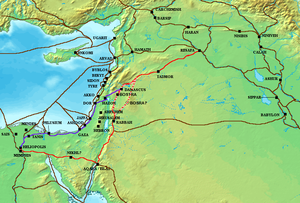 |
| The Via Maris is in purple. The King's Highway, mentioned in Numbers 20:17, is in red |
Search for more information about mistakes our Rabbis made at 4torah.com.
More on Sarah's stupidity, hypocrisy
Slate's John Dickerson:
Palin effectively quoted Ronald Reagan arguing that the criminal alone is responsible for the crime. "Acts of monstrous criminality stand on their own. They begin and end with the criminals who commit them," she said. Good. Then she went on to say that "journalists and pundits should not manufacture a blood libel that serves only to incite the very hatred and violence they purport to condemn." Bad. You can't argue that words don't create criminals and then argue in the next breath that, actually, yes, they might.
A very good catch, that does much to show just how cynical this woman is. Words are just words when she uses them, apparently, but dangerous weapons in the hands of her opponents. The fact that she was able to flip-flop so completely in the space of one paragraph when reading from a prepared script, says a lot about how the woman's neurons misfire.
Likewise a comment this morning from my old friend Akiva shows how her supporter's neurons also misfire. He writes: The fact that a private person with no political office gets this amount of attention for her statements is astounding. And her down home forthright method of approaching issues speaks much better to the average American than the normal political drivel.
First, Sarah isn't a private person. She's a public figure, who uses social networking to beg for our attention. Second, the attention she gets is mostly from the brain-dead masses who think her incomprehensible drivel is "forthright". (Seriously, Akiva, did you actually just say that? Forthright? Are you really unable to identify cynical political pandering to the very worst sort of American fears and prejudices when you see it?) Third, if you and the yokels would just ignore Sarah instead of drooling all over her FaceBook page we wouldn't have to waste time pointing out to you again, and again why she is wrong. Continues Akiva:
The good news for DovBear, Sarah Palin is going to be around for a while and very likely make it to the presidency. She'll be giving this blog much to write about in the years to come.
Yes, yes. The though of America being led by someone who quit because she found governing Alaska too stressful is definitely Good News. If she can't handle a state that's smaller than 20 American cities I'm sure she'll do great in the Oval Office.
Another very excellent item from Slate's William Saletin, reprinted in full, after the jump. A must read for people who, like Akiva, can't understand why Sara's statement yesterday was hypocritical in the extreme:
Palin effectively quoted Ronald Reagan arguing that the criminal alone is responsible for the crime. "Acts of monstrous criminality stand on their own. They begin and end with the criminals who commit them," she said. Good. Then she went on to say that "journalists and pundits should not manufacture a blood libel that serves only to incite the very hatred and violence they purport to condemn." Bad. You can't argue that words don't create criminals and then argue in the next breath that, actually, yes, they might.
A very good catch, that does much to show just how cynical this woman is. Words are just words when she uses them, apparently, but dangerous weapons in the hands of her opponents. The fact that she was able to flip-flop so completely in the space of one paragraph when reading from a prepared script, says a lot about how the woman's neurons misfire.
Likewise a comment this morning from my old friend Akiva shows how her supporter's neurons also misfire. He writes: The fact that a private person with no political office gets this amount of attention for her statements is astounding. And her down home forthright method of approaching issues speaks much better to the average American than the normal political drivel.
First, Sarah isn't a private person. She's a public figure, who uses social networking to beg for our attention. Second, the attention she gets is mostly from the brain-dead masses who think her incomprehensible drivel is "forthright". (Seriously, Akiva, did you actually just say that? Forthright? Are you really unable to identify cynical political pandering to the very worst sort of American fears and prejudices when you see it?) Third, if you and the yokels would just ignore Sarah instead of drooling all over her FaceBook page we wouldn't have to waste time pointing out to you again, and again why she is wrong. Continues Akiva:
The good news for DovBear, Sarah Palin is going to be around for a while and very likely make it to the presidency. She'll be giving this blog much to write about in the years to come.
Yes, yes. The though of America being led by someone who quit because she found governing Alaska too stressful is definitely Good News. If she can't handle a state that's smaller than 20 American cities I'm sure she'll do great in the Oval Office.
Another very excellent item from Slate's William Saletin, reprinted in full, after the jump. A must read for people who, like Akiva, can't understand why Sara's statement yesterday was hypocritical in the extreme:
Wednesday, January 12, 2011
How outrageous that Sarah Palin thinks the criticism she has received amounts to a blood libel....
...when it was obviously much more like an atom bomb dropped on Nagasaki.
Slate's William Saliten said this earlier today and I am happy to repeat it: Sarah Palin is a hypocrite. In her now famous blood libel video she made some hippie remark about how entire communities must never be blamed for the violent acts of the few. Uh huh. Well what about when the violent few are Muslims, Sarah? Hmm? What then?
As Saliten reminds us it was stupid Sarah who first made the ground zero mosque into a political issue, and she also refused to let up even after the mosque's imam denounced terror on national T.V. Sarah didn't care about the facts. No matter how much effort reasonable people put into explaining elementary points to her, she continued to use her Twitter and Facebook accounts to call on real Americans to do the honorable thing i.e hold all Muslims responsible for the acts of a violent few. I'm not so crass or insensitive as to refer to what Sarah did as a "blood libel" but an ordinary libel it most certainly was.
Search for more information about [topic] at 4torah.com.
Slate's William Saliten said this earlier today and I am happy to repeat it: Sarah Palin is a hypocrite. In her now famous blood libel video she made some hippie remark about how entire communities must never be blamed for the violent acts of the few. Uh huh. Well what about when the violent few are Muslims, Sarah? Hmm? What then?
As Saliten reminds us it was stupid Sarah who first made the ground zero mosque into a political issue, and she also refused to let up even after the mosque's imam denounced terror on national T.V. Sarah didn't care about the facts. No matter how much effort reasonable people put into explaining elementary points to her, she continued to use her Twitter and Facebook accounts to call on real Americans to do the honorable thing i.e hold all Muslims responsible for the acts of a violent few. I'm not so crass or insensitive as to refer to what Sarah did as a "blood libel" but an ordinary libel it most certainly was.
Search for more information about [topic] at 4torah.com.
Son in law gifts
Nowadays, you're considered a heel and a boor if you don't welcome your daughter's fiancee into the family with a complete set of the Talmud Bavli, Vilna edition. This can run several hundred dollars and as a gift its absurdly impractical. Your average twenty-something punk is usually not into learning and when he's ready to settle into a nice middle age Daf Yomi shiur to make friends and impress neighbors he'll probably use the Artscroll anyway. The rare son-in-law who actually does want to spend his time leaning over a Gemarah likely already has the books he needs or easy access to them and likely won't ever use most of the volumes in the complete set. I mean who learns Zevachim outside of a Daf Yomi aside from the rare scholar who, sorry, is probably not marrying your daughter. Besides, volumes from the fancy sets are much too heavy to shlep around and look best sitting on the shelf -which is of course the whole point of the exercise.
We Jews like to pretend we're scholars and we like to pretend our daughters are marrying scholars. It's why every ignoramus is supposed to give a learned sounding speech at his sheva brochos and why those same ignoramuses receive expensive books that ultimately end up as living room or study decorations that attempt to proclaim to all that their owner is a scholar, but in reality announce only that he has a father-in-law who follows convention.
When it's my turn, the son-in-law can have an IPad shas. It's lightweight, searchable, and costs about thirty bucks. Best of all it immediately let's the young man know that he shouldn't look to me for financial support. That, my friends, is called setting the tone from the outset. Try doing that with a leather bound shas.
We Jews like to pretend we're scholars and we like to pretend our daughters are marrying scholars. It's why every ignoramus is supposed to give a learned sounding speech at his sheva brochos and why those same ignoramuses receive expensive books that ultimately end up as living room or study decorations that attempt to proclaim to all that their owner is a scholar, but in reality announce only that he has a father-in-law who follows convention.
When it's my turn, the son-in-law can have an IPad shas. It's lightweight, searchable, and costs about thirty bucks. Best of all it immediately let's the young man know that he shouldn't look to me for financial support. That, my friends, is called setting the tone from the outset. Try doing that with a leather bound shas.
Perhaps the Way Segulos Were Intended
A Guest Post By E. Fink
Typically, the segula debate is a polarizing venture, pitting (for lack of better terminology) rationalists against mysticists. The mysticists fully believe in the power of segulos. They think some may be more powerful than others, but in the end, they all work. On the other side of the ledger are the rationalists who are more skeptical of the power of segulos. I assume they don't believe in their efficacy and therefore do not participate in mass segula events like Parshas Ha'mon.
I think both of these approaches are wrong.
Unoriginal observations about Tucson I wish to share
I suppose it is true that some on the left used the Tucson massacre to bash Sarah Palin. Largely this bashing of Sara was committed by people who dislike her and regularly mock her. Whatever was said about her post-massacre was not opportunistic but business as usual.
We saw the exact same thing after a gunmen shot up Fort Hood. If its true that the left used Tucson to point out that Sara and her coevals have injected unprecedented toxicity into the political discourse, it doubly true that the right used Fort Hood to push for the acceptance of pet policies in the name of national security. For the right, every Fort Hood style attack is Christmas because until the dust clears the right gets to bash Arabs, push for further limits on personal freedom, denounce democrats as soft terror, and strut around like some martial peacock of old using get-tough rhetoric.
Sauce. Gander. Goose.
Search for more information about rw double standards at 4torah.com.
We saw the exact same thing after a gunmen shot up Fort Hood. If its true that the left used Tucson to point out that Sara and her coevals have injected unprecedented toxicity into the political discourse, it doubly true that the right used Fort Hood to push for the acceptance of pet policies in the name of national security. For the right, every Fort Hood style attack is Christmas because until the dust clears the right gets to bash Arabs, push for further limits on personal freedom, denounce democrats as soft terror, and strut around like some martial peacock of old using get-tough rhetoric.
Sauce. Gander. Goose.
Search for more information about rw double standards at 4torah.com.
Tuesday, January 11, 2011
Parsha Notes Beshalach 5771
What everyone should know
When God leads the Jewish people out of Egypt, in the beginning of this week’s parsha, He takes them the ‘long way,’ purposely bypassing the shorter route since it would lead through the land of the Philistines. Rmbam and Ramban argue about the significance of this in ways that relate to the underlying philosophy of commandment-keeping.
As you may have noticed, the Song of the Sea says nothing about the sea being split. What this might mean is discussed here.
Much much more after the jump
When God leads the Jewish people out of Egypt, in the beginning of this week’s parsha, He takes them the ‘long way,’ purposely bypassing the shorter route since it would lead through the land of the Philistines. Rmbam and Ramban argue about the significance of this in ways that relate to the underlying philosophy of commandment-keeping.
As you may have noticed, the Song of the Sea says nothing about the sea being split. What this might mean is discussed here.
Much much more after the jump
Parsha Notes Beshalach 5771
What everyone should know
When God leads the Jewish people out of Egypt, in the beginning of this week’s parsha, He takes them the ‘long way,’ purposely bypassing the shorter route since it would lead through the land of the Philistines. Rmbam and Ramban argue about the significance of this in ways that relate to the underlying philosophy of commandment-keeping.
As you may have noticed, the Song of the Sea says nothing about the sea being split. What this might mean is discussed here.
Great moments in Parshanut
The gift of the mon is described by the bible as a test, and the Rishonim give five different explanation of what the test might have been. Suggestions include: (1) Would the Israelites refrain from taking mon on Shabbos (Rashi) (2) Would they trust the strange food? (Ramban) (3) With their needs supernaturally fulfilled, would the Israelites put their free time to good use? (Sforno)
Why did Moshe's hands become heavy? (1) Because he sinned by appointing Joshua to lead the war (Rashi) (2) Because he sinned by putting the war off until the next day (TPJ) (3) For assuming the supernatural protections had ended, as evidenced by his decision to appoint Joshua (Lubovitcher Rebbe)
Internal Parallels
When God leads the Jewish people out of Egypt, in the beginning of this week’s parsha, He takes them the ‘long way,’ purposely bypassing the shorter route since it would lead through the land of the Philistines. Rmbam and Ramban argue about the significance of this in ways that relate to the underlying philosophy of commandment-keeping.
As you may have noticed, the Song of the Sea says nothing about the sea being split. What this might mean is discussed here.
Great moments in Parshanut
The gift of the mon is described by the bible as a test, and the Rishonim give five different explanation of what the test might have been. Suggestions include: (1) Would the Israelites refrain from taking mon on Shabbos (Rashi) (2) Would they trust the strange food? (Ramban) (3) With their needs supernaturally fulfilled, would the Israelites put their free time to good use? (Sforno)
Why did Moshe's hands become heavy? (1) Because he sinned by appointing Joshua to lead the war (Rashi) (2) Because he sinned by putting the war off until the next day (TPJ) (3) For assuming the supernatural protections had ended, as evidenced by his decision to appoint Joshua (Lubovitcher Rebbe)
Internal Parallels
Exodus 17:13 says Joshua overwhelmed the Amalekites using the word וַיַּחֲלֹ֧שׁ; in Deuteronomy when Amalek's attack on Israelite stragglers is recalled the word used is הַנֶּחֱשָׁלִ֣ים. (Robert Alter)
The Song of the Sea is introduced with the phrase אָ֣ז יָשִֽׁיר־; forty years later when the sun stands still Joshua celebrates the miracle with a song that begins with the phrase אָ֣ז יְדַבֵּ֤ר.
All of Egypt's male warriors die at the sea; earlier in the story Pharaoh sentenced all male Israelite infants to death by drowning. (Rashi)
The text announces that Miriam is a witness at the water when Moshe is saved, and again when he splits the Sea. (Everett Fox)
Women are depicted as celebrating a military victory at the Sea and also in the Book of Samuel.
The wind blowing on the water, followed by a division between the sea and land is strongly reminiscent of the beginning of creation. (and the Lord led the sea with the strong east wind all night, and He made the sea into dry land and the waters split.)
External Parallels
In the Song of the Sea God is called a Man of War. In Canaanite poetry he is also represented as a warrior
Word play
Throughout the Exodus story, the word Kaved is used to describe the labor, and the king's heart. Later it is also used to describe Moshe's hands.
Contra Midrash
Who was first into the water? Sota 36b gives two opinions, quoting one Tanna who says Nachshon ben Aminadav of the tribe of Judah was first into the water, and another who says the glory should go to the entire tribe of Benjamin.
What is the significance of the famous fleshpots (flesh being an old English word for meat)? Mechilta says the Israelites ate well when they were slaves; Shmos Raba says they merely sat by the fleshpots, smelling the food, but were not allowed to take from it.
Number Games
The Israelites rest at a spring that has 12 streams and 70 trees; both are magic numbers in the bible
The word "yad" appears exactly 7 times in the Amelek episode. (Cassuito)
When the Jews complain to Moshe in Exodus 14:11-12 Egypt is mentioned 5 times, and the wilderness is mentioned twice.
Symbolism
Passing between walls of water is a strong bit of birth imagery. (Ilana Pardos)
Style
When Pharaoh has his back against the wall his speech is short and urgent. וַיְמַהֵר פַּרְעֹה לִקְרֹא לְמֹשֶׁה וּלְאַהֲרֹן וַיֹּאמֶר חָטָאתִי לַיהוָה אֱלֹהֵיכֶם וְלָכֶם׃ [Exodus 10:16] At other points in the story, he demonstrates confidence and imperiousness by speaking in verse: ואמר פרעה לבני ישראל נבכים הם בארץ סגר עליהם המדבר׃ [Exodus 14:3]
Narrative units in the Bible are frequently bookended with long poems. The Song of the Sea marks the conclusion of the Exodus story, and the beginning of the Wilderness tales.
Ashira l'hashem is consistent with ANE literary convention of making announcements at the beginning of poems. (Alter)
Which parts of the Song are really parts of the poem, and which are not?
Anachronisms
horse and rider may be an anachronism: At the time Egypt used chariots, not cavalry.
Puns
Kee goah goah is a great pun. It means "to be exalted" and is also the word for a sea surge.
Curiosities
We're told all of of Israel sang at the Sea. How did everyone know the words?
In Exodus 14:13 Moshe promises the Israelites that Egypt will never afflict them again, yet Egypt is depicted throughout the Book of Kings as a threat.
Historicity
Exodus 13:17 says: It came to pass when Pharaoh let the people go, that God did not lead them [by the] Way of the Land of the Philistines for it was near, because God said, Lest the people reconsider when they see war and return to Egypt. The "Way of the Land of the Philistines" was a fortified coastal highway, lined with armed Egyptians deployed there to protect the trade route. (Nahum Sarna)
Inside Rashi's Bes Medresh
Exodus 13:17: "...for it was near and it was easy to return by that road to Egypt. There are also many aggadic midrashim [regarding this]. "What are those midrashim?
(a) for it was too near (in time) to the promise Abrahma had made Abimelch [See Gen 20]
(b) For it was too near (in time) to when the Canaanites had taken the land, and they weren't yet deserving of genocide/expulsion etc.
Why doesn't Rashi use these midrashim to interpret the verse? Because they don't solve text problems.
Exodus 14:21 "...and the waters split All the water in the world." — [from Mechilta Exod. Rabbah 21:6]
Why does Rashi say this? Look at the verse: And Moses stretched out his hand over the sea, and the Lord led the sea with the strong east wind all night, and He made the sea into dry land and the waters split.
The verse uses the word "sea" three times, but when the miracle happens the language switches and we're told "the waters split."
(Whether or not Rashi actually thought every body of water in the world split at that moment is left as a question for the reader) (I think he's just proposing a solution to what some might see as a textual anomaly. I don't think he's attempting to provide a history lesson.)
A polite reminder for the Orthodox clergy: In your speeches this shabbos, please do not tell us that Moshe or the Jewish people "sang Az Yoshir." We know what you mean, but its imprecise. The first words of the song are not "az yashir" but "Ashira l'hashem kee goah goah" and the proper name of the song is "Shirat Hayam"
Search for more information about Beshalach at 4torah.com.
The Song of the Sea is introduced with the phrase אָ֣ז יָשִֽׁיר־; forty years later when the sun stands still Joshua celebrates the miracle with a song that begins with the phrase אָ֣ז יְדַבֵּ֤ר.
All of Egypt's male warriors die at the sea; earlier in the story Pharaoh sentenced all male Israelite infants to death by drowning. (Rashi)
The text announces that Miriam is a witness at the water when Moshe is saved, and again when he splits the Sea. (Everett Fox)
Women are depicted as celebrating a military victory at the Sea and also in the Book of Samuel.
The wind blowing on the water, followed by a division between the sea and land is strongly reminiscent of the beginning of creation. (and the Lord led the sea with the strong east wind all night, and He made the sea into dry land and the waters split.)
External Parallels
In the Song of the Sea God is called a Man of War. In Canaanite poetry he is also represented as a warrior
Word play
Throughout the Exodus story, the word Kaved is used to describe the labor, and the king's heart. Later it is also used to describe Moshe's hands.
Contra Midrash
Who was first into the water? Sota 36b gives two opinions, quoting one Tanna who says Nachshon ben Aminadav of the tribe of Judah was first into the water, and another who says the glory should go to the entire tribe of Benjamin.
What is the significance of the famous fleshpots (flesh being an old English word for meat)? Mechilta says the Israelites ate well when they were slaves; Shmos Raba says they merely sat by the fleshpots, smelling the food, but were not allowed to take from it.
Number Games
The Israelites rest at a spring that has 12 streams and 70 trees; both are magic numbers in the bible
The word "yad" appears exactly 7 times in the Amelek episode. (Cassuito)
When the Jews complain to Moshe in Exodus 14:11-12 Egypt is mentioned 5 times, and the wilderness is mentioned twice.
Symbolism
Passing between walls of water is a strong bit of birth imagery. (Ilana Pardos)
Style
When Pharaoh has his back against the wall his speech is short and urgent. וַיְמַהֵר פַּרְעֹה לִקְרֹא לְמֹשֶׁה וּלְאַהֲרֹן וַיֹּאמֶר חָטָאתִי לַיהוָה אֱלֹהֵיכֶם וְלָכֶם׃ [Exodus 10:16] At other points in the story, he demonstrates confidence and imperiousness by speaking in verse: ואמר פרעה לבני ישראל נבכים הם בארץ סגר עליהם המדבר׃ [Exodus 14:3]
Narrative units in the Bible are frequently bookended with long poems. The Song of the Sea marks the conclusion of the Exodus story, and the beginning of the Wilderness tales.
Ashira l'hashem is consistent with ANE literary convention of making announcements at the beginning of poems. (Alter)
Which parts of the Song are really parts of the poem, and which are not?
Anachronisms
horse and rider may be an anachronism: At the time Egypt used chariots, not cavalry.
Who is like you among the gods possibly indicates that the Israelites weren't quite yet monotheists when then song was first composed.
You will bring them and plant them in the mountain of Your inheritance, The place, O LORD, which You have made for Your dwelling, The sanctuary, O Lord, which Your hands have established seems like a clear reference to the Temple, and can be understood as either prophesy or evidence of later tampering. Sarna, incidentally, uses this to explain away the problem of the too-large multitude that was said to have participated in the Exodus.
As is well known, (see this and this) (and don't miss serious counterarguments in the comments) nothing that we know about the ancient world, and nothing that archaeologists have found in the Sinai lends even an iota of support to the idea that 600,000 (or 3 million) people left Egypt. Sarna's solution is ingenious. He says that Temple in Jerusalem was the point, or goal of the Exodus. At the time the Temple was built, the population in Israel was about 600,000. Saying that 600,000 left Egypt is a literary way of connecting the Exodus with the Temple, similar to how even the children of immigrants speak of their "American forefathers.
Rashi and Ramban read a verse to accommodate their belief in spontaneous generation
Rashi and Ramban read a verse to accommodate their belief in spontaneous generation
Puns
Kee goah goah is a great pun. It means "to be exalted" and is also the word for a sea surge.
Azi v'zimras is another pun. Zimrah means both song and power.
Curiosities
We're told all of of Israel sang at the Sea. How did everyone know the words?
In Exodus 14:13 Moshe promises the Israelites that Egypt will never afflict them again, yet Egypt is depicted throughout the Book of Kings as a threat.
Historicity
Exodus 13:17 says: It came to pass when Pharaoh let the people go, that God did not lead them [by the] Way of the Land of the Philistines for it was near, because God said, Lest the people reconsider when they see war and return to Egypt. The "Way of the Land of the Philistines" was a fortified coastal highway, lined with armed Egyptians deployed there to protect the trade route. (Nahum Sarna)
Inside Rashi's Bes Medresh
Exodus 13:17: "...for it was near and it was easy to return by that road to Egypt. There are also many aggadic midrashim [regarding this]. "What are those midrashim?
(a) for it was too near (in time) to the promise Abrahma had made Abimelch [See Gen 20]
(b) For it was too near (in time) to when the Canaanites had taken the land, and they weren't yet deserving of genocide/expulsion etc.
Why doesn't Rashi use these midrashim to interpret the verse? Because they don't solve text problems.
Exodus 14:21 "...and the waters split All the water in the world." — [from Mechilta Exod. Rabbah 21:6]
Why does Rashi say this? Look at the verse: And Moses stretched out his hand over the sea, and the Lord led the sea with the strong east wind all night, and He made the sea into dry land and the waters split.
The verse uses the word "sea" three times, but when the miracle happens the language switches and we're told "the waters split."
(Whether or not Rashi actually thought every body of water in the world split at that moment is left as a question for the reader) (I think he's just proposing a solution to what some might see as a textual anomaly. I don't think he's attempting to provide a history lesson.)
A polite reminder for the Orthodox clergy: In your speeches this shabbos, please do not tell us that Moshe or the Jewish people "sang Az Yoshir." We know what you mean, but its imprecise. The first words of the song are not "az yashir" but "Ashira l'hashem kee goah goah" and the proper name of the song is "Shirat Hayam"
Search for more information about Beshalach at 4torah.com.
Subscribe to:
Posts (Atom)