Support the Pathetic Annual Telethon

I give up. The previous links didn't work. Please use this button instead.

Novelty Song of the Century!


Tuition Wrap up


What follows are some of the points made on the school administrator's post, that must be re-emphasized.

(1) Schools take money for services, yet claim they aren't businesses. This strikes me as just an excuse to continue doing things wrong. We're not a business, goes the argument, so how can you expect us to create sound budgets, pay people on time, or rigorously enforce tuition contracts with deadbeat parents? It offends the egos of school administrators to hear this, but you're a business just like the landscaper or the pizza shop, and too often this ego is an obstacle to sound business practices. You have to run your schools professionaly, and "we're not a business" is no excuse. 

(2) Schools run roughshod over parents instead of treating them like customers. Examples of this include, (a) absurd vacation schedule, like closing on isru chag and the week before Pesach. This creates extra expenses and major inconvenience for parents. We manage to make Pesach without taking off for a week in advance. So can you, and your teachers. (b) Creating policies that satisfy the loudest and craziest parents, and not parent body in general (c) Creating policies without consulting the parents, or making any real effort to find out our needs, desires and preferences.   If you want our money, make us feel like you're listening to us and like you understand our situation

(3) Not paying teachers on time is a terrible thing and there is no excuse for it and not just because violating this halacha destroys your credibility. (Who they hell are you to tell us how our kids, and even our wives, are required to dress, if you're going to give yourself a free pass on this biblical rule? Do you serve ham in the cafeteria just because its easier?) If you can't find a way to pay your teachers on time, you don't deserve to exist. That's the litmus test. Plain and simple Create real budgets and do an adequate job at the hard work of fundraising and collections, or close your doors and vanish into the night. There are too many schools, as it is. If you're redundant and poorly managed, you're not doing anyone any favors by sticking around via violations of halacha. Just disappear.  

(4) If you're a wimp at collections, you are screwing the parents who pay on time. Every business in the world has collection problems, and you are not unique nor deserving of sympathy. You have to be firm and responsible about chasing down the deadbeats. That's part of your job and, sorry, but this means lawyers and collection agencies, and even lawsuits. It also means tossing out parents who stiff you. To do otherwise, is to abdicate your responsibility to the parents who meet their obligations.

(5) Stop thinking of scholarships as charity. That's not what they are. A school is in the business (yes business) of providing students with an "educational experience." Giving certain students a discount on tuition to ensure their attendance is a way to improve the "educational experience". Depending on your school, you may need smarter students, or nicer students, or students who are better athletes. Its okay to pay to acquire those types of students in the form of tuition breaks. Its also okay to give breaks to parents who provide services to the school. No-talent parents of undistinguished children who can't afford your school should be directed to a bank or a gmach or to a mosad that specializes in helping destitute parents cover tuition. We don't ask the grocer to subsidize poor people, do we? Instead we refer poor people to Masbiah, or Tomchei Shabbos, or any of a dozen other charities. The same sort of thing should exist for education. The schools should not be in the business of handing out charity. (Additionally, a mossad dedicated to the proposition that every Jewish child deserves a yeshiva education is much "sexier" than a mismanaged school that doesn't pay people on time, coddles pedophiles, and never paints the walls or paves the driveway.)

(6)  Parents are entitled to take vacations, drive nice cars, and send their kids to camp. We're not required to pay the schools full tuition before we can do anything else. We're allowed to negotiate with the schools, the same way we negotiate for houses, and cars, and any other big ticket item. Once an agreement is reached, we're required to meet it, and on time. But the idea that we're not entitled to any kind of discount before we downsize the car or cancel camp is wrong. Maybe. Mister Administrator, you shouldn't get your salary until you've done the same? Sacrificing for Torah should apply to you, too.

(7) Jewish schools are not nearly as excellent as they think they are. Some clues: (a)  Excellent educators don't need to work in crummy yeshivot that don't pay on time, and that offer no career development (b) Excellent schools don't employ the pedagogical methods of the shtetl. (c) Excellent schools have labs, and enrichment and trips and top tier facilities (d) Excellent schools are run by people who have either attended excellent schools, or go to conferences where they can exchange ideas with the managers of excellent schools (e) excellent schools are accredited. (f) excellent schools employ professional managers who know how to create real budgets, raise money, and make collections. (9) excellent schools have a host of prestigious alumni If your school does/has none of these things -news flash!- its not excellent.

(8) Parents who can't afford yeshiva should take responsibility for their situation.  If you can't afford a Lexus, you get a Honda. If you can't even afford that you take the bus, right? Yeshiva should be the same. Here are your choices (1) Successfully negotiate for a discount with the school, and I mean a discount you can afford to pay on time! (2) Find a cheaper school. (3) Choose public school. As a community, we need to wrap our heads around the idea that public school is a real option. Sending your kids to public school is not the end of the world. S/he can still grow up frum. 

(9)  Your tuition has no basis in reality. How do you realistically expect parents to pay $10K/kid in a world where the average income is less than 100K? Does every school administrator live in a fantasy land? Setting budgets, and hiring teachers with the expectation that people have that kind of money is a recipe for disaster. If your budget depends on collecting those tuitions, your budget is a joke!

Search for more information about [topic] at 4torah.com.

Why did God ban idols? My answer*


Read this post first.

Before we can understand why the Torah banned images of God, we must first understand what purpose those images served.  For a very long time, scholars couldn't accept that the statues found all over the middle east were though by their devotees to be actual gods. Their original consensus was that these idols of stone and clay were representations of the deity and something upon which the worshiper could focus his devotion. The worshiper knew, the theory went, that the god was off somewhere, and not the statue itself. Today, following the uncovering of reams of old texts, this theory is largely out of favor. No longer do scholars think that the idol was merely reminder of the god; today they mostly accept that the statue was thought to be something like a container for the god. 

Even this is hard for us to fathom. It sounds primitive and ridiculous, yet the evidence from the old texts seems clear. Based on their interpretations of these texts, James Kugel and others, propose that men and women of the ANE conceived of their gods as something of a celebrity, all powerful superhero. These gods usually lived in a sort of parallel reality, a dimension superimposed over this world, where they did their daily work of pulling the levers and pushing the buttons that made rain fall, and crops grow and so on. Occasionally, the gods would, forsome reason or another, take human form and pop into our world for a visit. Various OT narratives are thought by scholars to tell these types of stories. Gideon, for example, is minding his own business when he's greeted by a man. After a few moments of confusion, he recognizes that he's actually speaking to God, and falls on his face. Sarah laughs at something she hears the 3 guests say, but the verse tells us that it is God who objects, and the story of their visit is introduced with the words, "And God appeared to Abraham".  Many more example could be supplied.** Even if we must reject the notion that the biblical stories mean anything other than what later interpreters said they mean, there still exists plenty of evidence from other, extra-biblical texts, that this is how gods were thought to operate in the broader ANE culture. The case, Kugel says, can be made without the Bible. 

If you wanted to encourage these types of meetings, there were a few things you could do. One approach was to build the god a house, and entice him to visit with grilled meat and sweet smelling incense. This is believed to be the idea behind the ANE Temples that have been uncovered, and the rites performed in these Temples as described in various texts. Sacrifice, which predates Temples, of course,  may have been, in the ANE, an attempt to share a meal with a god. Another approach was the statue. If you built it correctly, the theory went, the god would come and dwell in it for a while. 

The God of Israel, however, was different. Or, as the scholars might put it, at some point the people of Israel began to think about Him differently. Though archeologists working in Israel and the fertile crescent have uncovered  hundreds if not thousands of statues, fewer than five have inscriptions which identify them as images of YKVK, and those are among the very oldest. The absence of these types of statues is surely significant. What it means, the scholars suggest, is that at some very early moment, the Israelites began to think of their God as one that could not be contained in something as petty as a statue. Or if you prefer, the God of Israel, via His dictation to Moses, made it perfectly clear to his people that He, unlike the other, more familiar gods, would never take up residence in a stone doll.  

6 of one, half dozen of the other....

---
 * Not really my answer, but an amalgamation of many answers.

** The narratives include: Gideon's call, the announcement of Shimshon's birth, Jacob's wrestling match with the man/angel, Abraham's 3 visitors, Joshua's encounter with the captain of YKVK's army, among many others. Though I'm discussing how scholars regard these stories, I'm also attempting to remain sensitive to how the stories are understood by the rabbinic interpreters.


Search for more information about idol worship at 4torah.com.

A word to JENNIFER IN MAMALAND


An anonymous guest post by a Yeshiva Administrator in response to Tuition pain-Tuition payin'

This is easily my hardest job as a school administrator and I wish it would come only once a year. Tonight, tomorrow and the day after will mark the umpteenth time I have had been trying to collect unpaid tuition dollars so that I can honor my institutional commitments to our faculty.

Yes, we are behind on salary payments to our devoted and talented staff. It is aggravating. It is humiliating. It is sleepless nights and dread filled days wondering how we can keep it all going. It is worse than the impending dental work looming over my head and making me fear the pain that is to come. I am hung up upon, avoided, talked about and/or even accused of misappropriation of funds (our books our open and fully transparent). And here I am at someone’s door again or calling on their cell phone to ask them to pay their bill for the excellent education my institution provided their child(ren) this past year.

See me, Hear me? On my knees. Pleeeeeeeease?

I am curious, do you negotiate with the butcher, the shoe store, the dress shop or the cashier at Walmart regarding price. So why does everyone negotiate with me?
Did you forget that scholarships are actually tzedakah funds you are asking for and/or receiving? They are.

I am truly sorry that Jennifer in Mamaland is offended or uncomfortable but we are talking about distribution of hard found tzedakah monies. Yes, scholarships are necessary. But we all need a reminder that it is personal charity which is funding these tuition grants and the sources for funds are fewer and fewer. The community has a responsibility to verify the veracity of the need before tzedaka funds are distributed, thus the forms, the questions and the committee reviews.

To those recalcitrant in honoring their commitments, I ask; do you pay your grocery bill? Your mortgage? Will you pay for that dreaded impending dental work bill? I am sure you will. So why not your tuition bill? I don’t mean, that you should pay more than you agreed to pay. I mean, just pay what you’re contract indicates you were going to pay. Don’t you realize that our budget is so tight that we count on the commitment you made to pay our bills?

Weren’t you the one that demanded educational excellence, good teachers and extra curricular programming so your child could grow and develop his/her mind, talents and skills. Why is school not your first priority for spending or rather investing (is there a better investment than a good Torah education?).

Funny, we are not a poor school just a patient and kind one. And yet somehow we are taken advantage of. Not by all, but by a more than a few who ruin it for everyone else.

Sadly and surprisingly, tuition just isn’t the priority it was for my parents and grandparents who were moser nefesh for my siblings and I to receive a Day School education.

Today the “sexy tzedakos” are all the rage. Schools are at the bottom of charity lists of the big renowned philanthropists, communal leaders and personal ma’aser accounts. Publicity garnering, headline making charities are where most tzedakah monies are headed. This, despite the fact, that they are not necessarily Shulchan Oruch approved or hierarchically appropriate. Indeed, kavod, as it frequently does, corrupts priorities. See Shulchan Oruch YD249:16 where funding children to learn is set as one of the two highest priorities for charity. Financial support of day schools and kal v’chomer tuition, certainly comes before summer camp, Pesach at the hotel and a brand new late model SUV in the driveway.

Help return the education of our youth into the priority it should be. In addition, I beg of you, once scholarships are granted, please honor them and pay your bill on time. People’s livelihood, peace of mind and your children’s education depend on it.

And, by the way, we actually do use the short form – it doesn’t change a thing.


Search for more information about school days  at 4torah.com.

Tuition pain = Tuition payin'


A GUEST POST BY JENNIFER IN MAMALAND

This is easily my hardest job as a parent, and it comes once a year. Tonight will mark the ELEVENTH year in a row that I have had to beg my kids' schools to let us not pay the $10,000-plus tuition bills in their entirety.

It is aggravating. It is humiliating. It is worse than impending dental work for looming over my head and making me fear the pain that is to come.

Read the rest of Jennifer's poste after the jump

Why did God ban idols?


What does God, creator of the world and all it contains, have against idols? Sure, I can understand why He'd be against our depicting rival gods in stone or wood - jealous God and all that - but why shouldn't we be allowed to make images of Him?

It can't be because he has no form. Though post biblical interpreters for the most part* explained away their implications, the Hebrew Bible has dozens of verses which suggest strongly that God appears and can be seen:

  • Then Solomon began to build the temple of the LORD in Jerusalem on Mount Moriah, where the LORD had appeared to his father David. - 2 Chron. 3:1
  • At Gibeon the LORD appeared to Solomon during the night in a dream... -1 Kings 3:5
  • The LORD appeared to Abram and said, "To your offspring I will give this land." So he built an altar there to the LORD, who had appeared to him. - Gen 12:7
  • My soul thirsts for God, for the living God, for the time when I can go and see God -Ps 42
  • You, O LORD, are among these people and you, O LORD, are seen by them eye to eye... - Num 14:14
  • They saw God, and they ate and they drank - Ex. 24:11
  • ...no one may see me and live. -- Ex 33:20 (implies rather strongly there IS something to see, only the experience of seeing it would be fatal)

If you're a Jew, with a an education like mine, you "know" none of these verses are to be understood literally, yet, it must be asked: If God, his secretaries and spokesmen were all able to speak so casually about Him having a form, why couldn't that form be depicted in art? We don't mind the verses that speak of a corporeal God because we all "know" the verses don't mean what they seem to mean. We read them with something like a wink. If we can make that mental correction when it comes to verses, why can't we make the same mental correction when it comes to statues? If I know (thanks to my fine education) that the Written Torah depicts things that aren't literally true, couldn't that same education teach me how to regard statues of God? Why was banning them necessary?

An answer, maybe, will appear in a later post.

* For the most part... Philo says Israel is called Israel from ish ra'ah El, or "a man seeing God". God also takes a human form in a great many aggadot, and there is reason to beleive that Rashi, among other Rishonim, were corprealists, too (or at least that they didn't consider it heresy to hold this view of God.) Deeply uncomfortable with these facts? That's because the victory of the Geonim and Rambam on this point was a absolutely complete.

Search for more information about the second commandment  at 4torah.com.

Sneak preview of a great new song


My friend Y-Love (Yitz Jordan)  is releasing a new song about dating, breaking-up, starting over, and the role of a rabbi in shidduch relationships.

It sounds semi-autobiographical, but Yitz isn't saying.

You can listen to a sample here. Afterwards, come back and tell me what you think: Should a rabbi be allowed to meddle in such matters? Once a happy couple is together, does their rabbi get a veto?


Search for more information about the great Y-Love at 4torah.com.

Is a "competent posek" competent in all areas?


A guest post by Rabba bar bar Chana

HSM recently posted on her blog about a problem between a lying mother and adult daughter. The subject matter is not relevant here, but suffice it to say that I agree with Hadassah and many of the commenters.

What I wanted to examine is the statement by several of the commenters that the daughter should bring her issue to a “competent posek”. This attitude is very common in the frum community, but I think it’s misplaced. Is it really the best thing to speak to a rav about the problem with her mother? Wouldn’t it make much more sense to ask a family counselor or psychologist? What makes a rav qualified to answer questions like this? He didn’t get training in dealing with such problems. He leaned gemara and shulchan aruch.

I would go to my rav for a question about whether a pot needs kashering. That’s his area of expertise. If I was having problems with a family member, I would ask advice from a therapist or family counselor. What’s behind the impulse to ask a rav about absolutely everything? I have a feeling that a lot of really bad decisions are being made because of this misplaced confidence in rabbanim.


Search for more information about poskim at 4torah.com.

The Statement of Principles


 A link to a Statement of Principles on the Place of Jews with a Homosexual Orientation in Our Community was sent to by many people last week. It appears to have been signed by many Rabbis, and perhaps your Rabbi should sign it, too. I have no way of knowing if the signatures are authentic.

Full statement with my two tiny comments after the jump

Why the women talk in shul


The women in our shul were talking all through the services yesterday. More than once I found myself thinking What a gaggle of geese. Can't they shut up?  Other man made faces, rolled their eyes, and gave little condescending shrugs. A few times, the gabbai walked to the back of the shul, and rapped on the mechitzah. That helped, but only for a moment. Then the dull hum of their chatter would start up again. "Like a horde of locusts" said my table mate.

I started to agree, when I caught myself and realized something important.

The women in our shul talk, because they're segregated into a tiny box in the back of the shul, from where they can't really see or hear anything. The mechitzah is 9 feet tall and solid wood, and the room's acoustics are such that a chzan, standing in his spot way at the front of the room, needs to project like a professional actor to be heard on the woman's side. According to my wife, its next to impossible for a woman to follow the service. If you were trapped in such a woman's section, would you find it easy to join the minyan? Our women aren't allowed to be part of the shul, so they don't act like they're part of the shul. We make it impossible for them to participate so they don't participate. And then adding insult on top of injury, we men, the architects of this unhappy situation, decide that women are uninterested in davening and incapable of keeping their mouthes shut, and therefore require nothing more than a little room, with no view and bad acoustics.

Here's how it works. In a shul like mine, women are treated like second class citizens, so they act like second class citizens, so we men think of them as second class citizens, so we treat them like second class citizens and round and round it goes. Neat, huh? Where did this start, and how does it end? Can the cycle be broken?


Search for more information about self fulfilling prophecies of our own creation at 4torah.com.

Rav Eliyahu zt"l and the beis din of mekubalim


A Guest Post by Rafi G

Rav Mordechai Eliyahu zt"l was by all accounts a very special rav and beloved by all factions, sectors and groups.

I read an interview, a couple of weeks ago, with his son Rav Shmuel Eliyah, the Chief Rabbi of Tzfat. He said that since the death stories of his greatness have been pouring in non-stop. Some stories related miracles the rav had been involved in performing for people. Some had been stories that showed his sensitivity, caring and empathy to every person from the simplest to the greatest of people. Rav Shmuel Eliyahu said they were compiling stories into a book.

An interesting story was printed in this book that was just published. I have not seen the book, but Ynet has reported on it.

I am not going to translate it completely, but will review it briefly.

It came to light after his death that Rav Modechai Eliyahu had been a judge on a special, secret, beis din that had been formed of mekubalim. His participation was meant to be kept secret, and only after his death did the other mekubalim feel it appropriate to tell his family about it.

This beis din met once a year and debated whether or not the jewish people were "ready" for the geulah. Has the time of geulah come yet, or not.

The beis din debated it and paskened that the time for geulah has come.

I would venture to suggest that the purpose of this is a concept we have that when beis din down here in this world paskens a certain way, the beis din above in heaven follows suit and paskens the same way. If that is correct, this would have been a way to "force God's hand", kevayachol, and bring the geulah.

As part of the beis din, they kept detailed ledgers of the arguments and logics presented, along with the final decision issued by the beis din. In a very unusual move, Rav Eliyahu was buried with the folder of documentation of the proceedings of the beis din. The purpose was for Rav Eliyahu to take the folder to the beis din above and show them how they debated the issue, the logic presented, how they came to their decision, and the decision that it is time for the geulah.

This, too, would be a step in "forcing God's hand".

This was all revealed to the family right after the death, as the mekubalim had to tell them about it so that they could bury the rav with the folder.

Let us hope that Rav Eliyahu's powers of persuasion are good enough to work wonders up there!


Search for more information about mekubalim at 4torah.com.

Some questions about A Serious Man


The following relates to the video seen here.

Things I wish to know:

(1) Is Good shabbos good yomtuf as a way of saying "and it happened quickly and unexpectedly" an authentic idiom for that time and place? (For the sake of this discussion, lets call the time and place late 19th century Poland.)

(2) The old man is wearing a shtreimal on a weeknight. Is that true to the period?

(3) He confesses to having shaved his cheeks that morning. ITTTTP? Would any Jewish man of that time and place shave any part of his face?

(4) When he enters, he compliments the wife on her appearance. ITTTTP?

(5) Was ice used for anything in 19th century Poland? Especially in the middle of the winter?

(6) Why isn't Dora's head covered. ITTTTP?

(7) Dora? What kind of name is Dora? ITTTTP?

(8) Is the old man Jesus? Is that why Dora answers his kindness by stabbing him, and slamming the door on him? Before Dora's rejection, her husband was eager to share some good news, a wonder that had him quite excited. Do the Coen's believe "rational men" recognize the favor performed by the maybe-he's-dead-maybe-he's-not Jesus, while only the cold, haughty and superstitious refuse to be budged?


Search for more information about the Jews of Poland at 4torah.com.

Something sweet from the Gmail Blog


Google asked for "photos of you video chatting with your grandma." This is what they got:


The caption: Emmanuel from Israel submitted this photo and wrote "My grandmother lives in Nice, France and could not come to our wedding in Israel, this is as close as we got to having her with us."
--

Of course if you're the sort who sees Cossacks on every street corner, and evil between the lines of every news article, your maladaptive thought process probably yields the following interpretation of the photo, and its presence on the Google blog: "Leave it to those left-wing elitists at Google to embarrass a poor Jewish women by suggesting she refused to attend her offspring's wedding. What are they saying? That our grandmothers don't love us enough to go to our weddings?"


Search for more information about [topic] at 4torah.com.

Two maaseh shehayas:

It was a Friday morning in yeshiva and the Rabbi was teeing off on Darwin. "If I work out and develop muscles, that means my kid is going to have big muscles, too? If a giraffe stretches out a little bit, his child gets a longer neck? Ha. Darwin. He didn't know what he was talking about!"

It was a Monday afternoon on Twitter, and one of the yeshiva dopes was making a parade of his ignorance. "Darwin only works if there are mutations, so where are the mutations? I don't see any strange creatures with six eyes and ten legs? Where are they all?"

The scientific errors should be obvious to anyone with a ninth grade education. The rabbi was bashing not on Darwin, but on Lamarck the 18th century academic who is best rememebered today for suggesting that acquired characteristics are inherited.  No respectable scientist thinks Lamarck was right. The theory the Rabbi debunked has been out of favor for almost 150 years. Next perhaps he's denounce alchemy. The yeshiva dope has seen too many scifi movies. Scientists don't claim that dramatic and obvious mutations happen quickly. They say that small, barely noticeable mutations occur gradually over eons and eons. The ancient multi-toed horse didn't transform overnight into the modern single hoofed horse. This took million of years, and happened so slowly that even if you were to line up a million generations of mother and daughter horse skeletons you wouldn't be able to pin point the precise moment when the change occurred. 

More interesting to me than the ignorance is the arrogance. If someone with no Talmudic experience were to issue a public challenge of Torah law, both the yeshiva dope and the Rabbi would be scandalized, and rightly so. Only a fool argues a subject he hasn't studied. Yet this is what the rabbi and the yeshiva dope did. Neither of them hesitated to pontificate on a subject about which they knew less than nothing.


Search for more information about [topic] at 4torah.com.

A great ghost story, in Yiddish


Darn shame this video can't be embedded. It is the opening of the Coens' A Serious Man, and the very best bit of yiddish theater I've ever seen, a real shtetl ghost story. It features Velvel his wife Dora and, well, I shan't spoil it. Yiddish speakers, please let us know what you think of the language. Is it accurate? Does the dialog mix up dialects?Are the idioms right, specifically the delightful use of "Gut shabos, gut yomtuf!" @5:08?

I saw two anachronisms: (1) The glare of frustrated, superior, disbelief Dora gives Velvel @2:20, and (2) the hearty, "And this is Dora!" a visitor bellows jovially upon entering @3:16. I can't speak for the language, but both Dora's expression, and the guest's accent seemed briefly out of place.

What does everyone else think?


Search for more information about [topic] at 4torah.com.

The Social Implications of the Rape by Deception Case


A Guest Post By E. Fink

There is an inherent racism in the Rape by Deception case. And no, I do not mean the court is racist in its ruling.

I mean the "victim".

If the man is Israeli it is okay to sleep with him after just meeting him, but if he is Arab then it is not okay to sleep with him?

I don't doubt that she feels this way. But what is the basis for her feeling this way? If she was very religious then perhaps she is concerned with the Jewish law of "marrying" a Jew. But I don't think that is what it is.

I think it indicates a strong social aversion to Arabs in Israeli society. So strong that a woman who is willing to sleep with a new acquaintance would not do so if he was Arab.

The court is dealing with the facts on the ground. She would not have consented if she knew he was Arab. That legal issue deserves discussion. What I think is a more productive discussion is why she feels that way.

What factors are okay to consider before sleeping with a man and what factors are not okay? The court seems to think that ethnicity is important enough that her consent was voided. In Israel it is possible that it is that important.

Is it any wonder that Arabs feel 2nd Class in Israel?

I understand how and why that social reality came to exist.

I also think that perhaps it is more harmful than helpful at this point.


Search for more information about racism in Israel at 4torah.com.

Dancing at Auschwitz


A Guest Post By E. Fink

Everyone has been talking about this video. (I mean everyone, from talk radio, newspapers, the AP, the Frum News sites, etc).

From the description:
On a recent trip to Europe, a family of three generations (a Holocaust survivor, his daughter and his grandchildren) dance to Gloria Gaynor's pop song - 'I Will Survive' at concentration camps and memorials throughout Europe.

This dance is a tribute to the tenacity of the human spirit and a celebration of life.

Is it appropriate for a survivor and his family to celebrate their survival in this manner? Everyone seems to have an opinion.

When I saw it, I was not "offended", but then again, I am a 4th generation American. I have no Holocaust scars in my direct ancestry. It's possible I am not as sensitive as I ought to be about this.

Having said that, I prefer to see this family as the modern day Rabbi Akiva who laughed when he saw the great Temple in ruins. When his weeping comrades asked him how he could cry at such a sight he reminded them that just as the destruction of the Temple was predicted, so too the rebuilding of the Temple and the return from exile was predicted.

Rabbi Akiva survived and he was confident that we would survive as a people. He was confident we would survive with our hopes and dreams intact even after witnessing a horrible event like the destruction of the Temple and the deaths of the thousands of Jews living in Jerusalem. The ever present optimism for the future has been a calling card for Jewish people for two millennia and Rabbi Akiva practically invented it.

On the eve of Tisha B'Av my father told me a wonderful Torah thought. At the end of the second chapter of Makkos there is an argument between Rabbi Meir and Rabbi Yehuda. Rabbi Yehuda holds that if a man is exiled as punishment for a negligent homicide, when his term completes he cannot return to his position of authority (like prince of the tribe) that he held before his exile. Rabbi Meir holds that one returning from exile can reclaim his position of authority. Halachically we follow Rabbi Yehuda. But Rabbi Meir was the student of Rabbi Akiva. It seems that Rabbi Akiva had integrated this lesson into his worldview and taught it to his student Rabbi Meir. Rabbi Akiva had such optimism that the Jewish people would return from their exile and reclaim the lofty position in Israel, with the Temple that he laughed when he saw its destruction.

Seems to me, these folks are students of Rabbi Akiva and Rabbi Meir. We need optimism. We need hope for the future. We need to be confident in our future. Dancing at Auschwitz tells me that these folks have that optimism.


FYI: The video has been taken off YouTube several times already for "Copyright Infringement". There are new versions on YouTube but I bet they get taken down eventually as well. So I grabbed this video from WeJew.Com. It's a sad commentary on our litigious society that this video was taken down...


Search for more information about surviving at 4torah.com.

Should we really be fasting?


A guest post by Rabba bar bar Chana

In an article in Haaretz, Anshel Pfeffer claims that it’s wrong to still fast on Tisha B’Av:

“Tisha B'Av was never supposed to be an eternal day of mourning…


“For the first time in the history of the Jews, a majority of them are choosing not to live in an independent Jewish state in Zion - of their own free will…


“Mourning on the Ninth of Av in this day and age flies in the face of both secular Zionism and religious Zionism. It contradicts the right of Jews around the world to decide where they prefer to live. The exile is over, and the temple has not been rebuilt because we don't want to do it.”
He definitely has a point, (despite his silly implication in the article that we should remove the mosques from the Temple Mount.) It’s ironic to see people who live in fancy houses in Flatbush, travel to Israel on El Al several times a year, and have full religious freedoms in America begging Hashem to “end the terrible golus!”

But there’s another way of looking at it, and it’s the way I choose to look at many of our traditions. What we commemorate on Tisha B’Av isn’t just the loss of the Temple. It isn’t just a yearning for the Beit HaMikdash to be rebuilt and for sacrifices and a monarchy to be reinstituted. As DovBear pointed out a few days ago, how likely, practical, or even desirable does that really seem?

Instead, we fast because we’ve fasted for 2,000 years. We mourn for the very real people who died for being Jews throughout our long history. We fast because our parents, their parents, and their parents fasted. Looking at the tragedies of Judaism, we also gaze at our rich and varied history.

There’s a myopia sometimes, in the way that many frum people look at Judaism. It’s a focus on a history that ended 2,000 years ago, and a focus on a future that has not yet come. There’s a lack of internalizing the richness of our history and of how Judaism (and Jews) changed and evolved and grew for millennia. It’s as if all of that time was just a holding pattern and is only religiously significant in terms of what came before and the hope of what will come.

The exile created the Judaism we have today. It’s a far different religion, and we’re a far different people, than what we were in the year 70 AD. Part and parcel of that religion is fasting on Tisha B’Av. It’s not just about the destruction, it’s about who we are now, who we were 100, 500, and 1,000 years ago. The kinot we read aren’t just about the destruction. They’re also about the time they were written in, the beautiful poetry of Eliezer HaKalir in the early medieval period or the ones written in the wake of the tragedy of our times, the Shoah.

It’s also about hope. Anshel Pfeffer claims that since Eretz Yisrael is under Jewish control and we could rebuild the Temple should we choose, there’s no need to fast. But as I wrote above, yearning for the redemption isn’t just about the Temple and the monarchy. Instead, it’s about yearning and hoping for a world at peace, where war and hate are no more. It’s a vision that can transcend sectarian differences and is unencumbered by petty differences of theology. Instead it’s about hope.

And that’s why we fast.


Search for more information about why we fast at 4torah.com.

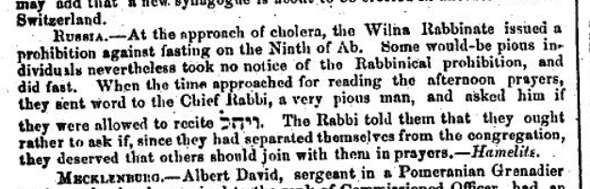
Pious Frauds


Source: http://onthemainline.blogspot.com/2010/07/canceled-fast-in-vilna-for-ninth-of-av.html
Article is the London Jewish Chronicle of October 16, 1871

Nice to see Jews are always Jews.

Hat tip Mark. Will update with source as soon as I know it.


Search for more information about [topic] at 4torah.com.

Old Posts about Tisha B'av and the Nine Days


What follows is a no-music, voices only, men only, presentation of Salamone de Rossi's Al Naharot Bavel. Who was Salamone de Rossi? Shame on you. de Rossi was a brilliant Italian composer, who in the 17th century(!) set many of our prayers to music in the baroque style.

Think of him a Lipa Smeltzer's spiritual great great great grandpappy.


Search for more information about 9 Av at 4torah.com.

God's Thoughts on Tisha B'Av


A GUEST POST BY HENOCH:

In consideration of all efforts to create and participate in meaningful programs for Tisha B’Av, it should be noted that in Sefer Zechariah Chapter 7, God's view on this subject is recorded.

Some background information: As the second Temple was being rebuilt, the Jews had been keeping the 4 fast days related to the destruction for the last 70 years. It occurred to residents of Bavel that perhaps these fasts were obsolete. After all, the Temple was being rebuilt, so why would they continue to mourn over its destruction? They assembled a delegation to go to Jerusalem where the halachic question would be brought to the leadership that still included Neviim. The answer given by God through Zechariah Hanavi is quite surprising and would be considered completely inappropriate had anyone else given that answer.

At first the question of whether to fast or not, is ignored. Then Zechariah said in the name of God that when Jews eat at times that they deem appropriate, or fast when they decide to fast, they do so because it is what they think will serve their own interests. It isn’t necessarily for the right reasons. Zechariah essentially states that our idea of fasting misses the mark and even questions its’ sincerity. He then goes further and says in the name of God what would be a more proper approach to the subject. He says that the correct approach to this problem is to
“Execute true judgment, and show mercy and compassion every man to his brother and oppress not the widow, nor the fatherless, the stranger, nor the poor; and let none of you devise evil against his brother in your heart.”
Being that the Jews ignored these basic ideas, they were exiled and scattered across the world.

Hashem is looking at us and saying, it is quite simple, and it has always been quite simple. I don’t want false piety or even grand programs that are limited to fasting and davening. If you want to do them, that is your decision. But don’t lose sight of what I want. Hashem says “I want honesty, compassion and love”.

Zechariah 7 is a treasure that should be reviewed and internalized in preparation for Tisha B’Av.


Search for more information about Tisha B'Av at 4torah.com.

Kupat Ha'Ir Blatantly Lies


A Guest Post By E. Fink

This year's Kupat Ha'Ir campaign is hilarious. It is a weak attempt at addressing the skeptics and scoffers (as they call them) and "prove" how their methods and promises are foolproof and of ancient vintage.

The 8 page propaganda piece is full of flimsy logic and scare tactics. I recommend seeing the thing for yourself, just for kicks.

My favorite part of the whole thing is the picture below. Don't they see that the caption below the photo is an obviously blatant lie?


How many other lies are in their ads...?


Search for more information about false advertising at 4torah.com.

Two more questions


The new, next, Jewish crisis


The Diaspora Need Not Apply
By ALANA NEWHOUSE
Published by The New York Times on July 15, 2010

WHO is a Jew? It’s an age-old inquiry, one that has for decades (if not centuries) provoked debate, discussion and too many punch lines to count — all inspired by what many assumed was the question’s essential unanswerability. But if developments this week are any indication, the Israeli parliament, the Knesset, might soon offer an official, surprising answer: almost no one.

Take the DovBear Survey


It is after the jump. Thanks in advance.

Important News From Monsey


A Guest Post By E. Fink

One bit of news from Monsey NY (where I am visiting for part of the summer):

A Rebbe Was Fired For Molesting a 5 Year Old Boy

This has been briefly mentioned on a couple other blogs and in the comments elsewhere. I want to publicize the swift action taken by one school (email me if you want to know which school) to fire a 70 year old rebbe who was busted for sexual abuse. He was fired after the hanhala verified the story and approached him. He eventually admitted the abuse and was given the boot immediately. Authorities were notified as well.

He is the second rebbe in as many years to be fired for a sex abuse offense at this yeshiva.

Some of the reasons I think this is important to publicize are:
  • People (victims) should know that their accusations are not going unheard. There are some schools where the hanhala is doing the right thing. This would increase the likelihood a victim will speak up.
  • Other schools should know that their competitors are weeding out the sickos and if they don't follow suit, they will be less desirable institutions.
  • Authorities and whistle-blowers will begin to try to work with our yeshivos instead of fighting them.

I am sure there are more. These are just off the top of my head.

(HT: Everyone in Monsey)


Search for more information about Monsey criminals at 4torah.com.

How dare they criticize a sitting president when we're at war?!


The very latest in Tea-Party treason:

A billboard ordered and paid for by the North Iowa Tea Party
shows President Barack Obama, Adolf Hitler, left and Vladimir Lenin.


My Gripe With the Museum of Tolerance


A Guest Post By E. Fink

I really like the Museum of Tolerance. The overall message of the museum is a message that I wholeheartedly agree with.

Tolerance is a very important value in my worldview and the museum does a super job teaching that message.

(For a more complete review of the museum read my previous post on my blog: My Visit to the Museum of Tolerance at the Simon Wiesenthal Center.)

There was one thing I noticed, or rather, did not notice that I find necessary to question and perhaps even criticize.

For all the talk and exhibits representing the horrors of racism, prejudice and segregation there was something missing. I could not help but imagine myself as a (hypothetical) average liberal, civil rights activist visiting the museum.

I am sure I would be impressed with the exhibits and their message. There is a possible segregation issue in one region of the world that is intimately related to the MOT. In fact this area is mentioned in various museum exhibits. Yet nowhere is the important civil rights issue mentioned or explored.

The region is the Middle East and specifically I am referring to Israel.

Objectively speaking, there is a level of segregation on Israel. There is a more privileged class and a less privileged class. The Jewish Israelis are the privileged class. They control the policies and laws of the country. The less privileged class are the Arab Muslims in general and in particular the Palestinians living in Gaza.

There is a wall that separates Israelis from Palestinians. There are laws that prevent some services and benefits from Gaza. In essence there is a level of segregation.

Of course, supporters of Israel explain that these measures are not segregation - they are protection. They will explain that these policies are justified. That may be true. But on its face, the situation certainly has an appearance of intolerance or racism.

I wish the Museum of Tolerance would have dealt with this issue. It should be presented and rebutted to the best of their ability. If it cannot be rebutted the museum should not be ashamed to admit that. Its omittance seems problematic to me.

The issue is in fact at the forefront of many humanitarian groups. The UN takes it very seriously as well. I would have loved to see a well reasoned, clearly articulated, intelligent response.

Instead I got nothing.

I like the museum a lot. On this issue they can do better. A lot better.


Search for more information about segregation at 4torah.com.

Something from Chaim Berlin's past they'd no doubt find embarrassing*


What follows is the coolest thing I've seen in some time, and I'm deeply indebted to Fred for finding it and putting it up on his blog. It is a Passover Haggadah, distributed by Yeshivat Chaim Berlin in 1945 and 1958 (and perhaps the intervening years too.)

* Headline aside, I really don't know if the Yeshiva, as a whole, would be embarrassed to see this online. Maybe yes. Maybe no. More after the jump.

If the Hareidim ruled us


An Iranian official shows men’s hairstyles that are promoted as permissible in Tehran’s long-running battle
against Western cultural influences and styles deemed “un-Islamic.”

Call me a fear-mongering blogger with cruel yet handsome eyes, but the photo/caption above and the accompanying article rang a few too many unpleasant bells. So did this: The Netherlands may be on the brink of its first football World Cup title, but in some parts of the Dutch Bible Belt, watching tv on a Sunday is totally forbidden...

Bans on watching TV. Bans on various clothing styles. Bans on various hairstyles. Christian, Muslim, and Jewish fundamentalist at times seem all the same, don't they?

Search for more information about bedfellows at 4torah.com.

The Times has been against Jews being in Israel since 1883


Date Published: September 23, 1883,
Article Summary: Well meaning gentiles are helping no one when they pay Jews to go to Palestine. The Jews don't want to go and when they get there its no surprise that they end up starving because Jews make lousy farmers. Also, they don't need any help from you with the emigrating. If there's one thing Jews have always known how to do on their own its emigrate. Besides, Jews contribute a hell of a lot to this country, and we don't want to lose them.  [Click on the image to enlarge it]


HT: Rabba bar bar Chana

Search for more information about how things change at 4torah.com.

What happened on 17 Tammuz?


Growing up, we always heard that everything terrible happened on Tisha B'av. The Crusades, the Holocaust, the World Wars, the expulsion from Spain, terrorist attacks - you name it. According to our credulous teachers all of it took place on the day set aside for sorrow, our eternal day of mourning.

When I got a little older, I came to understand that the reasoning here is fallacious. Sure, lots of terrible things happened on Tisha B'av, but what about all the terrible things that happened on other days? If we listed all the tragedies that Jewish people have endured wouldn't we see that the overwhelming majority of them occurred on other days? If the misses far outnumber the hits, can we still say that a meangful relationship exists between our historical tragedies and 9 Av? I don't think so.

With the passage of still more time, I discovered something else: Many of the so-called 9 Av tragedies, actually occurred on other days The great Yuter, an Orthodox Rabbi, pointed it out to me first, and though more than 5 years have passed since I first read Yuter's post, the shock of the discovery still hasn't completely worn off. I remain a little mad at being misled, and a little disappointed that people continue to be so credulous about something so easily disproved.

That's 9 Av, but  this post is about 17 Tammuz. When I was a kid, only 9 Av was connected to tragedies of the past, but I've recently found this post  on the OU's website which attempts to do the same thing for 17 Tammuz. A whole list of events is provided, but are these event's connection to 17 Tammuz as phony as the list Yuter debunked 5 years ago? I decided to find out. What follows is the OU's list with my notes and discoveries in italics

Rubashkin's Lawyer On Claims of Anti-Semitism


A Guest Post By E. Fink

I was shocked when I saw this.

If you read the frum papers you have been told that Rubashkin was singled out for being a Jew. We call this anti-Semitism.


I have been chastised by commenters on this blog and on my blog. They maintain that Rubashkin is a victim of a modern-day blood libel and my post was irresponsible and erroneous.

What does Rubashkin's attorney say?

Defense lawyers dismissed any notion that anti-Semitism underpinned the case. “Nobody responsible has made that allegation,” Lewin said.


Well that settles it. The frum newspapers, irate commenters and Shabbos Table (selective) ACLU members are simply not responsible.

Incredibly, I did not see a single frum news outlet report this (2 WEEK OLD) quote from Lewin.

Case closed.


Search for more information about philo-Semitism at 4torah.com.

July 4/17 Tamuz


A guest post by LeftWingPharisee

It's always bothered me that July 4th, 1776 was 17 Tammuz. This is haMalchus shel Chesed, a place where we are and have been basically free of persecution. The anti-Semitism here really has been minimal (though certainly not zero), especially compared to Europe. I was just in Texas for a few months on business, and the religious Christians there almost stood up for me because I was wearing a yomike. A Christian leader, John Hagee, like him or not, basically renounced converting Jews! What more could you ask for from non-Jews?

That said, there's still this nagging issue of 7/4/1776 = 17 Tammuz 5536. Why? What message did Hashem send us?

A thought came to me that could be an answer: in the US, we are solely responsible for our own transgressions. We will no longer have the excuse of goyish oppression. That "get out of jail free" card is not available any more. When we come before the Heavenly Court, we will stand alone.

DB's two cents: Why must the coincidence of the date mean something? I'm not sure I get or agree with the assumption underlining your post.  


Search for more information about [topic] at 4torah.com.

An Appropriate Maharsha


A Guest Post By E. Fink

(The Talmud in Kesuvos 66B - 67A relates the fall of the Nakdimin ben Gurion fortune. He went from a man who was fabulously wealthy to a man who was completely destitute. The Talmud wonders how it was possible that a man that was as generous as Nakdimin could lose his fortune. We would expect a man who gives charity to have Divine assistance and have his treasure preserved. The Talmud answers that he gave charity for the honor and recognition of being philanthropic and that is why he lost his wealth.)

The Maharsha (16th Century Poland) on Kesuvos 67A (Chiddushei Aggados):
"There are many wealthy people of our time who amass their fortunes dishonestly and with desecration of God's name by stealing from the Gentiles. They pursue honor by donating generous sums of money to charity. They hope their prominence earns them honor and "mi she-berach" blessings in order to further enhance their fame. This kind of behavior is purely a mitzva haba b'aveira (a good deed that results from a sin) and this kind of wealth has no "salt" and no perpetuity as we see with Nakdimin."
I wonder if the editors of our "frum" newspapers ever learned that Maharsha...

As a friend remarked, since when is a criminal's sentencing on par with the Ancient Romans flaying the flesh of R' Akiva?


Search for more information about famous Jews who should be infamous at 4torah.com.

Bad Barbecue


Dear Neighbor,

I enjoyed sitting on your deck today, eating your food, drinking your beer and exchanging smart remarks. What I did not enjoy was your menu. As a service to you, and all outdoor chefs everywhere, let me share these important tips:

- Don't serve burger patties. They taste disgusting, and strongly suggest extreme laziness on the part of the chef. Make a better burger. Buy chopped meat - never lean! - spice it to taste and shape it into a burger. Then grill. Nothing could be easier, and the difference between this burger and the terrible, flattened, tasteless patties you bought from the grocer, at a premium no less, is approximately the difference between ice cubes and ice cream.

- Make your own shishkabobs. The pre-made ones from the store aren't good and cost far too much. Man up. Buy some vegetables, cut up some meat, and make your own. 

- Cook to proper doneness.  Here's a newsflash for the Jewish cook. Well done meat tastes like an old shoe. Steak is supposed to be at least a little bit pink, and some people like it even a little red. It tastes better that way, and even if you don't agree its polite to check your guest's preference before depositing an overcooked, dry chunk of leather in front of him.

- Mass marketed America beer tastes like bat urine  Dave Barry said it first, and though I haven't been to the bat toilet to compare, I know Bud, Coors and the like are awful. If Dave says they taste like bat urine, I'm not going to second guess him.

Search for more information about snobbery at 4torah.com.

Good Shabos


Ok, true believers that's all for now. Recommended donation this week in honor of the holiday is $17 or $76 -- your choice :)

Shabbos music after the jump... all of its acapella b/ of the three weeks. (I really don't like acapella)


In defense of the Orthoprax Rabbi


The Orthoprax Rabbi is a new blogger who says that he believes in almost nothing yet continues to function successfully as an Orthodox Jewish Rabbi. He has a shul, he says, satisfied congregants who have just awarded him a juicy new contract, a happy family and thriving kids. So what's the problem? I'm not sure.

As best as I can summarize it the bloggers who have written condemning posts seem deeply offended that the OP Rabbi is "lying", or in the grips of some immature idea about "authenticity." But, I see a few mistakes: First, its not necessarily true that OPR has told any lies (aside from liturgical lies, which I'll discuss presently) and, second, who says professional lies are a moral failing?

Here are my counters to the different objections:

A proof that tannaim created midrashim?


On BT Shabbas 96b, Rabbi Akiva identifies Zelophehad as the mkoshesh eitzim or stick-gatherer on the basis of a gezeira shava that is a word the appears twice in different contexts. In this case, the word  is "bamidbar" or wilderness. Because it's used to tell us where the stick-gatherer sinned, and also where Zelophehad  - and seems superfluous in either instances - Rabbi Akiva concludes that the two people are one and the same.

Now where did this drasha/interpretation come from?

What's bothering Aryeh Ginzberg?


Aryeh Ginzberg, a Rabbi in the Five Towns, is aggrieved.  On June 17, he published an article in which he screams, tears his shirt, gnashes his teeth, pulls his hair, and confidently tells us we have a new reason to cry on Tisha B'av.  What's bothering the good Rabbi? Well, see if you can guess:

What was Zelophehad's sin?


When Mahlah, Noa, Hoglah, Milcah, and Tirzah made their emotional appeal to Moshe, they said their father Zelophehad had not taken part in Korah’s rebellion, but only died "of his own sin." The sin is not identified and indeed after R. Akiva, on BT Shabbos 96b suggests Zelophehad was the stick gatherer who is executed   in Numbers 15 for violating Shabbos, R. Yehuda ben Beteira rebukes him for speculating:
Akiva, either way, in the future you will have to give an accounting. If it is as you say, then the Torah [deliberately] conceals his identity, while you are revealing it; if it is not as you say, then you are slandering that righteous man."

Despite Yehuda ben Beteira's all together sound objection to naming Zelophehad's sin, the belief that Zelophehad was the stick gatherer has taken hold in the popular Orthodox Jewish imagination. All sorts of meta interpretations have been created to explain why he gathered sticks starting with BT Bava Basra 119b where we're told that Zelophehad went stick collecting only for the sake of proving to the wandering Israelites that Shabbos is important.

Another, far, far less famous interpretation, though its also found in the Talmud, and in Rashi's commentary,  is that Zelophehad was one of the maapilim, i.e.  the group of proto-Zionists who, in Numbers 14, rejected the you-Jews-are-staying-in-the-desert-for-forty-years decree and attempted to enter Canaan on their own. They were all wiped out.

What did the interpreters see that suggested to them that Zelophehad's sin was one or the other? Sometimes discovering the textual clues that led the interpreters in a particular directon can be difficult to reconstruct. In this case the Talmud gives us one answer. The stick gatherer, we're specifically told, committed his sin "in the desert"; later when the five Daughters go to Moshe, they reiterate that their father died "in the desert" Because mentioning the desert seems superfluous in both instances (where else would the sticks have been gathered, and where else would Zelophehad  have died?) the interpreters concluded that the stick gatherer and Zelophead were the same man.

According to Josh over at Parshablog, there are some other clues. First, we have the juxtaposition of stories. If you look back through the bible from the Daughters of Zelophead episode, the first sinner you encounter is Kozbi, the second is Korah and the third is the stick gatherer. Second, there's a parallel between the two accounts: Both the stick gatherer and the Daughters of Zelopheahad created situations that stumped Moshe. He didn't know how to punish the stick gatherer, and he didn't know how to answer the Daughters. In both cases he asked God for a ruling.

All of this seems to be pretty sound justification for the Zelophehad = stick gatherer interpretation. So where did the second, less famous, identification of Zelophehad as one of the maapilim come from? As follows: The stick gatherer sinned, and was killed in Year 1. The Daughters appealed to Moshe in Year 40. According to some interpreters, 5 elderly spinsters from one father was just too unlikely. This rules out Zelophehad = stick gatherer. If you continue to page backwards through the bible, the next sinners you encounter after the stick gatherer are the maapilim. Additionally, the sin of the maapilim seems to have been this: They loved Israel too much. This trait seems evident in the Daughters who went to Moshe in the first place because they could not abide the possibility that they would have no share in the Land.


Search for more information about Zelophehad  at 4torah.com.