Tuesday, October 09, 2007

Chava or chivya?


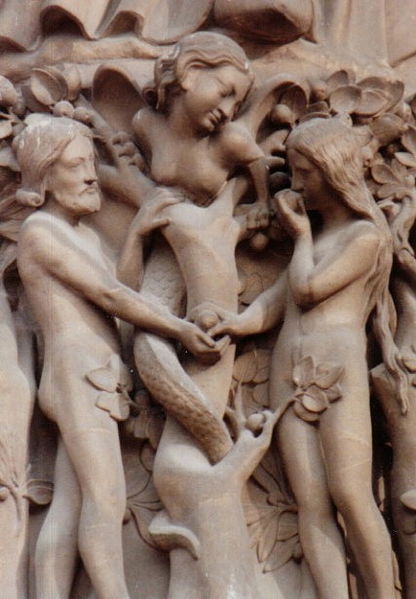
Should Chavah have been called Chaya? Here is Gen 3:20:

וַיִּקְרָא הָאָדָם שֵׁם אִשְׁתּוֹ, חַוָּה: כִּי הִוא הָיְתָה, אֵם כָּל-חָי

Robert Alter notes that Chavah is similar to chivya, the Aramaic for serpent, and wonders if Chava'a name might contain an allusion to an old Mesopotamian myth in which a giant primordial serpent is imagined to be the progenitor of all things, or, in other words, the אֵם כָּל-חָי.

The Zohar also notes this similarity and speculates that Adam gave his wife a name connected to her sin, but does not explain how Adam knew Aramaic back in the early days when all the world spoke Biblical Hebrew.

[Image: Adam, Eve, and the (female) serpent at the entrance to Notre Dame Cathedral in Paris.]

Things Chabad has taught me

"Every synagogue in the world has Jerusalem stone in it”
-- Rabbi Joseph Eisenbach, spiritual leader of Chabad Lubavitch of Litchfield County as reported by the New York Times.

(Rabbi Eisenbach told this wee little lie as part of his efforts to convince the local zoning board to allow him to convert a 19th century Victorian house into a shul.)

On that Cardinal's proposal

Yesterday we reported (with an assist from blues singer Mississippi Fred MacDowell) that Cardinal Francis George believes one stray, and little-known Talmudic opinion is the equivalent of the Good Friday prayer all Catholics everywhere once recited about perfidious Jews. Argues his Eminence: Now that the hate mongering prayer has been dropped, shouldn't Jews acknowledge the goodness, charity and mercy of the Catholic church by excising the bit from Yebamoth 49b about Jesus being a bastard?

Only not so fast.

First, no less a luminary than Gil Student has argued that the passage isn't really about Jesus. (I think he's wrong, but never mind.) Moreover, as some of my readers said yesterday, asking us to change the Talmud is like asking them to rewrite the Gospels. And, as others pointed out, the word the Talmud uses (mamzer) isn't an insult or a pejorative. Its simply the legal description of the offspring of a forbidden union. But more to the point, the passage isn't a prayer, it was never recited, or even studied by Jews the world over, and it has done nothing to form a communal view of Christianity. No Jew ever embarked on a murderous rampage after studying Yebamoth. If only Catholics were historically so well behaved on Good Friday.

But the really offensive thing about the Cardinal's proposal is that it brings us back to the 19th century when socialism, modernism and Americanism were on the rise, and the Church was running for its life. Though no Pope ever blamed America on the Jews, for about 100 years the Vatican, its newspapers and its spokemen identified Jews as the leaders of an international campaign against the Church. This bizzare view of history lives on today in men like Kurt-Peter Gumpel, the German Jesuit responsible for the cause of Pope Plus XII's canonization who said in 1998 that Jews need an `examination of conscience' for injuries to Catholic church. Why? Because we were "managers" of Soviet communism in its initial stages and "massive accomplices in the destruction of the Catholic church." By suggesting that we remove an ambiguous phrase from the Talmud, Cardinal George has bought into that ahistorical attitude.

Monday, October 08, 2007

DovBear Dialogue SM vs Naftuli Part 3

Part 1
Part 2

This letter was written by Naftuli

Dear SM,

Thank you for your response. It is clear, as Tzipporah pointed out in the comments, that both you and I are influenced by our legal and political environments. I want to focus on the major issue at hand, the usefulness of a written constitution, and then make a few points about some collateral matters identified in your post.

You clearly believe that a written constitution would not help Israel. But you don’t stop there. You go on to argue that “written constitutions do not work.” In other words, a written constitution is structurally incapable of working in every single instance (if I’m over-reading, please correct me). I believe this stronger claim is patently incorrect.

You identify a number of flaws of written constitutions, all of which revolve around the “rigidity” of the document. A number of constitutions are rigid, but a constitution does not need to difficult to amend. While the U.S. Constitution is notoriously difficult to amend because it requires an extraordinarily high rate of agreement to make changes, there is nothing endemic to written constitutions that require them to be rigid. Perhaps we could then agree on the value of a written constitution, but disagree on the amount of rigidity required.

However, I argued in my first post that rigidity is valuable. You responded that a rigid constitution is flawed for a number of reasons:

- It takes away important societal disputes from the political branches and places their resolution in the hands of unelected judges.
- The courts are emboldened to make political arguments precisely because their decisions are tethered to an important document.
- “….huge swathes of most written constitutions become redundant the moment they are signed”
Constitutions often contain contradictory clauses and are therefore incapable of resolving disputes.
It allows small groups to hijack the political system (e.g., “gun nuts”)

Ironically, I agree with you on 1, which is a classic problem in constitutional law in the U.S. and the topic of much philosophical debate. Alexander Bickel captured the problem best with his “contramajoritarian difficulty,” noting that allowing unelected judges to co-opt the political system runs contrary to democracy. There are all types of responses to Bickel’s problem, but the one I find the most appealing is that a written constitution is supposed to lock in rights that should not be subject to the whims of the majority. Judicial review is only relevant (with the exception of political market failures) when the majority is trying to take away rights that properly belong to minorities. What you consider a vice, I consider a virtue.

Now, if you’ve read anything I’ve written in the past, you know I do not believe that judges should be given unlimited reign to interpret the Constitution as they see fit. One of the most prominent (although not by any means the primary) defenses of Originalism is that it constrains judicial discretion by tying the text to the understanding of a certain era (by the way the existence of judicial methodologies belies your argument that judges will inevitably interpret the constitution based on their prejudices and mores). And there are other means of limiting judicial discretion, including precedent. Basically, a written constitution is a tightrope between allowing judges too much power and denying minorities the protections the founders believed they deserved. Your argument would have us subject the rights of minorities to the capricious whims of the majority.

Your second argument seems counterintuitive. Because there is a written text, judges are less constrained. But that argument seems to get it backward. Text constrains interpretation by its very nature. A statute that states “vehicles cannot enter the park” will unequivocally outlaw cars in the park if the statute means anything at all. If there was no such statute, however, judges would have a much easier time allowing cars to enter the park. Clearly the existence of a text makes judicial interpretation more limited, not less.

Are judges less likely to be activist in a country like England, which lacks a written constitution? I’ll defer to your greater knowledge of the English system and agree that they are. But England is a unique country, with a millennium of political and legal experiences, a strong adherence to custom (for example, the Queen will still not approach the House of Commons because of the actions of Charles I), and well-settled institutional roles. Very few countries can match England in that regard and certainly not a country like Israel.

3 and 4 are mistaken or at the very least overexaggerated. Again, I only have experience with the U.S. Constitution, but the vast majority of the Constitution is entirely relevant and is subject to massive amounts of litigation even in the 21st Century. Yes, the 3rd Amendment is inapposite given our current political climate, but I fail to see the problem with having clauses that are no longer litigated. And Constitutions are not contradictory per se, but all rights have limitations and those limitations are usually created by the courts and sometimes the political branches. But certainly having limited rights is better than no rights at all.

I don’t really see how 5 is relevant, certainly not in the U.S. The courts have interpreted the 2nd Amendment to be a collective right (every state and the federal government has gun restrictions), so the power of the gun lobby is not based on judicial fiat, but rather strong opinions in favor of gun ownership among a large percentage of the population and a well-organized lobby, headlined by the National Rifle Association. While religious and liberal groups (the ACLU is a good example) use the Constitution as support for their policy preferences, the courts are usually successful at sorting out good from bad claims over time (while Roe v. Wade was a horrible constitutional decision, it has slowly been chipped away). So while there are some negatives to enshrining rights, the positives overwhelm the negatives.

Now onto some collateral matters relating to Israel. You argued that Israel does not have enough respect for the rule of law. On that I wholeheartedly agree. But that’s precisely why a constitution will be useful. Constitutions generally necessitate the agreement of broad swathes of the population and a supermajority requirement will force the inclusion of even unpopular marginalized groups. And rather than allowing every group to force acquiescence to their every demand, it forces compromise on the small things in order to ensure that serious demands are taken seriously.

Later on you identify the problem not as the status of the law, but rather “the definition of ‘Israel’, ‘Jew’ and so forth.” But isn’t agreement on these fundamental terms most likely to take place as part of a comprehensive plan that resolves all the important problems in one fell swoop? A Basic Law that attempts to define “Jew” is going to fail because each side is going to further entrench itself as it has no reason to compromise. But if all the issues are put on the table, each side will be forced to engage in give-and-take, especially if the party is a minority. So the Religious Zionist community might support defining Israel more broadly than the Green Line, but they will have no chance of seeing that happen unless they compromise on other fundamentals. Basically, they’ll have to choose what really are the most important parts of their doctrine.

On the Supreme Court and Disengagement: I never read the opinion of the Supreme Court, but as far as I’m aware the Court has never even ruled that settlements on public property are a violation of international law (in the famous Elon Moreh case it ruled settlements on lands expropriated from Palestinians did violate international law). It has certainly never declared the occupation of Gaza illegal, although it did consider Israel’s presence there (rather than Israel’s rights to the area) to be an occupation, despite the government’s contention that the territory is disputed. So I doubt the illegality of the occupation was the official basis for the Court’s reluctance to deem the Disengagement a violation of national and international law.

One last point: throughout your response you invoke international law. I’d prefer to not have this debate devolve into an argument about the efficiency or justness of international law, but suffice it to say that I have serious qualms with the usefulness of international law given its non-democratic origins (customary law in particular) and the unjustified weight it gives to small non-governmental organizations. Frankly I’m not even sure international law is “law” in the philosophical sense.
Comment of the day

">whenever Ramban uses language such as "sodos HaTorah", it is more often than not a hint at a Kabbalistic explanation<<

"Here's a better rule: Whenever someone says something is "al pi kaballah", it's becasue that something makes no sense, and the writer thinks that by asserting, with no proof, that something is "al pi kaballah', it is allowed to be nonsense. In other words, to any objective modern observer kaballah appears to be all but nonsense, but as orthodox Jews, we are forbidden to say so explicitly.
Eli W. 10.08.07 - 12:16 pm #

Church to Jews: Let's make a deal

Report

A senior American cardinal has asked Jews to reconsider descriptions of Jesus as a "bastard" in exchange for a softening of traditional Catholic prayers calling for Jews to be converted to Christianity.

[snip]

"It does work both ways. [he said] Maybe this is an opening to say, 'Would you care to look at some of the Talmudic literature's description of Jesus as a bastard, and so on, and maybe make a few changes in some of that?'"

There are about 20 million things wrong with this, and from every possible perspective, including (1) theology, (2) history, and (3) human deceny.

I am working on a post that says more. Stay tuned.

Tip of the Galero: Fred on the Mainline

Sunday, October 07, 2007

What time did you finish?

Thursday night: Close to 11
Friday: Close to 2:30, though we didn't murder the musaf chazan, too much.

Gil on Kugel

R' Student has read the new Kugel book and the New York Times review of same, and has this to say:
"[Kugel's approach to TMS] isn't Orthodox by any stretch of the imagination. Even Marc Shapiro, whose book on the fundamental principles of Judaism argues for a broad definition of Orthodoxy, would agree--in the unlikely event that he would agree to publicly comment on this matter--that there is no way to fit Prof. Kugel's suggested approaches into Orthodoxy."
So what? The real question is this: Can Prof. Kugel's take be fit into JUDAISM. I mean you can't fit the Ibn Ezra (among many, many others) into "Orthodoxy" either.

Wednesday, October 03, 2007

101 Uses for a Used $125 Citron


As all God-fearing, segulah-loving frum people know, biting the pitem of an etrog after Sukkot is a segulah for an easy labor. As opposed to the many segulot our people are enamored of, this minhag actually has a authentic and trustworthy source.

Taamei HaMinhagim (p. 621) writes that this segula is based on Genesis Rabbah 15, which states that the Tree of Knowledge which Adam ate from was an etrog tree. To repent for humankind’s original sin, i.e., eating from the Tree of Knowledge, a woman should bite the pitem of the etrog, In exchange, the God of Pain and Suffering will grant her an easy labor. As with all segulot, this only works if the biting of the pitem ceremony is done today, Hoshana Raba. Should you miss partaking of this minhag today, be prepared to undergo 36-hours of painful labor, possibly a breech birth aided with forceps, to be followed by a Cesarean section with no anesthesia.

As with all segulot worth their salt, this one comes with a special prayer. This is the most accurate nusach, which seems to be preferred by the God of Pain and Suffering:

“Master of the Universe, since Eve ate from the Tree of Knowledge, her sin brought death to the world. If I had been alive at that time, I would not have eaten from it, nor taken any benefit. Just as I did not wish to invalidate this etrog during the seven days of Sukkot, I waited until today when the commandment (of lulav and etrog) is completed…I have enjoyed seeing the Tree of Knowledge, from which God commanded Adam and Eve not to eat. However, I would not have violated His command. Accept my prayers and supplications with good favor…rescue me that I may give birth with ease, and without pain, and that neither I nor my child suffer any harm, for You are the God of Salvation.”

That covers pregnant women. Women who are not yet pregnant, but wishing to conceive a male son, should eat the entire etrog. Preferably raw and not cut with a metal utensil. For obvious reasons, there are no segulot for having female babies. If you're practicing birth control (for medical reasons only, but please check with your local rabbi), the advice given is to double up on your contraception methods during this auspicious time of efficacious fertility rites.

What can you do with your very expensive citron if you’re a man?

The Talmud brings a few methods of nullifying the snake venom in exposed water. One proven method is to make a hole in an etrog, fill it with honey, heat it over coals, and then eat it. Alternatively, one may drink 170 cc of urine which has sat for 40 days. Please call Poison Control for further details.

For the sake of brevity, I will not include any recipes for etrog marmalade, which reportedly has the segulah of turning female fetuses into males.

If you know of any more segulot attributed to etrogim, please be kind and share them with your fellow readers.

Stay tuned for our next post, which will cover 101 Uses for Pop-Up Sukkahs.

These are the people in my neighborhood

Just a quick note of appreciation to the really excellent fellows who always are so careful to hiss YAALEH VAYAAVO in loud and piercing whispers during the silent amidah. Were it not for you, I might sometimes say the word v'sechezenu, and possibly even the word ay'nenu before remembering to go back and say the extra Yom Tov prayer.

And my what an epic disaster that would be.

So well done. Really. And, if you feel like sharing some of the awesome extra schar you've surely accumulated thanks to your helpful disruptions of the service, well, you know where to find me.

Anucha

by CousinOliver

Anucha Browne Sanders was awarded 11.6 million dollars for sexual harrasment by MSG and Knicks coach Isiah Thomas. Brown Sanders said, "What I did here, I did for every working woman in America."

Soo... Is she going to share her $11 million with all the working women in America?

Tuesday, October 02, 2007

My new favorite site

Piyut.com

Of special interest in their list of the top 12 piyyutim of all time, and musical renditions of some of the best ones, together with background information and elucidations.

Their top twelve are as follows: (chronologically)

1 - Kel Adon (duh)

2 - Dror Yikra (duh)

3 - Yedidi Hashachachta (eh)

4 - Shachar Avaksech (don't know it)

5 - Achot Ktana (I like it, but find it more difficult, and less accessible than some others on the list)

6 - Yigdal (duh)

7 - Lacha dodi (duh)

8 - Koh Ribon Olam (duh)

9 - Yedid Nefesh (duh)

10 - Adol Hakol (don't know it)

11 - Melech Goel U'moshia (don't know it)

12 - Keli Lama Azavtani (don't know it)

I'd have also included:

HaAderet vHaemuna
Mee Pi Kel
Melech Elyon
Adon Olam

Overheard on a Jewish street near you

Overheard on a Jewish street near you

Lefty: Psss. Hey buddy. C'mere
Ernie: Who me?
Lefty: SHHHHHH!
Ernie (whispering) Who me?
Lefty: Yeah. You. C'mere. How would you like to buy "Immeasurable Reward in Olam Habah."
Ernie: Immeasurable Reward in Olam Habah!!
Lefty: SHHHHHH!
Ernie:(whispering) Immeasurable Reward in Olam Habah!!
Lefty: Riiiiiiiight! And for no extra money you also get to help Torah U'Mesorah buy life insurance policies for male, Judaic study teachers.
Ernie: Male, Judaic study teachers!!!
Lefty: SHHHHHH! You know. Rabayim
Ernie: Well...
Lefty: Come on kid. Don't ask any questions. Today's your lucky day. Just buy it and take it home tonight. You'll really love it. Just buy the Immeasurable Reward in Olam Habah and take it home tonight

Unpalatable as it may sound, the skit you have just read is basicly the idea behind Torah U'Mesorah's latest scheme. What you do is play the special Torah Umesorah lottery, and as the ad promises, immeasurable reward in Olam Habah will be yours.
Immeasurable.

Riiiiiiiight!
---

I've composed a short list of the things I find offensive about this initiative:

1 - Only Rabayim benefit. Not female teachers. Not secular teachers.
2 - Isn't gambling, like, wrong? Or at least anti-Torah?
3 - If I can get "immeasurable reward" for playing the lottery, what kind of reward do I get when I make a straight gift of charity? More or less than "immeasurable?"
4 - Are you allowed to make unsubstantiated claims in an advertisement? I mean, how do the organizers know that any reward at all awaits us if we play their game? Shouldn't the promise of "immeasurable reward" carry an asterisk?

I'm left wondering why Torah U'Mesorah took this approach. Am I really the only potential customer embaressed and discouraged by the sexism and magical thinking the organization reaveals here?

Evil, cruel or patronizing?

A woman who's had trouble conceiving gets some helpful advice: ... the Kabbalah speaks of spiritual creatures who are created each time a husband and wife have relations—spiritual children, who are “real” even though they are not physical beings. When marital relations are done in accord with the Torah—when the husband and wife sanctify their marriage by keeping the laws of Taharas Hamishpacha (“family purity”)—the spiritual “children” they create are very elevated beings.

In other words, what? Be comforted in the knowledge that you have created lots of invisible children? Swell.

[Reprinted with permission]

The sad, sad case of Sholom Auslander

Who is Sholom Auslander? Author of "Foreskin’s Lament" a memoir of growing up Jewish.

What's so sad about him? He's abandoned Jewish observances, but despite his best efforts to stop, he can't escape the thought patterns of a religious Jew. For example: "The people who raised me will say I am not religious,” he writes. “They are mistaken.” He adds "I am painfully, cripplingly, incurably, miserably religious, and I have watched lately, dumbfounded and distraught, as around the world, more and more people seem to be finding Gods, each more hateful and bloody than the next, as I’m doing my best to lose Him. I’m failing miserably.”

That's sad? Sounds a little pathetic to me. What's sad is that he wants to leave, but can't. That's a sad commentary on the sort of Jews, and the sort Judaism who shaped him. A different upbringing might have produced someone capable of taking the best Judaism has to offer, along with the ability to reject or reconcile or otherwise manage the ugliness and stupidity that crept in over the long exile.

Your point? Not incidentally, this is my main beef with the Internet Kofrim. Even if they are right about everything - the DH and the age of the universe and all the rest - I still want to practice the Judaism in which I was raised. I like being part of something old. I like being part of a community of like minded people. I like the songs and the poems and the prayers. I like the food. I like the familiarity of the rituals and the worldly benefits many of them deliver. I like being Jewish. It works for me -- even if many of the details are difficult.

Monday, October 01, 2007

Will Giuliani destroy the GOP?

Begining to look that way

"Another Meeting with the Ineffable Presence"

Dear Mr. Bear:

Your readers may be interested in a sequel I have written regarding the encounter between man and the Divine: Now Posted exclusively on "Live Frei or Die."

"Another Meeting with the Ineffable Presence"

Sigh - Do any of you readers out there have any non-kfira you'd like me to post? Please?