If you have $5 to spare, please hit the tip jar at the top right. If you have more than $5 extra dollars available today, please hit the tip jar more than once, or consider buying a book or making a paypal donation.
Many thanks. I enjoy keeping this blog going, but as of late, blogging hasn't been its own reward as in previous years and months. Some small material indication that you, to whatever infinitesimal degree, value and enjoy what I've been trying to do here since October 2004 would mean quite a great deal to me.
~DB
Thursday, May 14, 2009

Wednesday, May 13, 2009
Sleep in Benji Lovitt's bed
I've never yearned to rest on Benji's matress, but should this be a treat you've secretly desired, the time has come to act on your ambition: click here.
Bonus: You can also cook at the stove where he doesn't cook, and gaze at yourself in his own personal mirror. All for just 2400 NIS.
Bonus: You can also cook at the stove where he doesn't cook, and gaze at yourself in his own personal mirror. All for just 2400 NIS.
Tuesday, May 12, 2009
Mitzvoth, not magic
Sometimes, I wonder if Rabbi Yehuda HaNasi might be jealous. He was the chief editor of the Mishna, after all, the first great code of Jewish law, a code studied to this day by school children and scholars alike, while also serving as a key leader of the Jewish community during Roman times. Yet the glory -if glory is measured in songs and stories- goes to Rabbi Shimon Bar Yochai, the man who may have written the Zohar, and is remembered, to this day, on his feast day, with bonfires and other tributes, including a pair of very long prayer poems which suggest, among other praises, that Bar Yochai was holy from the moment of his conception.
I want to win some of that glory for Yehuda HaNasi. I want celebrations in his honor, celebrations of scholarship, and for the talent for organization that made the Mishna possible.
Too much is made of mysticism. Too many Jews seek redemption by dunking in Mikvahs and running to graves and miracle workers, by mumbling Pslams, or performing segulahs. A feast day for Yehuda Hanasi, one with all the accoutrements (save, of course, the hagiographies, and the extolments borrowed from Christianity that make up the Lag Bomer liturgy) might trim the boat, and redirect some Jewish energy and attention toward the neglected idea that a Jew is redeemed through mitvoth -not through magic, mysticism, or miracles.
First appearence
Search for more information about the Mishana at 4torah.com.
I want to win some of that glory for Yehuda HaNasi. I want celebrations in his honor, celebrations of scholarship, and for the talent for organization that made the Mishna possible.
Too much is made of mysticism. Too many Jews seek redemption by dunking in Mikvahs and running to graves and miracle workers, by mumbling Pslams, or performing segulahs. A feast day for Yehuda Hanasi, one with all the accoutrements (save, of course, the hagiographies, and the extolments borrowed from Christianity that make up the Lag Bomer liturgy) might trim the boat, and redirect some Jewish energy and attention toward the neglected idea that a Jew is redeemed through mitvoth -not through magic, mysticism, or miracles.
First appearence
Search for more information about the Mishana at 4torah.com.
Ghosts of Lag B'omer Past
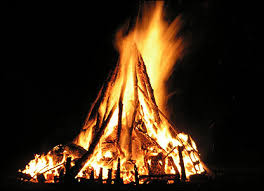
Here it is: The Lag b'omer Palooza you didn't even know you wanted:
- Why the Meron pilgrimage is an argument in favor of calling women for aliyot
- The Lag B'omer bonfire is every bit as foreign as the Yom Hashoa siren. [More]
- Jameel has translated an article which suggests our lag bomer celebrations came into existance because of a scribal error... [More]
- Yeshuahs For Sale (act fast) [More]
- Celebrating after the terror of mass plague: Why in the world is Lag B'omer a holiday? [Read it]
- Is the bonfire a religioun abomination on the order of insect snacks and sodomy? [Read it]
- Why don't we do anything for Rabbi Yehudah, author of the Mishna? [Read it]
Search for more information about Lag b'omer at 4torah.com.
Monday, May 11, 2009
Gateways excising photos of women too?


 A guest post by Gadolwannabe
When you think that you have seen it all, well look again! It now appears that even our Kiruv organizations, i.e., those who reach out to the non-frum, unaffiliated and OTD have had to toe the line of the Rabbinic Taliban that have taken control of our newspapers, Yeshivas and minds.
Let’s take the case of Gateways, an organization founded by South African Rabbi Mordecai Suchard who has made it his mission to be mekarev those Jews who have very little formal knowledge of the fundamentals of Judaism. In the past few years, Gateways has run retreats, seminars and programs for those who would like to learn more about their heritage and get them to dip their toes in the waters of Torah. To fund these efforts, and to support a large professional staff, Gateways has run retreats for frum Jews for the Yom Tovim which have become some of the most popular, and expensive, getaways for Pesach, Sukkos, Shavous, and even Rosh Hashana. These retreats have attracted a mix of Yeshivish and Modern Orthodox. The presenters and scholars have not only included well known affiliated Rabbanim and guest lecturers such as Rabbi Paysach Krohn, but also female personalities such as Rebbetzin Esther Jungreis. They have elaborately and extensively promoted their programs and lecturers in glossy brochures and on their web site: Gatewaysonline.com
A few months ago, Gateways posted on its web site and distributed to those on its mailing list a brochure advertising their 2009 Shavous program which included lectures by Rebbetzin Jungreis. The Rebbetzin has been a regular lecturer of Gateways on Shavous. As you will note from the brochure, a picture of Rebbetzin Jungreis as well as of Mrs. Debbie Greenblatt, a staff presenter, were prominently displayed. Now, look at the same brochure which appears on the Gateways web site today. Sure enough, the pictures of Rebbetzin Jungreis and of Mrs. Greenblatt have been removed.
I can understand Hamodia or Mishpacha excising photos of Israeli female Ministers. They are playing to their constituents. But Gateways? Their constituents are supposed to be the Lost Souls of Israel who have been partying and eating chazer and for whom Gateways is supposed to be a lifeline to redemption. Where is the inclusivity and attraction when 50% or more of the population is consigned to the cutting room floor? Is Gateways afraid that their Yeshivish clientele will desert them if the Rebbitzin shows off her blond sheitel? Not, really. I have been at the Gateways Shavuos retreat and the Rebbetzin draws a larger audience that Rabbi Krohn, including many men.
Unfortunately, Gateways is another organization that does not have the cahones to stand up to the kanoim and bearded Taliban lunatics that are running the asylum. Where is Moshe Rabbeinu when you need him?
Let’s take the case of Gateways, an organization founded by South African Rabbi Mordecai Suchard who has made it his mission to be mekarev those Jews who have very little formal knowledge of the fundamentals of Judaism. In the past few years, Gateways has run retreats, seminars and programs for those who would like to learn more about their heritage and get them to dip their toes in the waters of Torah. To fund these efforts, and to support a large professional staff, Gateways has run retreats for frum Jews for the Yom Tovim which have become some of the most popular, and expensive, getaways for Pesach, Sukkos, Shavous, and even Rosh Hashana. These retreats have attracted a mix of Yeshivish and Modern Orthodox. The presenters and scholars have not only included well known affiliated Rabbanim and guest lecturers such as Rabbi Paysach Krohn, but also female personalities such as Rebbetzin Esther Jungreis. They have elaborately and extensively promoted their programs and lecturers in glossy brochures and on their web site: Gatewaysonline.com
A few months ago, Gateways posted on its web site and distributed to those on its mailing list a brochure advertising their 2009 Shavous program which included lectures by Rebbetzin Jungreis. The Rebbetzin has been a regular lecturer of Gateways on Shavous. As you will note from the brochure, a picture of Rebbetzin Jungreis as well as of Mrs. Debbie Greenblatt, a staff presenter, were prominently displayed. Now, look at the same brochure which appears on the Gateways web site today. Sure enough, the pictures of Rebbetzin Jungreis and of Mrs. Greenblatt have been removed.
I can understand Hamodia or Mishpacha excising photos of Israeli female Ministers. They are playing to their constituents. But Gateways? Their constituents are supposed to be the Lost Souls of Israel who have been partying and eating chazer and for whom Gateways is supposed to be a lifeline to redemption. Where is the inclusivity and attraction when 50% or more of the population is consigned to the cutting room floor? Is Gateways afraid that their Yeshivish clientele will desert them if the Rebbitzin shows off her blond sheitel? Not, really. I have been at the Gateways Shavuos retreat and the Rebbetzin draws a larger audience that Rabbi Krohn, including many men.
Unfortunately, Gateways is another organization that does not have the cahones to stand up to the kanoim and bearded Taliban lunatics that are running the asylum. Where is Moshe Rabbeinu when you need him?
Redeeming First-born Donkeys
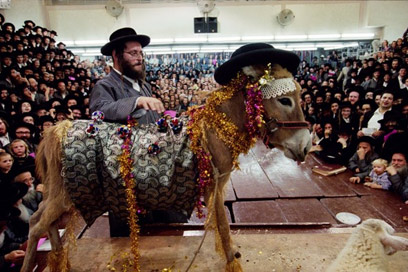 by the Bray of Fundie
 Seems we've developed a tastes for seeking out new and exotic Mitzvos while routinely ignoring or transgressing the ones that confront us daily.
I've got an aesthetic gripe as well. To me the decorations adorning the newborn Donkey are:
- Historically inauthentic. I somehow doubt that in ancient Israel, in an agrarian society of farmers and ranchers that may have featured many such pidyonos in a herd in any given year, that the ranchers bothered with dressing up the First-born Donkeys.
- The decorations seem kitsch and garish. Who came up with this idea/design? It looks to me like something more appropriate for a grade school arts and crafts project than for a community wide once in a lifetime Mitzvah observance.
- Is Tzaar Baalei Khayim not a factor? In the video I link to below the donkey seems a bit uncomfortable. Just leave the poor beast alone and get it over with as swiftly as possible
- Is the donkey the "kheftza" the Mitzvah or the sheep that it is being redeemed with? It seems to me that as the sheep is what will ultimately be the gift to the Kohen IT should be getting all dolled up, or maybe both animals, but why ONLY the donkey?
To see a video of the recent Melbourne community First-born Donkeys redemption click here.
What's next? A"snuff film" about a rancher who chose option "B" (
יג וְכָל-פֶּטֶר חֲמֹר תִּפְדֶּה בְשֶׂה, וְאִם-לֹא תִפְדֶּה וַעֲרַפְתּו="And every firstling of an ass thou shalt redeem with a lamb; and if thou wilt not redeem it, then thou shalt break its neck)
יג וְכָל-פֶּטֶר חֲמֹר תִּפְדֶּה בְשֶׂה, וְאִם-לֹא תִפְדֶּה וַעֲרַפְתּו="And every firstling of an ass thou shalt redeem with a lamb; and if thou wilt not redeem it, then thou shalt break its neck)
How would such a donkey be decorated??? With a black hood?
Search for more information about the first born donkey redemption at 4torah.com.
Abortion in Israel; frum pregnancies in America
Another execllent post by A Mother in Israel: Abortion in the Religious Zionist Community
Under discussion, is an article by Yifat Erlich in Makor Rishon which profiles frum couples who aborted pregnancies because of health problems with the fetus. These types of abortions are legal in Israel, and also permitted by halacha (according to most).
In her post, MII also tells a story about Rabbi Shlomo Aviner which helps explain why it is essential that abortion remain legal in the United States.
According to MII, Rabbi Aviner promised to "stand beside" older women who chose to become pregnant. This was widely understood to mean that he would permit abortions in the event that any of the health defects common to late pregnancies (for instance Downs Syndrome) were discovered.
The Rabbi's reasoning seems simple: Allow frum women to undergo halachicly permitted abortion, and more frum older women will become pregnant. More frum pregnancies mean more frum Jews.
If abortion is outlawed in the US, these mutar abortions will no longer be permitted here. If older Jewish women are denied the right to undergo these halachicly permitted abortions, many won't risk becoming pregnant at all. Thus, a total ban on abortion will interfere with Jewish families, in a way that is contrary to halacha.
Any frum Jewish woman's decision on abortion should remain between her and her doctor, her husband, and her rabbi. If the RW Christians win the abortion debate, this decision will instead be made by the state, and the result, as Rabbi Aviner feared, might well be fewer frum pregnancies.
Under discussion, is an article by Yifat Erlich in Makor Rishon which profiles frum couples who aborted pregnancies because of health problems with the fetus. These types of abortions are legal in Israel, and also permitted by halacha (according to most).
In her post, MII also tells a story about Rabbi Shlomo Aviner which helps explain why it is essential that abortion remain legal in the United States.
According to MII, Rabbi Aviner promised to "stand beside" older women who chose to become pregnant. This was widely understood to mean that he would permit abortions in the event that any of the health defects common to late pregnancies (for instance Downs Syndrome) were discovered.
The Rabbi's reasoning seems simple: Allow frum women to undergo halachicly permitted abortion, and more frum older women will become pregnant. More frum pregnancies mean more frum Jews.
If abortion is outlawed in the US, these mutar abortions will no longer be permitted here. If older Jewish women are denied the right to undergo these halachicly permitted abortions, many won't risk becoming pregnant at all. Thus, a total ban on abortion will interfere with Jewish families, in a way that is contrary to halacha.
Any frum Jewish woman's decision on abortion should remain between her and her doctor, her husband, and her rabbi. If the RW Christians win the abortion debate, this decision will instead be made by the state, and the result, as Rabbi Aviner feared, might well be fewer frum pregnancies.
Sunday, May 10, 2009
Ta'aseh lee Tovah (do me a kindness)
Please go to the far-right sidebar and click to "follow" this blog.
Thank you, and may we be forever zoche to do favors for each other.
Thank you, and may we be forever zoche to do favors for each other.
Celebrating Zionism
A (belated) guest post by DANIEL
Today is Israel's birthday. In recent months I have become notorious among my friends as an often-harsh critic of Israel. But, even for those who bitch about Israel 364 days a year, today is a day to celebrate. And indeed, there is a lot to celebrate. The establishment of Israel 61 years ago was the culmination of the Zionist dream. From a cultural perspective, Zionism is perhaps the single most important movement in Judaism's long history. Zionism allowed Jews to re-create a national culture in their ancestral homeland. Zionism revived the once-dead Hebrew language. Zionism promoted for the first time in two millenia the establishment of Jewish institutions such as universities, hospitals, and theatres. Zionism fostered outstanding contributions to mankind in science and in the arts. Zionism gave downtrodden and oppressed Jews around the world a fresh reason to hold their heads high. Zionism brought Jews out of the ghettos and into all facets of life. Zionism provided a central address for Jews of different backgrounds and traditions, separated for centuries, to embrace a common ground. Zionism gave Jews, the world's perpetual refugees, a place to call home.
Click here to read the rest of Celbrating Zionism
Today is about celebrating these accomplishments, but also about reflecting on them. In Israel, independence day is linked to remembrance day for fallen soldiers for precisely this reason. The accomplishments I listed are all of a cultural nature - from a cultural perspective, Zionism was an unparalleled and indeed a vital success for the Jewish People. Yet the movement is fraught with internal divisions, inherent contradictions, and even today lacks clear definition. What is Zionism? Today the term is used to denote political support for the State of Israel, but historically it referred to a movement for the re-establishment of a Jewish "homeland" in Palestine. The World Zionist Organization was formed in 1897, but as late as 1919 its general secretary emphatically denied that the creation of an independent Jewish state was or ever had been a part of the Zionist programme.[1]
Clearly then, there is more to Zionism than the idea of a Jewish State. Most of the great Jewish minds of the last century - including Einstein, Freud, Kafka, Arendt, Chomsky, Buber, Ben Yehuda, and Ahad Ha'am - saw in Zionism the potential for a Jewish social and cultural revival, but opposed Herzl's idea of an ethnically Jewish state.[2] In fact, Herzl is in many ways the antithesis of everything positive that Zionism has achieved. Herzl saw Jewish culture as inferior. He initially favoured assimilation over nationalism, and promoted mass conversion to Christianity as the answer to the "Jewish question."[3] Only after the Dreyfus Affair did Herzl realize that assimilation could not succeed and he began to advocate for a Jewish state. To Herzl, Judaism was an ethnicity and nothing more. The state he envisioned would have nothing to do with Jewish culture or religion - it would be a colonial German-speaking state in Argentina or Uganda modelled after secular European culture.[4] He even saw anti-Semites as his allies in driving the Jews out of Europe.[5] Herzl's Zionism was not in any way a product of Judaism (it was the furthest thing from it), but of European ethnonationalism. Ethnonationalism is about building military strength, seizing land, and preserving the dominance of one ethnic group. Yet this dangerous and discredited ideology has shaped Zionism since its inception.
I am proud of Israel, not for the strength of its army or the resilience of its economy, but for the cultural renewal it brought to the Jewish People. Zionism might be one of the most important movements in the history of Judaism, but the key is to never forget that as a Jewish movement Zionism should be subservient to Judaism, not the other way around. We must not redefine our 4000-year-old religious and cultural identity to conform with a 110-year-old political ideology. Early Zionists tried to blur the lines, couching their secular aims in the language of divine redemption and commodifying religious artifacts like the Western Wall (which Yeshayahu Leibowitz referred to as the discotel)[6]. The tragedy is that Jews have begun to define themselves according to Zionism, rather than defining Zionism in terms of their Judaism. Striving for exclusive political sovereignty over the land of Israel is not a part of Judaism - we are not crusaders, duty-bound to liberate our holy sites from the hands of infidels. For most of our history, we lived in exile, and even when we were in our homeland we were usually ruled by foreigners - Romans, Greeks, Persians, Babylonians, Assyrians, Egyptians, etc - the Davidic dynasty reigned for only a few generations, and hardly defines who we are as a people. Clearly, exclusive Jewish political sovereignty is not a requirement for our cultural and spiritual fulfillment.
Today, on the day of celebration of Zionism's fruition, we need to contemplate what Zionism means to us. Zionism as ethnonationalism, as systemic inequality against Israel's Arabs and military oppression of the Palestinian people, is something that I will continue to fight at every turn. Zionism as Jewish cultural rebirth is what I choose to celebrate. We must be careful not to conflate the two, as many have done and many continue to do. I take offense when I see symbols of my religion confused for symbols of occupation. We should not accept the status quo. We need to question the defunct ethnonationalist premises of Herzl's Zionism. I adhere instead to the Zionism of Buber and Ginsberg. Why should the ideals that our ancestors fought and died for - separation of Church and State, universal emancipation, the abolition of ethnic quotas - apply in all other states where we live but not in our own.
Could Zionism have achieved its cultural victories without its ethnonationalist element? Probably - many of Israel's great cultural institutions, like Hebrew University, Hadassa Hospital, the Technion, the Israel Philharmonic Orchestra, numerous theatre and cinema companies, the modern Hebrew language, and the city of Tel Aviv, were established long before Israel's political independence. Until the outbreak of violence in the 1920s when ethnonationalism became official Zionist policy, local Arabs could be persuaded to cooperate with Zionist objectives, including the mass immigration of European Jews, and govern Palestine jointly (see for example the Faisal-Weizman Agreement)[7]. If early Zionists had not chosen to pursue ethnonationalism - the establishment of a state exclusively for Jews on shared land - then perhaps cultural renewal could have been attained without touching off a war of civilizations that will last for generations. Without consigning millions of Palestinians to live as refugees, millions of Jewish youths to military service, tens of thousands on both sides to death, and trillions of dollars to warfare.
But we should focus on the future, not the past. The Jewish State is here to stay. It has done a lot of good and it has done a lot of bad, and one does not cancel out the other. The positive things that Zionism has brought to Judaism and the world exist independently of the bad things it has brought; we can and should celebrate the good and at the same time address the bad. Currently the two-state solution is the most realistic framework for moving forward. Let's work on continuing to steer Zionism toward the ideals that guided us in the past, the ideals of liberalism and justice. There is no principle more quintessentially Jewish than "love your neighbour as yourself,"[8] and I contend that Israel cannot be a truly Jewish state until it embraces this most basic tenet (not in a hippy let's-hug-our-enemy way, but in a treating-the-other-as-human way) in relation to its Palestinian neighbours, who are currently commemorating their nakba under one of the most oppressive military occupations of the modern era. Though we acknowledge their suffering, let us celebrate the incredible achievements of Zionism even as we recognize the enormity of the work that remains.
Happy Independence Day.
FOOTNOTES
[1] Nahum Sokolow, History of Zionism 1600-1918 (London : Loggmans, Green, 1919) at p. xxiv. I wasn't sure what to make of this when I came across it online, but I checked the primary source and it is legit. Sokolow, who was then general secretary of the WZO (and was later its president) wrote explicitly that Zionism did not call for an independent Jewish state and that this was merely a fabrication propagated by anti-Zionists to discredit the movement.
[2] Cultural Zionism is a movement largely credited to Ahad Ha'am (Asher Ginsberg) which called for the establishment of a Jewish home in Palestine while respecting the rights of its native inhabitants and opposing a Jewish ethnocracy. For more detailed sources relating to the figures named above, ask me, but for the sake of brevity I will only quote Einstein: “I should much rather see reasonable agreement with the Arabs on the basis of living together in peace than the creation of a Jewish state... My awareness of the essential nature of Judaism resists the idea of a Jewish state with borders, an army, and a measure of temporal power... I am afraid of the inner damage Judaism will sustain.” (http://www.guardian.co.uk/world/2005/feb/16/israel.india).
[3] Daniel P. Hadley, Catholicism, France and Zionism: 1895-1904 (http://gainesjunction.tamu.edu/issues/vol4num1/dhadley/) at para. 11, note 12. Herzl went so far as to try to enlist the Pope's help in converting Jews en masse to Christianity. See also: note 5.
[4] Wikipedia it. See also: note 5.
[5] http://www.jpost.com/servlet/Satellite?cid=1157913663330&pagename=JPost%2FJPArticle%2FShowFull. The movie referenced can be watched here: http://www.shofar.net/site/emedia.asp?id=962&Prourl=http://oldserver.shofar-tv.com/MEDIA/Languages\english\Herzel-eng.wmv . Warning: the sources it uses are all reliable and academic, but the movie has a very extremist religious agenda. Some pretty shocking stuff, but worth a look.
[6] http://www.hadassah.org/news/content/per_hadassah/archive/2001/Feb01/wall.htm
[7] http://domino.un.org/UNISPAL.NSF/9a798adbf322aff38525617b006d88d7/5bff833964edb9bf85256ced00673d1f!OpenDocument especially art. iv.
[8] According to tradition, the scholar Hillel referred to that sentence as comprising the entire Torah, and all the rest as merely commentary.
Search for more information about Zionism at 4torah.com.
Today is Israel's birthday. In recent months I have become notorious among my friends as an often-harsh critic of Israel. But, even for those who bitch about Israel 364 days a year, today is a day to celebrate. And indeed, there is a lot to celebrate. The establishment of Israel 61 years ago was the culmination of the Zionist dream. From a cultural perspective, Zionism is perhaps the single most important movement in Judaism's long history. Zionism allowed Jews to re-create a national culture in their ancestral homeland. Zionism revived the once-dead Hebrew language. Zionism promoted for the first time in two millenia the establishment of Jewish institutions such as universities, hospitals, and theatres. Zionism fostered outstanding contributions to mankind in science and in the arts. Zionism gave downtrodden and oppressed Jews around the world a fresh reason to hold their heads high. Zionism brought Jews out of the ghettos and into all facets of life. Zionism provided a central address for Jews of different backgrounds and traditions, separated for centuries, to embrace a common ground. Zionism gave Jews, the world's perpetual refugees, a place to call home.
Click here to read the rest of Celbrating Zionism
Today is about celebrating these accomplishments, but also about reflecting on them. In Israel, independence day is linked to remembrance day for fallen soldiers for precisely this reason. The accomplishments I listed are all of a cultural nature - from a cultural perspective, Zionism was an unparalleled and indeed a vital success for the Jewish People. Yet the movement is fraught with internal divisions, inherent contradictions, and even today lacks clear definition. What is Zionism? Today the term is used to denote political support for the State of Israel, but historically it referred to a movement for the re-establishment of a Jewish "homeland" in Palestine. The World Zionist Organization was formed in 1897, but as late as 1919 its general secretary emphatically denied that the creation of an independent Jewish state was or ever had been a part of the Zionist programme.[1]
Clearly then, there is more to Zionism than the idea of a Jewish State. Most of the great Jewish minds of the last century - including Einstein, Freud, Kafka, Arendt, Chomsky, Buber, Ben Yehuda, and Ahad Ha'am - saw in Zionism the potential for a Jewish social and cultural revival, but opposed Herzl's idea of an ethnically Jewish state.[2] In fact, Herzl is in many ways the antithesis of everything positive that Zionism has achieved. Herzl saw Jewish culture as inferior. He initially favoured assimilation over nationalism, and promoted mass conversion to Christianity as the answer to the "Jewish question."[3] Only after the Dreyfus Affair did Herzl realize that assimilation could not succeed and he began to advocate for a Jewish state. To Herzl, Judaism was an ethnicity and nothing more. The state he envisioned would have nothing to do with Jewish culture or religion - it would be a colonial German-speaking state in Argentina or Uganda modelled after secular European culture.[4] He even saw anti-Semites as his allies in driving the Jews out of Europe.[5] Herzl's Zionism was not in any way a product of Judaism (it was the furthest thing from it), but of European ethnonationalism. Ethnonationalism is about building military strength, seizing land, and preserving the dominance of one ethnic group. Yet this dangerous and discredited ideology has shaped Zionism since its inception.
I am proud of Israel, not for the strength of its army or the resilience of its economy, but for the cultural renewal it brought to the Jewish People. Zionism might be one of the most important movements in the history of Judaism, but the key is to never forget that as a Jewish movement Zionism should be subservient to Judaism, not the other way around. We must not redefine our 4000-year-old religious and cultural identity to conform with a 110-year-old political ideology. Early Zionists tried to blur the lines, couching their secular aims in the language of divine redemption and commodifying religious artifacts like the Western Wall (which Yeshayahu Leibowitz referred to as the discotel)[6]. The tragedy is that Jews have begun to define themselves according to Zionism, rather than defining Zionism in terms of their Judaism. Striving for exclusive political sovereignty over the land of Israel is not a part of Judaism - we are not crusaders, duty-bound to liberate our holy sites from the hands of infidels. For most of our history, we lived in exile, and even when we were in our homeland we were usually ruled by foreigners - Romans, Greeks, Persians, Babylonians, Assyrians, Egyptians, etc - the Davidic dynasty reigned for only a few generations, and hardly defines who we are as a people. Clearly, exclusive Jewish political sovereignty is not a requirement for our cultural and spiritual fulfillment.
Today, on the day of celebration of Zionism's fruition, we need to contemplate what Zionism means to us. Zionism as ethnonationalism, as systemic inequality against Israel's Arabs and military oppression of the Palestinian people, is something that I will continue to fight at every turn. Zionism as Jewish cultural rebirth is what I choose to celebrate. We must be careful not to conflate the two, as many have done and many continue to do. I take offense when I see symbols of my religion confused for symbols of occupation. We should not accept the status quo. We need to question the defunct ethnonationalist premises of Herzl's Zionism. I adhere instead to the Zionism of Buber and Ginsberg. Why should the ideals that our ancestors fought and died for - separation of Church and State, universal emancipation, the abolition of ethnic quotas - apply in all other states where we live but not in our own.
Could Zionism have achieved its cultural victories without its ethnonationalist element? Probably - many of Israel's great cultural institutions, like Hebrew University, Hadassa Hospital, the Technion, the Israel Philharmonic Orchestra, numerous theatre and cinema companies, the modern Hebrew language, and the city of Tel Aviv, were established long before Israel's political independence. Until the outbreak of violence in the 1920s when ethnonationalism became official Zionist policy, local Arabs could be persuaded to cooperate with Zionist objectives, including the mass immigration of European Jews, and govern Palestine jointly (see for example the Faisal-Weizman Agreement)[7]. If early Zionists had not chosen to pursue ethnonationalism - the establishment of a state exclusively for Jews on shared land - then perhaps cultural renewal could have been attained without touching off a war of civilizations that will last for generations. Without consigning millions of Palestinians to live as refugees, millions of Jewish youths to military service, tens of thousands on both sides to death, and trillions of dollars to warfare.
But we should focus on the future, not the past. The Jewish State is here to stay. It has done a lot of good and it has done a lot of bad, and one does not cancel out the other. The positive things that Zionism has brought to Judaism and the world exist independently of the bad things it has brought; we can and should celebrate the good and at the same time address the bad. Currently the two-state solution is the most realistic framework for moving forward. Let's work on continuing to steer Zionism toward the ideals that guided us in the past, the ideals of liberalism and justice. There is no principle more quintessentially Jewish than "love your neighbour as yourself,"[8] and I contend that Israel cannot be a truly Jewish state until it embraces this most basic tenet (not in a hippy let's-hug-our-enemy way, but in a treating-the-other-as-human way) in relation to its Palestinian neighbours, who are currently commemorating their nakba under one of the most oppressive military occupations of the modern era. Though we acknowledge their suffering, let us celebrate the incredible achievements of Zionism even as we recognize the enormity of the work that remains.
Happy Independence Day.
FOOTNOTES
[1] Nahum Sokolow, History of Zionism 1600-1918 (London : Loggmans, Green, 1919) at p. xxiv. I wasn't sure what to make of this when I came across it online, but I checked the primary source and it is legit. Sokolow, who was then general secretary of the WZO (and was later its president) wrote explicitly that Zionism did not call for an independent Jewish state and that this was merely a fabrication propagated by anti-Zionists to discredit the movement.
[2] Cultural Zionism is a movement largely credited to Ahad Ha'am (Asher Ginsberg) which called for the establishment of a Jewish home in Palestine while respecting the rights of its native inhabitants and opposing a Jewish ethnocracy. For more detailed sources relating to the figures named above, ask me, but for the sake of brevity I will only quote Einstein: “I should much rather see reasonable agreement with the Arabs on the basis of living together in peace than the creation of a Jewish state... My awareness of the essential nature of Judaism resists the idea of a Jewish state with borders, an army, and a measure of temporal power... I am afraid of the inner damage Judaism will sustain.” (http://www.guardian.co.uk/world/2005/feb/16/israel.india).
[3] Daniel P. Hadley, Catholicism, France and Zionism: 1895-1904 (http://gainesjunction.tamu.edu/issues/vol4num1/dhadley/) at para. 11, note 12. Herzl went so far as to try to enlist the Pope's help in converting Jews en masse to Christianity. See also: note 5.
[4] Wikipedia it. See also: note 5.
[5] http://www.jpost.com/servlet/Satellite?cid=1157913663330&pagename=JPost%2FJPArticle%2FShowFull. The movie referenced can be watched here: http://www.shofar.net/site/emedia.asp?id=962&Prourl=http://oldserver.shofar-tv.com/MEDIA/Languages\english\Herzel-eng.wmv . Warning: the sources it uses are all reliable and academic, but the movie has a very extremist religious agenda. Some pretty shocking stuff, but worth a look.
[6] http://www.hadassah.org/news/content/per_hadassah/archive/2001/Feb01/wall.htm
[7] http://domino.un.org/UNISPAL.NSF/9a798adbf322aff38525617b006d88d7/5bff833964edb9bf85256ced00673d1f!OpenDocument especially art. iv.
[8] According to tradition, the scholar Hillel referred to that sentence as comprising the entire Torah, and all the rest as merely commentary.
Search for more information about Zionism at 4torah.com.
Hunchback or long eyebrows
This is a very poorly researched post (if you can call it a post at all)
In Lev 21 God lists the various deformities that disqualify a kohen. Among the ailments are the גִבֵּן (geeben) and the דק (dak)
Virtually every major English translation of the Bible takes geeben as hunchback, and indeed this is the modern Israeli word for that affliction. Rashi however reads it as "sourcils in French, [meaning] that his eyebrow (גַּבִּין) hairs are [abnormally] long and droop. — [Bech. 43b]"
(Hard to understand why long eyebrow hairs would render a kohen unfit. Hunchback is a better fit)
With the exception of the Douay-Rheims Bible, all take dak as dwarf. Rashi (and Douay-Rheims) have it as an eye affliction of some kind. Rashi says its a membrane that covers the eyes, ie a cataract.
(תבלל is the next item on the list, and this is also an eye affliction, which most take as cataract. Is it likely cataract would appear twice?)
In both case, the context seems to argue against Rashi, but I'm not enough of a philologist to settle this dispute(in fact, I'm no kind of philologist at all.)
So, readers, its on you.
Related: Leviticus and Disability: My Take on Nick's Crusade
In Lev 21 God lists the various deformities that disqualify a kohen. Among the ailments are the גִבֵּן (geeben) and the דק (dak)
Virtually every major English translation of the Bible takes geeben as hunchback, and indeed this is the modern Israeli word for that affliction. Rashi however reads it as "sourcils in French, [meaning] that his eyebrow (גַּבִּין) hairs are [abnormally] long and droop. — [Bech. 43b]"
(Hard to understand why long eyebrow hairs would render a kohen unfit. Hunchback is a better fit)
With the exception of the Douay-Rheims Bible, all take dak as dwarf. Rashi (and Douay-Rheims) have it as an eye affliction of some kind. Rashi says its a membrane that covers the eyes, ie a cataract.
(תבלל is the next item on the list, and this is also an eye affliction, which most take as cataract. Is it likely cataract would appear twice?)
In both case, the context seems to argue against Rashi, but I'm not enough of a philologist to settle this dispute(in fact, I'm no kind of philologist at all.)
So, readers, its on you.
Related: Leviticus and Disability: My Take on Nick's Crusade
Friday, May 08, 2009
Star Trek!
:: The New York Times published a very favorable review of the new Star Trek flick.
The editors must not realize both Spock and Kirk were first portrayed by Jews [/snark
:: Many eons ago, I saw a Purim shpiel which offered theoretical answers to Star Trek halacha questions. I recall:
Can Data be counted in a minyan (no) Do you need two replicators, one for meat and one for dairy? (yes) A starfleet ship can be as large as a small city. Does it require an eruv? (yes) Do you sit shiva for someone who has been transported? (no, but only because it would impose a burden on the commuity) (Transporters convert a person or object into an energy pattern (a process called dematerialization), then "beam" it to a target, where it is reconverted into matter (rematerialization). Wikipedia)
You're welcome to work out the underlying reasoning for yourselves.
:: And finally, here's something to argue about tomorrow ben gavra l'gavra: Which fictional race is a more blatant and therefore more offensive, Jewish stereotype: The big-eared, greedy Goblin bankers in Harry Potter, or the big-eared, greedy Ferengi mercenaries in Star Trek?
Search for more information about Star Trek at 4torah.com.
The editors must not realize both Spock and Kirk were first portrayed by Jews [/snark
:: Many eons ago, I saw a Purim shpiel which offered theoretical answers to Star Trek halacha questions. I recall:
You're welcome to work out the underlying reasoning for yourselves.
:: And finally, here's something to argue about tomorrow ben gavra l'gavra: Which fictional race is a more blatant and therefore more offensive, Jewish stereotype: The big-eared, greedy Goblin bankers in Harry Potter, or the big-eared, greedy Ferengi mercenaries in Star Trek?
Search for more information about Star Trek at 4torah.com.
Thursday, May 07, 2009
Bad timing award
Talk about bad timing. My FaceBook "friend" David Klinghoffer blogs Why I'm "Christian-Friendly" on the selfsame day Westboro Baptist announces a plan to picket shuls. Seems they've peeved both that we're so gay friendly, and also because we murdered their omnipotent, almost all-powerful Lord. Klinghoffer's money quote
There's more to say about why DK is wrong, but I am past zonked. Perhaps tomorrow.
yes, I'm "Christian-friendly." Why on earth would I not be? We don't live in Europe -- medieval, mid-20th century, or modern -- where religious, ideological, and secular-fed anti-Semitism was and is rife. We live in America, the most philo-Semitic country in history and arguably the most passionately Christian in the world today.Sorry, but the hard-core Catholics in Brazil, Peru, and Africa are far more passionately Christian than sloppy feel-good mega-church Americans (and of course the most passionately religious countries today are Muslim) Besides, American philo-Semitism comes with some awfully big strings attached, and a few intolerable conditions, so who needs it?
There's more to say about why DK is wrong, but I am past zonked. Perhaps tomorrow.
Shul seating
In our shul we usually sit at tables, as in this picture. When we need extra space, the tables are stored in the basement, and we sit in rows, like this.
A few weeks ago, we had a Bar Mitzvah, and many guests were expected. To accomodate them the tables were stored away, aside for one that was moved flush against a side wall, like this. (The green box is the table. The lines represent the rows of chairs)
When I came in that Shabbos morning (a little late) (shut up) one guy had turned his chair sideways and was sitting at the table, with his back toward the room (see here; he is the red circle. The arrow indicates the direction he was facing.)
Now of course this guy is an idiot, but exactly what kind of idiot? I came up with some possibilities:


A few weeks ago, we had a Bar Mitzvah, and many guests were expected. To accomodate them the tables were stored away, aside for one that was moved flush against a side wall, like this. (The green box is the table. The lines represent the rows of chairs)

When I came in that Shabbos morning (a little late) (shut up) one guy had turned his chair sideways and was sitting at the table, with his back toward the room (see here; he is the red circle. The arrow indicates the direction he was facing.)

Now of course this guy is an idiot, but exactly what kind of idiot? I came up with some possibilities:
- Pious moron (Heimish Torah-true Jews must always pray at tables!)
- Insecure moron (Oy, how my children will suffer if word gets out that I once sat in a pew like those modern YI Jews)
- Slothful moron (What? Sitting this way is more comfortable!)
- Uncooperative moron (Just who in the samhell do those gabbaim think they are rearranging the shul like this? Was the Rabbi informed?)
- Clueless moron (I was supposed to sit in the rows like everyone else? Oopsie!)
- Glutenous moron (If I sit in the rows, I won't be able to escape for mid-prayer kiddush)
Rabbi tells soldiers not to act Jewish
A Guest Post by Rafi G
(originally posted on LII)

A short while ago there was a notice in the news about the IDF enforcing policy about beards. Soldiers in the IDF are not allowed to have beards unless they meet certain requirements. The army rarely enforced this and similar rules.
In an effort to improve the level of discipline, the army has decided to enforce these rules. no more beards. No longer being unkempt. No more letting things go. but because we live in a Jewish country, and the IDF has plenty of religious soldiers and wants to keep good relations with them, they had to show some flexibility on that. So they came up with a set of exceptions. Religious soldiers are allowed to have a beard, as long as they get the approval of their commanding officer.
Along comes sefirat ha'omer when we show outward displays of mourning, such as not shaving and getting haircuts, and suddenly we have a problem. People who were able to shave as per the army rules until now, suddenly cannot. But they do not have permission to let it grow out.
Yisrael HaYom newspaper wrote today about an incident in the army in which 6 soldiers affiliated with the Conservative movement wished to get permission to not shave during sefirat ha'omer. The army rabbi refused to give them recognition as religious soldiers and therefore their request was rejected. the rabbi said that he does not recognize the Conservative Movement as religious and therefore they cannot be considered religious. (they have appealed and are waiting for a response, but in the meantime they have had to shave because of this ruling).
I do not understand this rabbi's position. I understand he does not want to give any tacit recognition of the Conservative Movement - just like most Orthodox rabbis have the position of not sharing a pulpit at events with Conservative/Reform rabbis so as not to be perceived as approving of them in their positions. He thinks that by approving the request of 6 individual soldiers, he will be perceived as approving of the whole Conservative Movement.
It was not the Conservative Movement asking permission to be recognized as religious soldiers. It was 6 individual soldiers. And if they asked if they could put on tefillin, would the army rabbi not allow them saying they are not religious so they are not allowed? If they asked for time for davening, would he reject that as well?
These were 6 individual soldiers. Since when do we reject the right of individuals, no matter their affiliation, to perform mitzvahs (granted, not shaving during sefira is not actually a mitzvah per se, but it is a widespread Jewish custom)? What right did this rabbi have to reject the request of an individual to follow Jewish tradition?
The rabbi should be applauding every occurrence of his soldiers trying to keep tradition and custom, and not rejecting it.
Search for more information about [topic] at 4torah.com.
(originally posted on LII)

A short while ago there was a notice in the news about the IDF enforcing policy about beards. Soldiers in the IDF are not allowed to have beards unless they meet certain requirements. The army rarely enforced this and similar rules.
In an effort to improve the level of discipline, the army has decided to enforce these rules. no more beards. No longer being unkempt. No more letting things go. but because we live in a Jewish country, and the IDF has plenty of religious soldiers and wants to keep good relations with them, they had to show some flexibility on that. So they came up with a set of exceptions. Religious soldiers are allowed to have a beard, as long as they get the approval of their commanding officer.
Along comes sefirat ha'omer when we show outward displays of mourning, such as not shaving and getting haircuts, and suddenly we have a problem. People who were able to shave as per the army rules until now, suddenly cannot. But they do not have permission to let it grow out.
Yisrael HaYom newspaper wrote today about an incident in the army in which 6 soldiers affiliated with the Conservative movement wished to get permission to not shave during sefirat ha'omer. The army rabbi refused to give them recognition as religious soldiers and therefore their request was rejected. the rabbi said that he does not recognize the Conservative Movement as religious and therefore they cannot be considered religious. (they have appealed and are waiting for a response, but in the meantime they have had to shave because of this ruling).
I do not understand this rabbi's position. I understand he does not want to give any tacit recognition of the Conservative Movement - just like most Orthodox rabbis have the position of not sharing a pulpit at events with Conservative/Reform rabbis so as not to be perceived as approving of them in their positions. He thinks that by approving the request of 6 individual soldiers, he will be perceived as approving of the whole Conservative Movement.
It was not the Conservative Movement asking permission to be recognized as religious soldiers. It was 6 individual soldiers. And if they asked if they could put on tefillin, would the army rabbi not allow them saying they are not religious so they are not allowed? If they asked for time for davening, would he reject that as well?
These were 6 individual soldiers. Since when do we reject the right of individuals, no matter their affiliation, to perform mitzvahs (granted, not shaving during sefira is not actually a mitzvah per se, but it is a widespread Jewish custom)? What right did this rabbi have to reject the request of an individual to follow Jewish tradition?
The rabbi should be applauding every occurrence of his soldiers trying to keep tradition and custom, and not rejecting it.
Search for more information about [topic] at 4torah.com.
Wednesday, May 06, 2009
Temple discrimination
@NickDupree via Twitter:
What do you think of ban on disabled kohanim doing sacrifices in this week's parsha? is that discrimination?
I replied: Yes its discrimination per 2009. Lots of Torah rules don't fit 2009 standards.
And this is true: The Torah is full of rules and requirements and presumptions that no longer fit anyone's idea of morality. Slavery is the most famous example. The rules on marriage and rape are others. Though I confess it never occured to me, I must agree the ban on disabled kohanim from participating in the Temple service is another example.
Search for more information about the ban on disabled kohanim at 4torah.com.
Subscribe to:
Posts (Atom)