Monday, October 15, 2007

Menken Hearts Coulter

Here is what Menken said about Coulter's latest ani-Jewish jab:

...she demonstrated not an iota of anti-Semitism, and the media is taking her to task for being nothing more nor less than a traditional Christian...

Coulter did speak as a believing Christian and she did express the tenets of her faith as she understands them. But so what? None of that ought to make her immune from criticism. Coulter's belief about Jews being imperfect may be legitimately Christian, but it is also offensive. There is no reason to pretend otherwise. Wrong ideas should be demolished, not excused. And Menken knows this. His blog is based on this. Consider for instance, his treatment of liberal expressions of Judaism. He is never shy about attacking liberal Jews who speak publicly about their sincerely held religious convictions. When a Jew is the one thinking and expressing thoughts Menken dislikes, the gloves come off immediately. So why are Ann Coulter's barbarities deserving of Menken's protection?


The answer is obvious. Menken holds that nothing a RW religious person says should ever be called into question. Say what you want about Jews -insult them, offend them, call them names, it doesn't matter- so long as you vote GOP you can always count on Mencken's support.


This Just In: The Ibn Ezra and Rambam's approach to witchcraft was not " in keeping with Judaism."

Bad news for two of our favorite Rishonim. Our friendly neighborhood deep thinkers at Aish Hatorah appear to have tossed him out of the religion.

Here's what Aish has to say about witchcraft:
When a person matures, three general approaches towards the occult and other outside forces begin to emerge. There are the serious, rational mindsets who laugh it all off. For them the world is rational, quantifiable and anything else is utter rubbish... [second approach... third approach] None of these three general approaches are in keeping with Judaism.
And here are the Torah approaches Aish wishes to pretend don't exist:

(1) Rambam, Yad Hachazaka: [Belief in] astrology, sorcery, oaths, lucky charms, demons, forecasting the future, and talking to the dead - all these are the essence of idol worship, and are lies that fools believe to be both true and wise, or were lies made up by the rulers to cheat the public. All these things are based on false beliefs, which have no point or use. He who believes that these are true practices -but forbidden by the Torah- is nothing but a fool. . . . the only person who will use these beliefs is one who is a gullible person who will believe anything, or a fraud who wishes to cheat the public."

(1a) Rambam, Yad Hachazaka: And these things [ie: magic, witchcraft, sorcery, and superstition] are all lies and deception... it isn't proper for Jews, who are wise and clever, to continue this nonsense and it should never enter their minds that there is an advantage or benefit [to'elet] to using these things... any person who believes in these things and imagines that there is truth and wisdom behind them - though the Torah prohibits them (to Jews) - is from among the fools and the stupid people [scholim u'chasrei daa't] and in the category of [people] who have incomplete mental facilities. Those who posses authentic wisdom and pure knowledge know through clear proofs that every one of these things that the Torah prohibited is not wisdom, but nothingness and nonsense [tohu v'hevel] that is continued by empty-headed people [chasrei da'at] who have caused the ways of truth to be abandoned.

(2) Ibn Ezra (Leviticus, 19:31):"Those with empty brains say 'were it not that fortune tellers and magicians were true, the Torah would not prohibit them.' But I (Ibn Ezra) say just the opposite of their words, because the Torah doesn't prohibit that which is true, but it prohibits that which is false. "

(Speaking of witches, I'll be back in a few with some thoughts on Ann Coulter. )

Friday, October 12, 2007

An example of the Agudat Israel's Ethics

The Jewish Observer, house organ of Agudat Israel, has an article on skepticism in the Orthodox world, excerpted by the Admar on his blog, which succinctly argues that Jews who are moving away from Orthodoxy should be approached with love, not criticism.

Why do I say excerpted? Because the Admar dropped a disclaimer (in blue below) from the original article.

The original article said:
A yeshiva student was happily dancing at his former room-mate’s wedding, and pushed his way “to the middle of the circle” to entertain the chosen and kallah (successfully, we should add) with a break-dance (ask your teenager if you don’t know what this is). He was in a great mood, full of simchah, full of love for his fellow Jews,and feeling good about himself, until his Rosh Yeshivah pulled him aside at the chasanah and strongly criticized him for a dance step “from the street.”

(The authors do not, of course, condone a ben Torah break-dancing or engaging in any other behavior derived from secular culture that isn't consistent with Torah value.)

What will the Rosh Yeshiva say after 120 years when he learns that his comment was one of a series of little pushes, and perhaps even “the last straw,” that eventually sent this promising student “out of the circle completely” and out of Torah observance?"
Everyone catch that? The "authors" of course (of course!) think break-dancing is wrong, but they also think the RY was wrong for criticizing the kid.

Sounds like our authors are a bit confused, right?

Only not so fast.

One of them, Mordichai Brecher, has provided this explanation [Click Comment: #6] As an author of the article I would like to respond to the previous comment that R. Horowitz did not delete the comment about breakdancing. In fact, the JO placed it there without consulting me. Breakdancing does not bother me in the least.

So, lets see if I have this straight:

(1) The JO changed the article without the permission of its authors. This is a "terrible breach of editorial ethics." [See neoHaskalah (Click: Comment # 7)]

(2) By committing this breach of ethics, they made two of their contributors look like hypocrites and/or confused fools.

(3) By committing this breach of ethics, they also managed to undermine the article's entire argument. The anecdote about the RY was presented as an example of how a heavy hand can drive Jews away from Orthodoxy. But according to the disclaimer a heavy hand is called for because of course (of course!) no one condones breakdancing! [See Fred's blog]

If Agudat Yisroel has any guts (they don't) a correction must appear in the magazine's next edition.

They aint making (haredi) Jews like Harav Hagaon Shlita the Admar Yankie Horowitz anymore

Click


[RELATED]

Wish I'd said it

Stolen from here via: He Who Must Not Be Named

"When they say "Judeo-Christian", they actually mean "Judeo-Christian," and they actually hope it means "Jews-for-Jesus-Christian" someday.

It's all good as long as it translates into more book sales to bigots."

Noah: Oldies, goodies

Here, brought to you by the ghost of DovBear past, are some classic posts on the parsha every skeptic likes to hate.

Noah gathers the animals for the ark

The curse of Ham

On Noah

On his flood

Now the whole world had one language and a common speech: What was it?

Answering Acher

Safe Skeptism

An example of idiocy (by Ed)

Thursday, October 11, 2007

John McCain is an idiot

I'm a little late to this story, but lmaan achai varay-eye I feel I must let you know that John McCain is an idiot. He said:
I just have to say in all candor that since this nation was founded primarily on Christian principles... I would probably have to say yes, that the Constitution established the United States of America as a Christian nation
Why is he in an idiot? Because the US was founded on the values of the enlightenment, not the values of Christianity. This is why the United States has no pope, no slaves, and no faith tests for those who might wish to hold public office. Indeed, not many of the biblical, or canon laws have any sway here. Additionally, you may have noticed that Christianity doesn't run on principles like democracy, tolerance, or the separation of power.

Also, he is an idiot, because the U.S. Constitution contains no mention of "God" or "Christianity."

And finally he is an idiot, because, in 1797, during the lifetime of the founders, America made a treaty with Tripoli, declaring that "the government of the United States is not, in any sense, founded on the Christian religion." This was written during Washington's presidency, and approved by the Senate under John Adams.

Tell your friends.

Mo's Issue

This reminded me of this

Too Hot for Hirhurim!

As the blogosphere knows, Reshimu reject Gil Student has started selling announcements on his blog. (I think this is a swell idea, and may copy it -- which is only fair given how Gil took his high-brow Torah-true format from me.)

The bad news for some of Gil's prospective advertisers though, is that Hirhurim isn't about to be run like Craigslist. Some ads will be rejected. So here's my solution: If Gil says no to your ad, provide me with proof that Gil turned it down and I will I'll run it here for free. [Exclusions: I'm not going to run ads looking for no-tell hookups, for example, and I reserve the right to reject anything obscene.]


Here's the first one:


For honest discussions about Torah and Judaism, please visit extremegh.blogspot.com

Wednesday, October 10, 2007

Ann Coulter is still on TV?

Well, after this lets hope the so-called "liberal" media has learned its lesson.

From the midvar sheker tirchak files

California Kiruv group slammed for deception. Also, they sound downright mean:
After talking throughout the meal with a group of male friends, Marcus was confronted as she left the table by Bracha Zaret, the wife of Moshe Zaret, a Jewish Awareness Movement rabbi. The rebbetzin, apparently incensed by Marcus' immodesty, asked her if she was on any medication. Marcus was puzzled, not realizing that the question was meant as an insult. Zaret then kicked her out of the house, telling her that she would never amount to anything and would be unmarried at forty
Wow. If that sort of treatment doesn't convince you to embrace the God of our Fathers and to accept His laws, you clearly have obstinance issues...

Hat-tip: The kvetcher

Obviously this idiot has never been to my next door neighbors house for shabbos lunch...

Observant Jews long ago sided with safety over taste by boiling, boiling, and then boiling some more. Cholent is the Yiddish word for food that is prepared in advance of the Sabbath, when ovens cannot be lit. Cholent cooks on a hot plate for 18 hours or more, pushing the food to within an inch of its life. Without ever sampling it, you can imagine its perfect non-ness, not even a hint of taste. But oh-so-safe.

From: Americans should eat more excrement - By Kent Sepkowitz: Slate Magazine

Josh and the Snake

Josh Waxmen has an excellent response to the post I wrote yesterday about the origins of Chava's name.

I tired to comment there, but Blogger is bloggered; anyway, responding here might send Josh traffic he richly deserves

He writes:

So too here, Alter discards the explicit etymology of the [naming] verse, but then wishes to connect it to the narrative anyway. Since there is a serpent in the story, connect her name to the serpent. But who is to say there was any connection to the story at all? For example, connect it to חוה, to express, to state, to experience.

Is he discarding the etymology or is he attempting to understand it on its own terms? The verse gives us a n explanation for Chava's name that fits neither the story nor her name. Nowhere do we see Chava acting as "the mother of all that lives;" and even if she did, wouldn't ChaYa be the appropriate name? (Rashi catches this problem and smooths it out by arguing that the vav and the yud are interchangeable.)

Anyway, it isn't the serpent in the narrative Alter wishes to connect her to, but the Mesopotamian serpent ancients imagined was "the mother of all that lives." He holds that the Garden story is a myth built on older myths, and adapted to suit new times and places. Perhaps he would say that our Garden story was conceived as a response to the older serpent myth, a way of establishing that a woman called Chava, and not a chivya, was the progenitor of all living things.

Today's scheme

I'm considering a run for president as a Fundementalist third party candidate. I figure that's got to pay better than blogging.

Abortion bad! Fear Gays! Don't Think! Israel is never wrong!

(Do I sound convincing?)

Look who sounds like Bill Clinton today:

Condi Rice!

Money quote
Next week Secretary of State Rice will travel again to the Middle East — her eighth trip since last October, when she announced her "personal commitment" to the goal of a Palestinian state since there "could be no greater legacy for America."
My, my. What was that you silly, easily-fooled, knee-Jerk Zionists were saying about W. being Israel's best friend in the whole wide world? Hmmm? Feel free to submit your retractions to IToldYouSo@dovbear.com.

Hattip: TTC

Head vs. Heart

Alan Wolfe has a book review in the current TNR about competing religious impulses. What he says about the conflict within Protestantism is largely true about Judaism. Below I excerpt the article, with a few emendations which I hope will make some of the parallels obvious.

Brains and Beliefs
by Alan Wolfe
Post date: 09.26.07
Issue date: 10.08.07
Head and Heart: American Christianities
By Garry Wills

Read the recent books making the case against religion, and you might think that the biggest conflict in this country is between those who believe and those who do not. Listen to evangelicals proclaiming that they have every right to question Mitt Romney's Mormonism, and you might conclude that the biggest disagreements are between one religion and another. Garry Wills has another point to make. The argument of Head and Heart is that we are hopelessly divided not over religions and not between religions, but within religions. American Christianity in general, and American Protestantism more specifically, has always contained two currents, two wings--one that appeals to logic and reason, and another that appeals to emotion and belonging. Judaism in general and American Orthodox Judaism more specifically contains two currents, two wings -- one that appeals to logic and reason, and another that appeals to emotion and belonging. (and though its tempting to say the first group are the Modern Orthodox and the Yeshivish, while the second are Hasidim and, perhaps, the dimmer Yeshivish lights, this is an oversimplification: People of the head and people of the heart can be found in all three communities.)

[SNIP]

And so we come, as the reader all along knows we will, to the culture wars of the twentieth century. Those wars have their origin in the fundamentalist protest against modernity, where it is not difficult to see the forces lining up to support Wills's argument. In one corner stands biblical literalism, pre-Millennialism, male chauvinism, American exceptionalism, anti-Catholicism, and political conservatism. [Not to mention GOP Jews, Hasidim, the staff of Cross Currents, Gil Student, and, kneejerk Zionists] In the other: biblical scholarship, post-Millennialism, internationalism, religious toleration, gender equality, and political liberalism. [Sadly, there aren't nearly enough people like this on the "Orthodox" wing of Judaism, but we do exist] (Pre-Mills and post-Mills differed on when Jesus would return to earth: Moshiach would arrive for the former, his arrival is imminent and, aside from personal redemption, there is little we can do to prepare [aside from doing more ben adam l'makom mitzvos]; for the latter, his arrival is far off and we can improve the social world before he comes [via ben adom lchavero mitzvot] .) From the 1920s until the 1980s, the Enlightenment camp more modern expressions of Judaism thought it was winning the struggle. Only in the past few decades has it begun to realize the extent to which it was routed.

Wills ends his account not with Jerry Falwell on one side and followers of Reinhold Niebuhr on the other, but with Karl Rove. The election of 2000 was a turning point for Wills. Americans sometimes say they are a religious country, but in 2000 they actually became one, and it was all the work of Rove. Did Wills write his entire book to defend the religion of the head against the religion of the heart generally, or more specifically against the especially noxious form it took in the politics of George W. Bush? His concluding two chapters lead one to believe that his inspiration was mainly political. The Republican base [aided and abetted by GOP Jews] hates every- thing that Enlightened religion has brought to this country and wants to stop it dead in its tracks. It routinely violates the First Amendment. It lets fanatical Christian activists write legislation. It forced politicians to rush to the bedside of Terri Schiavo, whom they saw as the world's "oldest and largest fetus." "All the Evangelicals' resentments under previous presidents, including Republicans like Reagan and the first Bush, were now being addressed," Wills writes.

[SNIP]

"These are not separate churches or separate religions," Wills says of Enlightenment and Evangelical religion. "They do not excommunicate each other. They are simply two tendencies, two temperaments, and an absolute or sterile division between them is stultifying."

[SNIP]

And this, in turn, suggests that what Wills views as an essentially Protestant dualism applies more broadly to every religion. Judaism's intellectuality may be its most prominent feature, but it does have its mystics and obscurantists and fideists and New Agers [and anti-intellectual close minded morons, including, but not limited to, Ed] . And for all I know, individual Mormons may resonate emotionally with the Tabernacle Choir. Religion, as we learned from Weber and Durkheim, appeals to another world while living firmly in this one. Since it is already given to dichotomies--the sacred and the profane, the sinful and the saved, heaven and hell, good versus evil--shouldn't we expect that, by its very dualistic propensities, it will appeal to both reason and revelation? Clearly some religions lean one way and others in a different direction, but they are all wrestling with the same forces.

Moreover, once you start down this path, there is no reason to stop with religion. Anthropologists such as Claude Lévi- Strauss and Mary Douglas remind us that dichotomizing is another term for culture: the raw and the cooked, purity and danger--the list is endless. Perhaps the dualism between the heart and the head is not something that people have learned from religion, but something that religion has learned from people. It is not, after all, as if the conflict between reason and emotion were confined to prayer. Baseball fanatics can be divided into passionate fans and keepers of statistics; psychotherapy relies on powerful memories and on logical deduction; and foreign-policy-making includes both realists and idealists. Some dualities are not useful because they apply to too few things, and some are not useful because they apply to too many.

If Wills's target is really the evangelical revival so prominent in today's Republican Party, his analysis does not add much to what we already know about it. Is Pat Robertson a man of the heart or a man of the head? The only answer one can give is that, like Tom Paine, he is neither--but for the opposite reason. Robertson, so far as I can tell, rarely uses his head; he is the very definition of a right-wing anti-intellectual. But neither does he in any large way use his heart: he is mean-spirited, and he seems to be totally devoid of enthusiasm for anything other than his successful business ventures and self-promoting media appearances. Just because nearly everyone is divided between the head and the heart does not mean that everyone is.

[SNIP]

When I see James Dobson on television, the first word that comes into my head is not "otherworldly." Wills, I believe, would agree with this; his focus on Karl Rove, a man he describes as having "no discernible religious beliefs himself," suggests as much. But then why end a book on American religion with a movement that is, in both intent and purpose, essentially political? Wills falls too easily for a political movement's presentation of itself as a religious movement. Head and Heart would have been a more effective book if it had ended not with what is happening in Washington, but with what is taking place in the megachurches. Rick Warren, not Karl Rove, should have dominated the final chapters. And the reason for that is simple: American evangelicalism has been flourishing not because of its affinities with the Republican Party, but because, in speaking to the heart more than to the head, it appeals to people searching for personal advice about how to lead their lives.

Garry Wills's call to combine the two sides of American religious experience is a sensible one. "There is no reason why Enlightened religion has to become desiccated and cerebral, all light and no heat," he writes. "Nor why the Evangelical has to be mindlessly enthusiastic, all heat and no light." This is Wills not at his most iconoclastic, but at his most reasonable. Who could object to the idea that since the head and the heart are both aspects of being human, and since no active human being can function without either, the two ought to find their proper balance? If religion and politics follow the same trends, then the cycles of American political history posited by Arthur Schlesinger Jr. will have their counterparts in American religious experience. We leaned in one direction too much and then compensated too greatly in the other. Eventually we will find our balance.

So let me play here the role that Wills usually assigns to himself and argue against the reasonable position. If we are to have religion, shouldn't we have more religion of the head? I am not impartial here, being a head person myself. But after spending lots of time visiting evangelical colleges and seminaries and attending megachurch services, I come away bemoaning not some right-wing Christian plot to take over the country, but the sheer tackiness of so much of what I experienced. It would be nice, just once, to listen to a sermon delivered by an evangelical preacher that left one with a deeper sense of the world's ironies and complexities. Perhaps those who flock to megachurches would be more uplifted by hearing a Bach chorale than another variant of Christian rock. I certainly would not mind seeing Niebuhr sold in Christian bookstores--or, for that matter, Augustine included in required courses at Catholic universities. My friends among the faithful tell me that revelation is not opposed to reason. When I look back in Western history, I see their point. When I look around me at contemporary religious movements, I do not.

Contemporary religion's lack of intellectual depth may be more dangerous to our country's future than religion's involvement in politics. The contrast between the tragic consequences of America's involvement in Iraq and the generally indifferent views that Americans take toward those consequences strikes me as evidence of how desperately we need a religious sensibility more complex than the one we have. The ability of the Bush administration to redistribute income from the poor to the rich without substantial opposition testifies not only to the weakness of the left, but also to the absence of a deep appreciation of the Jewish prophets and the historical Jesus. Americans did not elect George W. Bush to the presidency twice because they are a devout people. Bush is our president not because Americans are religious, but because they are not religious enough--not, at least, if religion means having a social conscience, being judged, living with wisdom, adhering to the law. Had we more religion-- the kind, for example, that motivated the abolitionists and influenced Abraham Lincoln--we would not have been afflicted for so long with the likes of Newt Gingrich and Tom DeLay. [Emphasis added]

Contemporary religion's lack of intellectual depth is also one of the reasons that contemporary atheism is having such a good ride. The recent sensations by Richard Dawkins, Daniel Dennett, Sam Harris, and Christopher Hitchens are all as predictable and shallow as the religion they spend so much time mocking. Serious atheism of the head should challenge serious religion of the head; but most contemporary atheists prefer to demolish the coarse superstitions all around them, and to call them religion, and to enjoy the applause. And how could it be otherwise? If you do not have serious belief, it is hard to have serious non- belief. Unlike Diderot and Voltaire, today's polemical skeptics are battening from the absence of hard targets, of philosophically sophisticated targets. It is surely not the business of American religion to supply its critics with their weapons; but it would strengthen both American religion and American atheism if the critics had something at which they could fire.

It is true that evangelicals and mainline Protestants disagree politically, but if serious theological differences between them exist, they are hard to spot. Neither camp has produced a serious work of religious thought in decades. Compared to today's emerging religious figures, Billy Graham--Billy Graham!--seems like a giant. It is not that we lack for Tillichs and Niebuhrs: there are no plurals here, such figures are hard to come by in any age. But we do not even have Billy Sunday! In our anti-philosophical and politicized and wildly psychological culture, in which all anybody seems to be seeking is convenience or affirmation or power, our religious life is in trouble indeed.

Garry Wills entered a Jesuit seminary in the early 1950s, leaving just before graduation. In an earlier period of American history, he might have finished his training and become an important religious thinker. Instead he has pursued his vocation outside the church, and while we may all be better off for that--Wills is a prodigious force in our country's intellectual life--his religion is certainly poorer for his absence. But that's the way it is in modern life: there remain places in American religion for people who use their heads, but all too many people who use their heads do not really mean to fill them. And so we have the religion of the heart run amok. It makes people feel better. It also means that while we may, if we are lucky, have more writers like Garry Wills, we are not likely ever again to have figures like Roger Williams, Jonathan Edwards, or even Anthony Benezet.

Alan Wolfe is a contributing editor at The New Republic.

Tuesday, October 09, 2007

Chava or chivya?


Should Chavah have been called Chaya? Here is Gen 3:20:

וַיִּקְרָא הָאָדָם שֵׁם אִשְׁתּוֹ, חַוָּה: כִּי הִוא הָיְתָה, אֵם כָּל-חָי

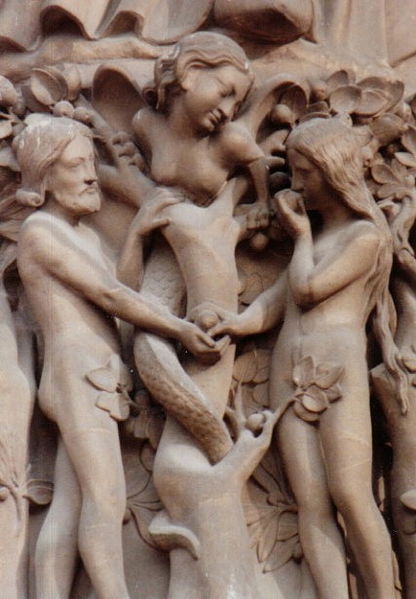
Robert Alter notes that Chavah is similar to chivya, the Aramaic for serpent, and wonders if Chava'a name might contain an allusion to an old Mesopotamian myth in which a giant primordial serpent is imagined to be the progenitor of all things, or, in other words, the אֵם כָּל-חָי.

The Zohar also notes this similarity and speculates that Adam gave his wife a name connected to her sin, but does not explain how Adam knew Aramaic back in the early days when all the world spoke Biblical Hebrew.

[Image: Adam, Eve, and the (female) serpent at the entrance to Notre Dame Cathedral in Paris.]